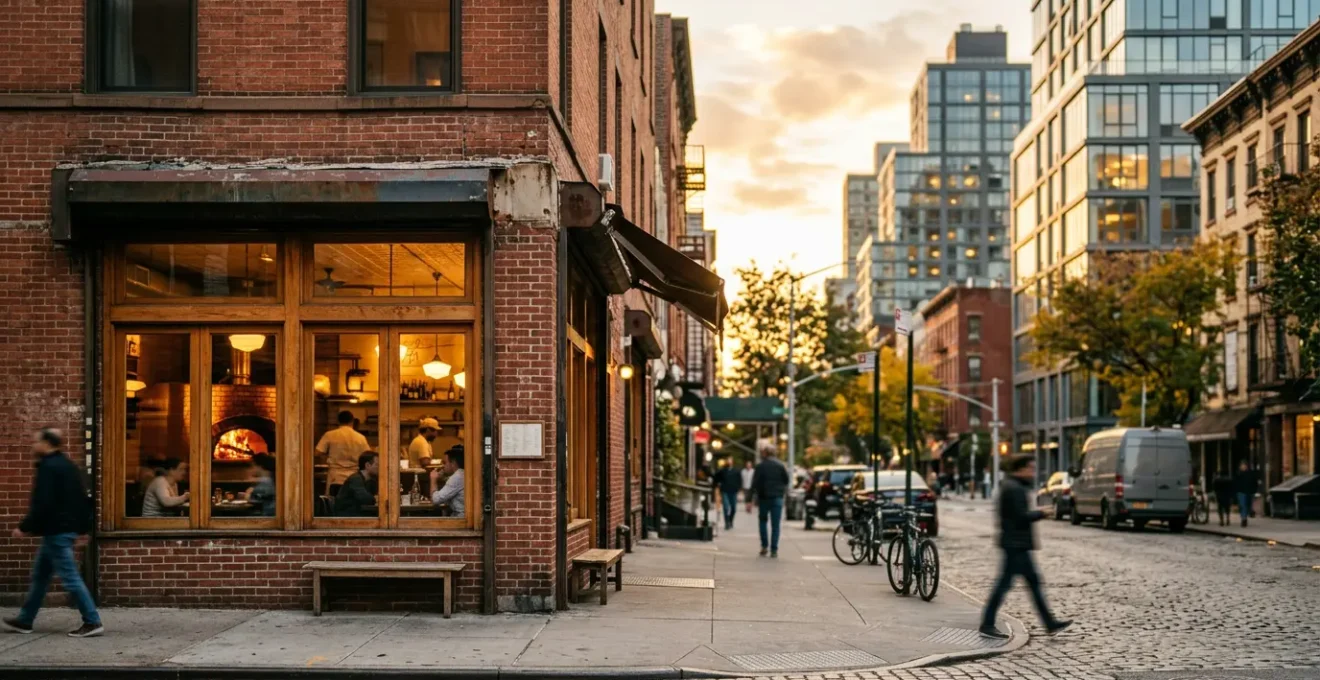
The survival of a neighborhood pizzeria in gentrified Brooklyn has less to do with the price of a slice and more to do with a portfolio of invisible, non-replicable assets.
- Economic survival depends on leveraging “social capital”—the trust and loyalty of regulars—which functions as a powerful, though un-bankable, currency.
- These pizzerias build an “economic moat” not just with unique recipes, but with their role as community hubs, a service national chains cannot offer.
Recommendation: Next time you visit your local spot, look beyond the menu. The real value—and the key to their resilience—is in the relationships being built between the counter and the community.
You walk into your favorite neighborhood pizzeria in Brooklyn. The owner nods, your “usual” is already in the oven, and the price somehow still feels reasonable. Outside, a new condo building casts a long shadow, and a luxury boutique has replaced the old hardware store. The question hangs in the air, thick as the smell of garlic and oregano: In a world of staggering rent hikes and relentless gentrification, how does this place still exist? It feels like a small miracle, a stubborn act of defiance against market forces.
The common answers feel too simple. Pundits talk about “customer loyalty” or “authentic recipes” as if they are magical shields. While true, these are just symptoms of a much deeper, more complex business strategy. The reality is far more intricate than simply having the best sauce. It’s a delicate dance of razor-thin margins, generational pressures, and quiet, un-billable services that form the true foundation of their resilience. They aren’t just selling food; they’re managing a complex ecosystem of community trust and economic pragmatism.
The key to understanding their survival isn’t to look at them as simple restaurants, but as complex community institutions. Their most valuable inventory isn’t mozzarella or flour, but a portfolio of intangible assets—reputation, social capital, and legacy—that are nearly impossible for a corporate chain to replicate. This isn’t just a story about pizza; it’s a masterclass in small business resilience against overwhelming odds.
This analysis will deconstruct the survival strategies of these beloved establishments. We will explore the immense pressures they face, from inflation to succession, and uncover the unique economic and social mechanics they employ not just to stay afloat, but to remain the beating heart of their neighborhoods.
Summary: Uncovering the survival tactics of Brooklyn’s local pizzerias
- The Price of Mozzarella: How Inflation Hits the $3 Slice
- When the Kids Don’t Want the Dough: The Crisis of Succession
- Gluten-Free Crusts and Vegan Cheese: Necessary Evils for Survival?
- The “Regular” Discount: How Face Time Gets You Free Sodas
- Chains vs. Mom-and-Pop: Why the Dollar Slice Wars Hurt Families
- Why Your Plumber Will Charge You $50 More for a Service Call
- Dollar Slice vs. Coal Oven: The difference in Chew and Char
- The Fold Method: Why Eating NYC Pizza with a Fork Is a Social Crime?
The Price of Mozzarella: How Inflation Hits the $3 Slice
The first and most visible battle for any pizzeria owner is fought on the balance sheet. The price of everything, from the flour for the dough to the cardboard for the boxes, is climbing. As a consultant, this is the most straightforward pressure point to analyze: rising input costs. According to the National Restaurant Association, businesses have seen a staggering 35% increase in both food and labor costs since 2019. This isn’t a minor adjustment; it’s a seismic shift that forces owners to make tough decisions. That classic New York $3 slice is no longer just a slice of pizza; it’s a symbol of a business model under extreme duress.
Many customers wonder why prices creep up. It’s not greed; it’s survival. The same industry data reveals that average menu prices had to increase by 31% between 2020 and 2025 just for restaurants to maintain their historically thin 5% profit margin. For a family-run pizzeria, absorbing these costs is often not an option. They lack the bulk purchasing power of a national chain like Domino’s or Pizza Hut, which can negotiate massive contracts for cheese and pepperoni, shielding them from the worst of market volatility.
This inflationary pressure creates a difficult choice. Raise prices too high, and you risk alienating the loyal, working-class customer base that has sustained you for decades. Don’t raise them enough, and you risk being unable to pay your rent, your staff, or yourself. This is the tightrope every owner walks. They aren’t just baking pizzas; they are performing a high-stakes economic calculation with every single order, trying to balance community affordability with financial solvency. The very soul of the neighborhood spot is at risk when the cost of mozzarella outpaces wages.
When the Kids Don’t Want the Dough: The Crisis of Succession
Beyond the external pressures of rent and inflation lies a more intimate, and often more devastating, internal threat: the crisis of succession. The founder, who poured their life into the business, is ready to retire. But what happens when the next generation, educated and with different aspirations, doesn’t want to take over the family legacy of 16-hour days and flour-dusted clothes? This isn’t a hypothetical; it’s a statistical reality. Data from the Small Business Administration shows a harsh truth: only 30% of family businesses survive into the second generation, and a mere 12% make it to the third.
From a business consultant’s perspective, this is a failure in transferring the most critical of intangible assets. The owner’s knowledge, their relationships with suppliers, and the deep well of community trust they’ve built over decades cannot be easily written into a will. When the succession plan is simply “hoping a kid takes over,” the business’s long-term viability is on shaky ground. The children may see the immense sacrifice their parents made and opt for a more stable career path, viewing the pizzeria not as an inheritance but as a burden.
This challenge is about more than just a lack of interest; it’s often a perceived lack of readiness, creating a succession paradox that can paralyze a family enterprise.
The Succession Paradox: A Gap Between Interest and Readiness
A 2026 Deloitte survey of family business executives highlights this disconnect. While 61% reported that a family member was interested in the CEO role, fewer than a quarter (23%) believed that individual was actually prepared to take the helm. This gap is particularly pronounced in larger enterprises, with many now looking towards professional management rather than family lineage. For a small pizzeria, where the “CEO” is also the head chef and chief community liaison, finding a successor with the right blend of passion and skill is an existential challenge.
Gluten-Free Crusts and Vegan Cheese: Necessary Evils for Survival?
For a pizzeria that has built its reputation on a 70-year-old recipe, the idea of adding “cauliflower crust” or “vegan pepperoni” can feel like a betrayal. Yet, in a gentrifying neighborhood, the customer base is constantly changing. New residents arrive with different dietary preferences, expectations, and spending habits. The question for the owner is stark: do you stick to tradition and risk becoming a relic, or do you adapt and risk diluting your brand? This is not just a culinary choice; it’s a strategic pivot in response to clear market data.
The numbers don’t lie. With nearly 9.7 million people in the U.S. identifying as vegan or vegetarian, ignoring this demographic is like refusing to take credit cards. It’s a deliberate decision to exclude a growing segment of the market. From a consultant’s viewpoint, this adaptation is a necessary evolution. Offering a gluten-free or vegan option isn’t about abandoning the classic slice; it’s about expanding the customer base so that a group of friends or a family with mixed dietary needs can all eat at the same table. It transforms a “no” into a “yes.”
The most successful pizzerias handle this transition with intelligence. They don’t replace their core offerings. Instead, they frame these new items as additions, often at a premium price point. This strategy is brilliant for two reasons. First, it caters to the new demand without alienating the old guard who just want a regular slice. Second, the higher price on these specialty items helps subsidize the classic, more affordable slices, allowing the pizzeria to maintain its reputation as a neighborhood staple. It’s a way of letting the new, often wealthier, residents help keep the pizzeria accessible for everyone. It’s not a “necessary evil,” but a savvy act of market segmentation and cross-subsidization.
The “Regular” Discount: How Face Time Gets You Free Sodas
Walk into a chain like Sbarro and ask for a discount because you were there yesterday. You’ll be met with a blank stare. Do the same at your local family-run spot, and the owner might just throw in a free can of soda. This isn’t bad business; it’s the engine of their survival. This is social capital in action—an intangible asset more valuable than any marketing budget. Every “on the house” garlic knot or friendly chat about the Yankees is a small deposit into a community trust fund.
This phenomenon is what sociologists call the creation of a “third place.” These are anchors of community life that facilitate and foster broader, more creative interaction. As one urban sociologist might put it:
The Pizzeria as a ‘Third Place’: Connect this phenomenon to the sociological concept of a ‘third place’ (after home and work). These pizzerias survive because they are vital, informal community hubs—a service chains cannot replicate.
– Urban sociology concept, Third Place Theory Application
A chain sells pizza. A neighborhood pizzeria sells pizza *and* a sense of belonging. This is their unassailable economic moat. The “regular discount” isn’t a loss; it’s an investment in customer retention that pays dividends for years. It ensures that when times get tough, the community rallies around *their* spot, not the anonymous franchise down the street. It’s the reason a local will choose to spend their money there, even if it’s a few cents more expensive.
Action Plan: Auditing Your Neighborhood Pizzeria’s Survival Assets
- Points of contact: Is it just a transactional counter? Or does the owner know names, ask about families, and create a real, human connection?
- Collecte: Inventory the “intangible” signals. Note the “Don’t worry, pay me next time” moments, the extra garlic knots for the kids, or the local Little League team photo taped to the wall.
- Cohérence: Does the “old school” vibe clash with a new, corporate-looking digital menu, or is every element, from the font to the shakers, aligned with the family’s story?
- Mémorabilité/émotion: Is the experience generic and forgettable, or does it create a specific feeling of belonging and comfort that a chain can’t possibly replicate?
- Plan d’intégration: How do these elements combine to build an economic moat? Identify the one key asset—be it the owner’s personality, a truly unique recipe, or its function as a community hub—that serves as its ultimate defense.
Chains vs. Mom-and-Pop: Why the Dollar Slice Wars Hurt Families
The arrival of a dollar-slice chain in a neighborhood is often seen by consumers as a win: cheap, fast pizza. But for the family-run pizzeria, it’s a declaration of a price war they cannot win. Chains operate on a model of massive volume and ruthless efficiency. They can leverage economies of scale on ingredients, use cheaper, lower-quality products, and operate with a lean, often non-unionized staff. They aren’t in the business of creating a “third place”; they are in the business of selling calories at the lowest possible cost.
This dynamic puts mom-and-pop shops in an impossible position. They cannot compete on price without sacrificing the very quality that defines them. Their business model is built on using better cheese, a more flavorful sauce, and dough that’s given time to develop. To match a dollar-slice price point would mean gutting their product and becoming a lesser version of the very thing they are fighting against. This is why the “dollar slice wars” are so damaging; they change the customer’s perception of what a slice of pizza *should* cost, devaluing the craftsmanship of traditional pizzerias.
The pressure is compounded by the relentless real estate market. As one documentary on Brooklyn’s gentrification noted, the fight is often brutally one-sided. Landlords, enticed by the promise of a corporate tenant with a long lease and a big bank account, find ways to push out long-term businesses. Between 2019 and 2021 alone, Brooklyn retail spaces experienced a 23% rent hike. This isn’t a fair fight; it’s a war of attrition where the family business has fewer resources and is far more vulnerable.
Why Your Plumber Will Charge You $50 More for a Service Call
The economic pressures squeezing your local pizzeria are not unique to the food industry. They are a symptom of a city-wide affliction affecting nearly every small, independent business. Consider your local plumber. When they quote you $50 more for a service call than they did three years ago, it’s not because they’ve suddenly become greedy. It’s because the entire cost structure of operating a small business in Brooklyn has been fundamentally altered. The plumber’s commercial van insurance, their parking costs, and, crucially, the rent for their own small business depot in the borough have all skyrocketed.
This is the hidden tax of gentrification. It’s not just residential rents that soar; commercial rents follow suit, creating a domino effect. Recent commercial real estate data shows that office rents in Brooklyn rose by 3% in the first quarter of 2024 alone. While that may seem small, it’s a steady, relentless increase on top of already high costs. For a business operating on thin margins, every percentage point matters. These are not optional expenses; they are the fundamental costs of doing business in the city.
By framing the pizzeria’s struggle within this broader context, we can see it for what it is: a case study in a larger economic shift. The same forces that make a plumber’s visit more expensive are the ones pushing the pizzeria owner to charge more for a slice. Both are facing a landscape where the underlying costs—from real estate to insurance to supplies—are rising faster than what the community can comfortably bear. Understanding this shared struggle is crucial; it shows that supporting one local business is, in effect, supporting the entire ecosystem of the neighborhood’s economic health.
Key Takeaways
- Survival is not just about a good recipe; it’s about managing a complex portfolio of tangible quality and intangible social assets.
- Adaptation, such as adding vegan options, is a savvy business strategy to broaden the customer base, not a betrayal of tradition.
- The biggest competitive advantage a family-run pizzeria has over a chain is its role as a “third place,” a community hub that fosters a deep, economically valuable loyalty.
Dollar Slice vs. Coal Oven: The difference in Chew and Char
In a saturated market, the most enduring form of competitive advantage is a superior product. While a family-run pizzeria cannot compete with a chain on price, it can and must compete on quality. This is where the tangible assets come back into focus. The difference between a dollar slice and a slice from a classic coal-oven spot isn’t a matter of opinion; it’s a matter of chemistry, physics, and craftsmanship. It is their most defensible economic moat.
The dollar slice is an industrial product. The dough is often made with lower-protein flour, mixed quickly, and baked in a gas-conveyor oven at a relatively low temperature (around 500-600°F). The result is functional but forgettable: a uniform, often doughy crust that serves primarily as a vehicle for cheap cheese and sauce. It’s designed for speed and cost-effectiveness, not for flavor or texture.
A traditional coal-oven pizzeria, by contrast, is an artisan workshop. The dough is typically made with high-protein flour and allowed a long, slow fermentation to develop complex flavors. The key is the oven itself. A coal oven can reach temperatures of 800-1000°F, cooking a pizza in a matter of minutes. This intense, dry heat does two things. It creates a crisp, structurally sound crust that won’t flop. At the same time, it produces the signature “char” or “leopard-spotting”—pockets of caramelization that add a smoky, slightly bitter complexity that balances the sweetness of the tomatoes and the richness of the cheese. This is a textural and flavor profile that a gas oven simply cannot replicate.
The Fold Method: Why Eating NYC Pizza with a Fork Is a Social Crime?
The final, and perhaps most subtle, asset in a Brooklyn pizzeria’s survival kit is cultural. It’s the collection of rituals, codes, and shared understandings that surround the act of eating a slice. The most famous of these is “The Fold.” Using a fork and knife on a slice is more than just impractical; it’s a social signal that you’re an outsider, someone who doesn’t understand the city’s unwritten rules. This isn’t just snobbery; it’s a functional test of the pizza’s quality.
As pizza aficionados will tell you, the fold is a sign of structural integrity. A proper New York slice, particularly one from a classic shop, is engineered to be folded. The crust should be thin and crisp enough on the bottom to provide a stable base, yet pliable enough to bend without cracking. A crust that is too thick and bready, or too brittle and cracker-like, will fail the fold test. In this sense, the fold is a quick, tactile quality check. It’s a physical manifestation of the craftsmanship we discussed earlier. A slice that can’t be folded is a sign of an inferior, non-traditional pizza.
This cultural element creates a powerful bond between the pizzeria and its community. It transforms the act of eating into a shared experience, a piece of local identity. It’s a small thing, but it’s part of the rich tapestry of intangible value that chains can never hope to weave. Chains can replicate a recipe, but they cannot replicate culture. They can’t replicate the specific way a neighborhood talks about, argues about, and celebrates its pizza. By upholding these traditions—by making a slice that *demands* to be folded—the family-run pizzeria reinforces its status as a genuine cultural institution, not just a place to eat.