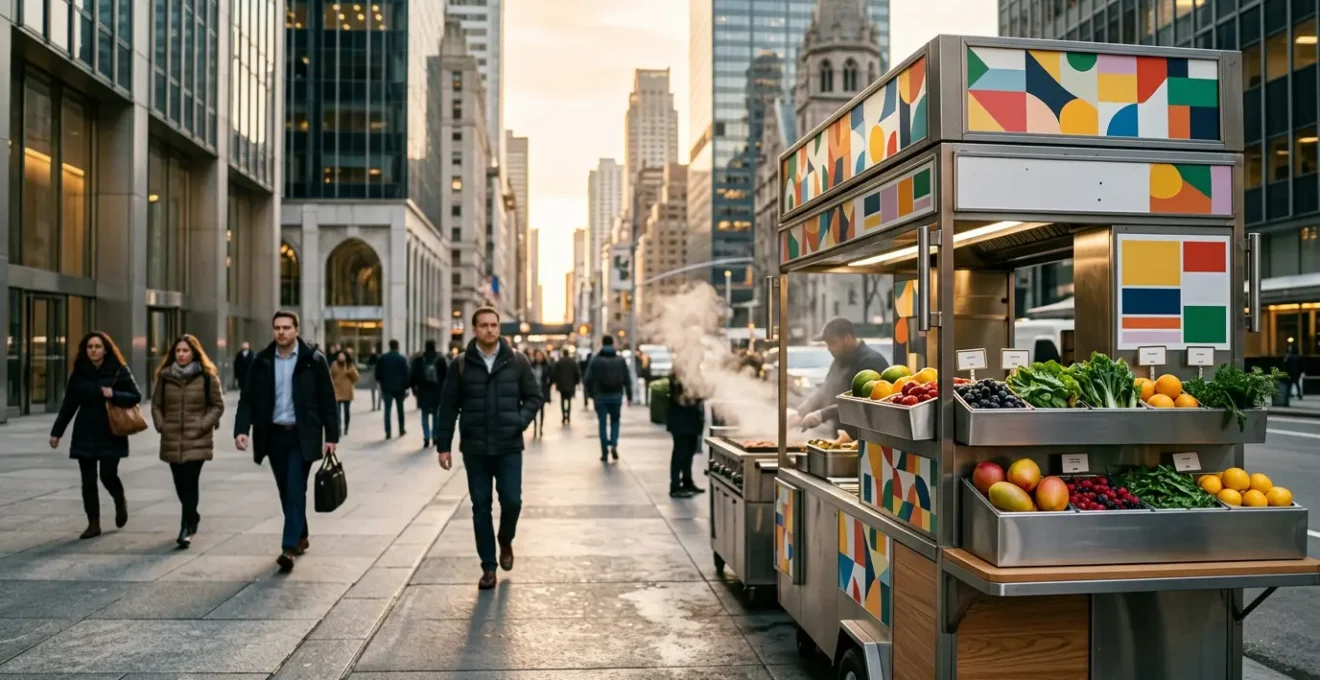
In summary:
- Prioritize street vendors who demonstrate clear hygiene practices, like using tongs for food and separate hands for money.
- Avoid the 3 PM energy crash by choosing snacks balanced with protein, fiber, and healthy fats instead of high-carb options like bagels.
- Scrutinize “healthy” drinks; whole-fruit smoothies are generally better than fiber-stripped juices which can be sugar bombs.
- Discover non-chain lunch spots and budget strategies, like bodega hot bars and premium food carts, to eat well for under $15.
- Understand food safety basics, like temperature danger zones, to make smarter choices between street meat options like hot dogs and chicken skewers.
It’s 2:45 PM in Midtown Manhattan. Your energy is tanking, your stomach is rumbling, and your commute home looms large. The smell of roasted nuts and street pretzels wafts through the air, tempting you with a quick, easy fix. For the health-conscious commuter, this is a daily dilemma. You know you need fuel, but the landscape seems dominated by greasy hot dog water, sugary sodas, and overpriced salads that don’t satisfy. The usual advice—”pack your own snacks” or “just grab an apple”—feels disconnected from the reality of a hectic urban workday.
The truth is, most of us fall into predictable nutritional traps. We grab a bagel for a quick boost or a green juice thinking it’s the pinnacle of health, only to find ourselves crashing an hour later. We eye the pre-cut mango with suspicion but don’t know what to look for. This isn’t just about avoiding a hot dog; it’s about understanding the complex urban food ecosystem you operate in every day. The key isn’t to fear it, but to learn how to navigate it like a pro.
But what if the solution wasn’t about willpower, but about strategy? What if you could decode the hidden signals of a safe food cart, understand the psychology behind a vendor’s pricing, and build a crash-proof snack from unlikely sources? This guide moves beyond the obvious. It’s a nutrition scout’s field manual to conquering Midtown’s food scene, transforming you from a hungry, overwhelmed commuter into a savvy urban forager who knows exactly where to find high-performance fuel that won’t break the bank or your diet.
This article will break down the essential strategies you need. We’ll cover everything from street fruit hygiene and the science behind the afternoon crash to budget lunch hacks and the art of eating a salad on the move. Prepare to upgrade your snacking strategy.
Summary: Healthy Urban Snacks: Where to Grab Fuel in Midtown That Isn’t a Hot Dog?
- Are the Pre-Cut Mangoes Safe? A Guide to Street Fruit Hygiene
- The Smell of Roasted Nuts: Why the Price Is Never Posted
- The 3 PM Crash: Why a Bagel Is the Wrong Snack for Afternoon Energy
- Green Juice vs. Smoothie: Which is Just a Sugar Bomb in Disguise?
- How to Eat a Salad While Walking Without Spilling on Your Suit
- Where to Eat Lunch in Midtown Under $15 That Isn’t a Chain
- Hot Dog vs. Chicken Skewer: Which Street Meat Is Safer?
- How to Survive the Midtown Manhattan Commute Without Losing Your Sanity?
Are the Pre-Cut Mangoes Safe? A Guide to Street Fruit Hygiene
That container of vibrant, pre-cut mango or melon can seem like a perfect, healthy oasis in a concrete desert. But the question always lingers: is it safe? While vendors may be knowledgeable, a 2024 study on street food handler practices found that while 67% of vendors had good knowledge, only 53% practiced correct hygiene. This gap between knowing and doing is where your role as a nutrition scout comes in. You don’t need a microscope, just a trained eye.
Instead of guessing, learn to look for specific hygiene cues. A professional operation will have a clear, organized workflow. Observe for a few seconds. Are they using tongs or gloves to handle the fruit? Crucially, do they use one hand for money and a separate, clean hand (or tool) for food? This separation is one of the most important indicators of good food safety practices, preventing the transfer of germs from cash to your snack. A vendor who takes your money and then immediately grabs fruit with the same hand is a major red flag.
Your visual audit should also include their setup. Here are key things to look for:
- Ice Quality: Look at the ice in their cooler. Is it clear and clean-looking? Cloudy or dirty ice could suggest it came from a questionable water source or is being handled poorly.
- Utensil Storage: Are cutting boards, knives, and tongs stored in a clean, covered container when not in use? They should never be resting on the sidewalk or an unclean surface.
- Temperature Control: The best vendors keep their pre-cut fruit visibly chilled on a bed of ice or in a refrigerated unit. Fruit that’s sitting out in the sun, even if it looks fresh, is at a higher risk for bacterial growth. If it’s not cold to the touch, walk away.
By actively looking for these positive signs of safety, you can confidently enjoy street fruit as the convenient, healthy snack it’s meant to be.
The Smell of Roasted Nuts: Why the Price Is Never Posted
There’s no scent more quintessentially Midtown than the warm, sugary aroma of roasted nuts from a street cart. It’s a powerful sensory trigger, designed to stop you in your tracks. But have you ever noticed that you can smell them from half a block away, yet you can’t see a price until you’re standing right at the cart, money in hand? This isn’t an oversight; it’s a brilliant piece of urban retail psychology.
The strategy is twofold. First, the powerful aroma creates an immediate, almost primal craving. It bypasses your rational brain and speaks directly to your impulse for a warm, comforting snack. Second, the lack of a posted price—a practice known as price ambiguity—forces you to engage with the vendor. You have to ask, “How much for a bag?” Once you’ve started that conversation, you’ve made a small psychological commitment. Backing out after hearing the price (which is often higher than you’d expect) feels more awkward, so most people just go through with the purchase.
As a nutrition scout, your job is to understand and outsmart these tactics. While nuts themselves are a fantastic source of healthy fats and protein, the candied varieties sold at these carts are often coated in sugar and honey, turning a healthy snack into a dessert. The portion sizes are also deceptively large. To navigate this, make it your rule to always ask the price first, from a slight distance. This breaks the psychological script. Then, if the price is right, ask for the “plain” or “lightly salted” option if available, and opt for the smallest size to control your portion.
This simple habit of asking before you commit puts you back in control, ensuring your snack is a conscious choice, not just an impulse buy.
The 3 PM Crash: Why a Bagel Is the Wrong Snack for Afternoon Energy
The dreaded 3 PM slump is the bane of the office worker. Your focus blurs, your eyelids feel heavy, and the urge for a nap becomes overwhelming. In this moment of desperation, it’s tempting to reach for a quick, carb-heavy fix like a bagel, a muffin, or a pretzel. It seems logical: you need energy, and carbs are energy. Unfortunately, this is a classic nutritional trap. Simple carbohydrates like these cause a rapid spike in blood sugar, giving you a fleeting burst of energy, followed by an even more dramatic crash as your body releases insulin to control the sugar rush.
This isn’t just a feeling; it’s a well-documented physiological response. As noted by health experts, high-glycemic foods like white bread and bagels cause rapid blood sugar spikes followed by sharp drops, leaving you more tired than before. This is the opposite of what you need to power through the rest of your workday and the commute home. The key to sustained energy isn’t just getting calories; it’s managing your blood sugar. To do this, you need a snack built on a foundation of Protein, Fat, and Fiber (PFF).
This PFF combination slows down digestion and the absorption of sugar into your bloodstream, providing a steady, stable release of energy instead of a volatile spike and crash. You can build a powerful PFF snack right in Midtown without setting foot in a grocery store.
Your Crash-Proof Snack Blueprint: Building the PFF Power-Up
- Start with a Protein Foundation: Pop into a bodega or deli and grab a Greek yogurt, two hard-boiled eggs, or even a few slices of grilled chicken from the counter. Protein is the cornerstone of satiety and stable blood sugar.
- Add a Healthy Fat Layer: Pair your protein with a cheese stick, a small handful of plain almonds (from a fruit stand), or a single-serving pack of guacamole. Fat promotes fullness and further slows the glycemic response.
- Include a Fiber Component: Complete your snack with a high-fiber carbohydrate. An apple or a cup of berries from a fruit cart is perfect. The fiber provides sustained energy and keeps you feeling full.
- Execute a Timing Strategy: The real pro move is to eat your PFF snack preventively around 1:30-2:00 PM. Don’t wait for the crash to hit. By fueling your body proactively, you sail right through the 3 PM slump without a dip in energy.
This strategic approach to snacking transforms food from a mere craving-filler into a high-performance tool for productivity and well-being.
Green Juice vs. Smoothie: Which is Just a Sugar Bomb in Disguise?
In the quest for a healthy urban snack, green-colored drinks have become a symbol of virtue. Both green juice and smoothies seem like an efficient way to get a blast of vitamins and nutrients on the go. However, from a nutritional scout’s perspective, the difference between them is vast, and one can be a significant nutritional trap. The primary distinction lies in one crucial component: fiber. Juicing extracts the liquid from fruits and vegetables, but it discards the pulp—and with it, all the beneficial fiber.
Without fiber to buffer its absorption, the sugar (even natural fructose) from the juice hits your bloodstream almost instantly, causing a blood sugar spike similar to drinking a soda. It’s a fast-track to a subsequent energy crash. In contrast, a smoothie is made by blending whole fruits and vegetables, retaining all the fiber. This fiber slows down sugar absorption, promotes a feeling of fullness, and supports digestive health. While smoothies can also be high in sugar, the presence of fiber makes them a much more stable source of energy. In fact, research often shows that commercial smoothies can be surprisingly sugary; research published in BMJ Open found an average of 13 g/100 ml sugar content in smoothies, often more than juice, highlighting the need to be mindful of ingredients.
To make an informed choice, you need to look beyond the “green” color and understand the fundamental impact on your body. This table breaks down the key differences:
| Factor | Green Juice | Smoothie (Whole Fruit) |
|---|---|---|
| Fiber Content | Little to none (pulp removed) | High (whole fruit blended) |
| Blood Sugar Impact | Rapid spike and crash | Gradual rise with fiber |
| Satiety Duration | 60 minutes or less | 2-3 hours sustained fullness |
| Calorie Density | Lower (concentrated liquid) | Higher but more filling |
| Sugar Absorption Rate | Fast (no fiber buffer) | Slow (fiber moderates) |
When ordering a smoothie, take it a step further: ask for it to be made with more vegetables than fruit (a good ratio is 2:1, veggies to fruit) and ensure the base is water or unsweetened milk, not a sugary juice blend.
How to Eat a Salad While Walking Without Spilling on Your Suit
The sad desk salad is a cliché for a reason. But in the fast-paced environment of Midtown, sometimes you don’t even have a desk—you have a five-minute walk between meetings. Eating a salad while walking seems like an advanced urban sport, one with a high risk of dressing-related casualties on your work attire. It’s a common commuter problem: how do you get your healthy greens in without wearing them for the rest of the day? The answer lies not in a fork, but in physics.
The key is the “Shake Method,” a technique perfected by time-crunched New Yorkers. It requires a salad in a sturdy container with a secure lid—a non-negotiable first step. Most build-your-own salad chains now offer these. Before you even think about opening it, you must transform your meal from a pile of ingredients into a fully integrated dish. This is where your technique comes in. You are not gently tossing; you are emulsifying.
Grip the container firmly with both hands, ensuring the lid is snapped shut on all sides. Now, shake it. Don’t be timid. Shake it vertically, horizontally, and diagonally for a solid 15-20 seconds. You are using motion to distribute the dressing evenly, coating every leaf of lettuce, every piece of chicken, every chickpea. This process ensures that you get a perfect, flavorful bite every time, without any pools of dressing at the bottom waiting to spill. The result is a cohesive meal, not a collection of parts. Once shaken, you can open it and eat with a fork, confident that the dressing is on the salad, not on its way to your lapel.
For an even safer experience, always get the dressing on the side. This gives you full control over the amount you add before you begin the crucial shaking process. It’s a small detail that makes a world of difference in your mobile dining success.
Where to Eat Lunch in Midtown Under $15 That Isn’t a Chain
Eating a healthy lunch in Midtown for under $15 can feel like a mythical quest, especially if you’re trying to avoid the national chain restaurants that line every block. The perception is that you must choose between cheap and greasy or healthy and exorbitantly priced. However, a savvy nutrition scout knows that the best value is often found by looking past the glossy storefronts and embracing the local urban food ecosystem. There are pockets of value and nutrition if you know where and how to look.
The key is to think like a local and leverage the options that serve thousands of everyday New Yorkers, not just tourists. This means sidestepping the trendy, branded lunch spots and heading for the more utilitarian, high-volume vendors. It’s about finding places where you can control the ingredients and the cost. Here are four proven strategies for securing a satisfying, non-chain Midtown lunch on a budget:
- The Bodega Hot Bar: Many corner delis and bodegas have extensive hot and cold food bars sold by weight. This is your chance to build a truly custom, healthy meal. Your strategy: load up on nutrient-dense, lighter items like grilled chicken, steamed vegetables, and quinoa. Avoid heavy, mayo-drenched salads and fried items, which will quickly drive up the price and derail your health goals.
- The Classic Pizza Slice: Don’t underestimate the humble pizzeria. Two slices from a classic, non-chain slice shop and a bottle of water can often come in well under $10. For a healthier choice, look for a thin crust, ask for extra vegetable toppings, and gently blot any excess grease with a napkin. It’s a surprisingly balanced meal of carbs, protein (from the cheese), and fat.
- Premium Food Carts: Go beyond the hot dog stands. Seek out the highly-rated Halal carts or specialty taco vendors. A platter of chicken over rice (ask for sauce on the side) or a few birria tacos can be a complete, flavorful, and filling meal for around $12-15. Look for carts with a long line of locals—it’s the best quality indicator.
- Supermarket Salad Bar Arbitrage: Chain salad shops charge a premium for their brand. A savvy alternative is the salad bar at a supermarket like Whole Foods. By focusing on light but nutritious items like greens, raw vegetables, and lean proteins, you can often build a larger, healthier salad for a fraction of the price of the boutique chains.
This approach is the essence of economic arbitrage in the urban food landscape—getting maximum nutritional value for your dollar by understanding the system.
Hot Dog vs. Chicken Skewer: Which Street Meat Is Safer?
When faced with the classic Midtown street meat dilemma, the choice often comes down to a hot dog or a chicken skewer. From a purely nutritional standpoint, grilled chicken seems like the obvious winner over processed meat. However, when it comes to food safety on the street, the answer is more complex. The primary concern is not just what the food is, but how it’s cooked and held. This is where understanding the “temperature danger zone” becomes critical for any urban explorer.
Food safety experts identify that the range between 40°F – 140°F (5°C – 60°C) is the temperature danger zone where bacteria can multiply rapidly. The goal is to keep hot foods hot (above 140°F) and cold foods cold (below 40°F). Now, let’s apply this to our street meat options. A hot dog cart typically keeps pre-cooked hot dogs submerged in hot water that is visibly steaming. This water is almost always kept well above the 140°F threshold, effectively preventing bacterial growth. The hot dog is a very stable, safe product in this environment.
A chicken skewer, on the other hand, presents a higher risk. The chicken is often cooked from raw on a small grill. If the vendor is busy, they may rush the cooking process, leading to chicken that is browned on the outside but potentially undercooked on the inside, right in the danger zone. Furthermore, skewers might be cooked in a batch and then left to sit on a cooler part of the grill, allowing their internal temperature to drop into the danger zone. While a perfectly cooked chicken skewer is a great option, the variability in cooking makes it inherently riskier than the consistently hot hot dog.
If you do opt for the skewer, make a point to watch the vendor cook it and ask for one fresh off the hottest part of the grill to minimize your risk.
Key takeaways
- True health on the go comes from strategic choices, not just avoiding obvious junk food. Master the urban food ecosystem.
- Sustainable energy is built on a foundation of Protein, Fat, and Fiber (PFF), which stabilizes blood sugar and prevents the dreaded afternoon crash.
- Observable hygiene is your best defense. Look for specific practices like separate hands for money and food, and proper temperature control.
How to Survive the Midtown Manhattan Commute Without Losing Your Sanity?
For many, the Midtown commute is the most stressful part of the day. The crowded sidewalks, the packed subway cars, the delays—it’s a daily gauntlet that frays nerves and drains what little energy you have left. We try to cope with podcasts, music, or simply zoning out. But what if the real secret to a more tolerable commute wasn’t an external distraction, but an internal one? The truth is, your ability to handle the stress of the commute is directly linked to your physiological state, which is dictated by how you’ve fueled your body throughout the day.
Think about it: when are you most likely to get irritated by a slow walker or a packed train? It’s when you’re already tired, hungry, and your blood sugar is low. That 3 PM slump we discussed doesn’t just affect your work; it amplifies your stress response. The irritability and fatigue you feel are symptoms of an energy crash, making every minor annoyance of the commute feel like a major crisis. You’re not just mentally tired; you are physically depleted and have no patience or resilience left to deal with the journey home.
This is where your role as a nutrition scout becomes your ultimate survival tool. By making a strategic snacking choice in the afternoon—choosing a balanced PFF snack over a sugary or high-carb one—you are effectively pre-loading your sanity for the commute. You’re ensuring your blood sugar remains stable, your energy levels stay consistent, and your mood remains balanced. A well-fed brain is a resilient brain, one that can process the chaos of Penn Station or Times Square without going into fight-or-flight mode.
The best commute hack isn’t a new app or noise-canceling headphones. It’s the apple, handful of almonds, and cheese stick you ate at 2:30 PM. Start treating your afternoon snack not as a treat, but as essential gear for the urban expedition ahead.