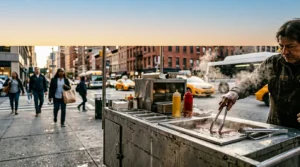
The decision to eat a ‘dirty water’ dog isn’t just about hunger; it’s a complex risk calculation involving economics, psychology, and a misunderstood public health system.
- Safety is less about the “dirty water” (which must be kept at a specific temperature) and more about vendor practices and food turnover.
- The high price and scarcity are not due to the ingredients but a decades-old, broken permit system creating a black market.
Recommendation: Judge the vendor, not just the cart. Look for high turnover, clean hands, and a visible ‘A’ grade as your best indicators of safety.
The scent hits you first. A steamy, savory cloud of grilled onions and warm bread, cutting through the city’s exhaust fumes. You see the iconic blue and yellow umbrella, the glint of stainless steel, and the cart—a small island of culinary hope on a vast concrete ocean. This is the New York City hot dog stand, a gastronomic ritual as ingrained in the urban landscape as the yellow cab. For generations, locals and tourists alike have engaged in this simple, satisfying transaction, grabbing a quick, cheap bite that tastes like the city itself. It’s a moment of pure, unadulterated comfort.
And yet, a voice of caution always whispers in the background. We’ve all heard the advice: check for the letter grade, make sure there’s a long line, and whatever you do, don’t think too hard about the nickname “dirty water.” This surface-level wisdom treats the street food experience as a simple gamble. But this view misses the fascinatingly complex systems at play. The reality of street food, from the humble hot dog to the famed Halal Guys platter or the tempting cups of pre-cut mango, is a story of economics, public policy, and even brain chemistry.
But what if the very things we fear are misunderstood? What if the infamous water is actually a required safety feature, and the $4 price tag has less to do with the sausage and more to do with a shadow economy of permits worth hundreds of thousands of dollars? This isn’t just an article about whether a hot dog is safe to eat. It’s a deep dive into the hidden world of NYC street food. We are going to unpack the science of the water bath, the brutal economics that keep vendors in business, the psychology of our late-night cravings, and how to read the city’s health codes like a seasoned pro. Forget the platitudes; it’s time to understand the real story behind the “dirty water” dog.
This guide will deconstruct the most common questions and myths surrounding NYC’s most iconic street food. By understanding the systems at play, you’ll be able to make informed choices and appreciate the complex world behind that simple, delicious hot dog.
Summary: The “Dirty Water” Dog: A Historian’s Guide to NYC’s Iconic Street Meat
- How Long Has That Sausage Been in the Water? A Safety Guide
- Mustard vs. Ketchup: The Regional Rules of Hot Dog Toppings
- The $200,000 Permit: Why Your Hot Dog Costs $4
- Hot Dog vs. Chicken Skewer: Which Street Meat Is Safer?
- The 2 AM Alcohol Sponge: Why Hot Dogs Taste Better After Drinking
- Is Street Food Safe? Understanding NYC’s Vendor Letter Grades
- Are the Pre-Cut Mangoes Safe? A Guide to Street Fruit Hygiene
- Is Waiting 45 Minutes for The Halal Guys Chicken Over Rice Still Worth It?
How Long Has That Sausage Been in the Water? A Safety Guide
The term “dirty water” dog is both an affectionate nickname and a source of deep suspicion. But the iconic water bath is not a sign of poor hygiene; it’s a food safety method known as “hot holding.” Since hot dogs are pre-cooked, the vendor’s primary job is to keep them at a temperature that prevents bacterial growth until they are served. The water, seasoned with salt and spices that build up over the day, serves as an efficient medium to maintain this heat and add flavor. The critical factor isn’t the water’s appearance, but its temperature.
The entire process is a race against time and temperature. Food safety guidelines from the FDA mandate that hot-held foods must be kept at a temperature between 135°F to 140°F (57°C to 60°C). This range is the “safe zone” that inhibits the growth of common pathogens. A diligent vendor will use a thermometer to monitor this, ensuring the sausages remain safe for consumption. The real danger arises not from the “dirty” water itself, but from a cart where the water has cooled, allowing the hot dogs to enter the “danger zone” (40°F – 140°F) where bacteria can multiply rapidly.
This is why high turnover is your best friend. A busy cart is constantly selling its current stock and adding fresh hot dogs to the water, minimizing the time any single sausage spends sitting around. As street food expert Colleen Taylor Sen pithily states, “The minute anything is sitting around, you’re in trouble.” Therefore, a long line isn’t just a sign of popularity; it’s a visual confirmation that the food is moving, which is a key pillar of street food safety.
Mustard vs. Ketchup: The Regional Rules of Hot Dog Toppings
Once you’ve navigated the safety aspects, you enter the realm of the gastronomic ritual: the toppings. In the world of hot dogs, what you put on top is a statement of identity, and the rules, though unwritten, are fiercely defended. The classic New York-style hot dog is a minimalist masterpiece: a swipe of spicy brown mustard and either sauerkraut or onions sautéed in a sweet sauce. This combination is designed to complement the salty, savory frankfurter without overwhelming it.
Putting ketchup on a hot dog, particularly for anyone over the age of twelve, is a subject of national debate. In Chicago, it’s considered an outright culinary sin. In New York, it’s merely frowned upon, a sign of a tourist or an unsophisticated palate. The reasoning is rooted in flavor balance; the high sugar and vinegar content of ketchup is believed to mask the nuanced flavors of the meat. Mustard, with its sharp, pungent notes, is seen as the superior condiment for cutting through the richness of the sausage.
This debate extends beyond taste into texture and tradition. The visceral appeal of the condiments—the thick, glossy sheen of ketchup versus the slightly grainy, earthy texture of deli mustard—is part of the total sensory experience. It’s a choice that connects the eater to a long history of street-side dining, a simple decision that places you within a specific culinary tradition.
Ultimately, the choice is yours, but understanding the unspoken rules is part of the fun. Ordering “one with mustard and kraut” marks you as someone who knows the code. It’s a small nod to the history and culture of the cart, a simple act that transforms a quick meal into an authentic New York experience. Choosing your toppings is the final step in a time-honored urban ritual.
The $200,000 Permit: Why Your Hot Dog Costs $4
You hand over a few dollars for your hot dog and bun, a transaction that feels simple and fair. But the price you pay is not a reflection of the cost of pork and flour. It’s a direct consequence of a decades-old policy of economic scarcity that has created a fierce, often unseen, battle for sidewalk space. The official cost of a mobile food vending permit in NYC is surprisingly low, often just a couple hundred dollars. The problem? The city capped the number of these permits in the early 1980s and has barely budged since.
This artificial cap has created an astronomical demand for a finite resource. A 2024 NYC Independent Budget Office report found there are over 20,000 people on waitlists for the few thousand available permits. With the official channel effectively closed, a thriving and illegal secondary market has emerged. Permit holders, some of whom may no longer even be in the country, rent out their permits to aspiring vendors for staggering sums, sometimes as high as $25,000 for a two-year lease.
This underground economy puts vendors in an impossible position. To operate legally, they must pay exorbitant black-market prices, a cost that is inevitably passed on to the consumer in the price of a hot dog or a pretzel. The system punishes the very entrepreneurs it should be supporting, turning a simple business into a high-stakes financial gamble.
The Illegal Secondary Permit Market in NYC
Though official city licenses and permits only cost a low-level processing fee (typically $200 or lower), the shortage of City-issued permits has contributed to a persistent informal vending economy and the creation of an illegal secondary market where permits and licenses rent at significantly higher prices. This scarcity, with caps unchanged since the 1980s, forces many vendors to operate without permits or pay premium prices on the black market, sometimes reaching $200,000 for a coveted spot near a landmark like the Metropolitan Museum of Art.
So when you buy that hot dog, you’re not just paying for food. You’re paying for a vendor’s right to exist on that corner, a cost inflated by a broken system. It’s a testament to the resilience of these small business owners that they can make a living at all under such conditions.
Hot Dog vs. Chicken Skewer: Which Street Meat Is Safer?
When standing before a row of street carts, the consumer is forced to make a quick risk calculus. Does the sizzling chicken on a stick look safer than the hot dogs floating in their water bath? The answer is more complicated than it appears. Globally, the stakes of food safety are high; the World Health Organization reports that approximately 1 in 10 people fall ill from contaminated food annually. Street food, by its very nature, carries inherent risks, but different preparation methods present different challenges.
A hot dog is a pre-cooked product. As we’ve established, its safety hinges on being held at a consistently high temperature. The primary risk is time-temperature abuse. A chicken skewer, on the other hand, often starts as raw meat. Its safety depends entirely on being cooked thoroughly to a high enough internal temperature to kill pathogens like Salmonella and Campylobacter. This puts the responsibility squarely on the vendor’s actions in that moment. A distracted vendor might undercook the chicken, posing an immediate and significant health risk.
In theory, a properly hot-held, pre-cooked hot dog from a busy cart is a very low-risk proposition. The cooking was done in a controlled factory environment, and the vendor’s job is simply to keep it hot. The raw chicken skewer relies on perfect execution on the street, amidst distractions and variable conditions. Therefore, while a well-cooked skewer is perfectly safe, an improperly handled one carries a higher potential for acute foodborne illness than a hot dog from a reputable vendor.
Your Street Food Safety Checklist: 5 Points to Verify
- Watch the flow: Look for vendors with crowds and heavy turnover—a fast pace means food isn’t languishing on counters exposed to the elements.
- Demand it fresh: Only eat street food prepared in front of you. If a vendor tries to sell you a premade item from the side, politely request one that is made-to-order.
- Check the hands: See if the vendor touches money and food with the same hands. Look for the use of gloves, tongs, or a separate person handling cash or contactless payments.
- Observe the cleaning: Avoid vendors who repeatedly rinse dishes or utensils in a single, murky container of standing water. Fresh, running water is a good sign.
- Inspect the station: Do a quick cleanliness check on the vendor’s uniform, the cart surfaces, and the general cooking station before placing your order.
Ultimately, your best defense is active observation. By using these visual cues, you can make a more informed decision and shift the odds significantly in your favor, regardless of what’s on the menu.
The 2 AM Alcohol Sponge: Why Hot Dogs Taste Better After Drinking
It’s a universal urban phenomenon: the night ends, the bars close, and a magnetic force pulls you towards the nearest street food cart. That hot dog, which might have seemed merely adequate at 2 PM, suddenly tastes like the most delicious thing on earth at 2 AM. This isn’t just your imagination or the “alcohol munchies.” There is a fascinating neurological reason for this intense craving, a perfect storm of biochemical craving that transforms a simple sausage into a gourmet experience.
The answer lies in a neuropeptide in the brain called galanin. As Princeton University researchers discovered, galanin plays a dual role in our appetite. The consumption of fat prompts the hypothalamus to produce more galanin, which in turn increases the appetite for more fat. Crucially, the consumption of alcohol triggers the exact same process. Alcohol boosts galanin production, and galanin creates a powerful craving for fatty, energy-dense foods. A hot dog, with its high fat and salt content, is the perfect delivery system to satisfy this biologically-driven urge.
This creates a powerful feedback loop. As the late Princeton Professor Bartley Hoebel, a leading researcher in this field, explained, “Consumption of alcohol produces galanin, and galanin promotes the consumption of alcohol. That would perpetuate the behavior.” While the hot dog might not perpetuate drinking, it perfectly answers the call that the alcohol-induced galanin has put out. It’s not just a comforting “alcohol sponge”; it’s your brain, under the influence of a specific chemical, demanding exactly what the hot dog vendor is selling.
This neurological link explains the almost mystical appeal of late-night street food. It’s a deep, biological need being met in a moment of vulnerability. The hot dog cart isn’t just a business; it’s an essential part of the city’s nightlife ecosystem, a beacon of hope for the galanin-driven masses.
Is Street Food Safe? Understanding NYC’s Vendor Letter Grades
The most visible symbol of food safety in New York City is the letter grade card prominently displayed on food carts and trucks. Instituted by the Department of Health and Mental Hygiene (DOHMH), this system aims to provide the public with a simple, at-a-glance measure of a vendor’s sanitary compliance. Seeing an ‘A’ grade is reassuring, while a ‘B’ or ‘C’ can be an immediate red flag. But to truly use this system effectively, it’s important to understand what these grades actually mean.
Inspectors visit food vendors unannounced and assign points for any violations they find. A lower score is better. Violations are categorized by their severity, with critical issues like improper food temperatures or bare-hand contact with food racking up the most points. The final score determines the grade. This system provides a transparent snapshot of the conditions at the time of the inspection.
However, the story doesn’t end there. A vendor who receives a poor score on an initial inspection is given a chance to improve before the grade is posted. The “Grade Pending” sign you often see means a vendor received a ‘B’ or ‘C’ on their inspection and is either awaiting a re-inspection or has chosen to contest the findings. It’s a period of limbo that doesn’t automatically mean the cart is unsafe, but it does indicate that issues were found. For the consumer, the ‘A’ grade remains the gold standard, signifying that the vendor passed their inspection with minimal or no critical violations.
The table below, based on the official NYC DOHMH framework, breaks down the scoring system. Understanding these tiers allows you to move from a passive observer to an informed participant in the city’s food safety landscape.
| Grade | Point Range | Meaning | Re-inspection Schedule |
|---|---|---|---|
| A | 0-13 points | Fewest violations; low risk for foodborne illness; demonstrates excellent food handling and sanitation practices | Annual inspection cycle |
| B | 14-27 points | Moderate violations; may include temperature control issues or sanitation lapses | 150-210 day cycle |
| C | 28+ points | Significant violations requiring immediate attention; critical food safety concerns | 90-150 day cycle (monthly until score drops below 28) |
| Grade Pending | 14+ points (both inspections) | Restaurant received B or C on re-inspection and is appealing; does not always indicate terrible conditions | Pending administrative hearing resolution |
Are the Pre-Cut Mangoes Safe? A Guide to Street Fruit Hygiene
On a hot summer day, the vibrant colors of pre-cut fruit cups—mango, pineapple, watermelon—can seem like an oasis of freshness. They offer a healthy, convenient alternative to the heavier fare of other carts. However, these seemingly innocent snacks carry a unique set of risks that are important to consider. Unlike a whole piece of fruit protected by its skin, pre-cut fruit is highly susceptible to contamination.
The primary concerns are two-fold: the water used to rinse the fruit and the hygiene of the cutting process. If the fruit is rinsed with non-potable water, it can introduce a host of bacteria. Furthermore, every time a knife cuts through the fruit’s skin, it can transfer contaminants from the outside to the sterile flesh inside. The hands of the vendor, the cleanliness of the cutting board, and the knife itself all become potential points of cross-contamination.
As Alvin Lee, Director at the Institute for Food Safety and Health, advises, “Depending on the destination, avoid raw food, which may have been rinsed with contaminated water or contains parasites, bacteria or other toxic microorganisms.” This advice is particularly salient for pre-cut fruit. Once cut, the fruit’s exposed, moist, and sugary surfaces become an ideal breeding ground for bacteria, especially when sitting in the heat. A whole apple you buy from a cart and wash yourself is an entirely different proposition from a cup of melon that was cut hours earlier.
This doesn’t mean all street fruit is off-limits. The safest choice is always to buy whole fruit and cut it yourself. If you do opt for a pre-cut cup, apply the same observational rules you would for any other street food: look for a vendor with a clean station, who uses gloves, and has high turnover. Ask when the fruit was cut. A responsible vendor will be transparent, and your health is worth the extra diligence.
To Remember
- The “dirty water” is a safety method (hot holding) required to be above 135°F; the real risk is temperature abuse, not the water itself.
- A vendor’s ‘A’ grade, high customer turnover, and clean handling of money and food are your most reliable safety indicators.
- The price of street food is heavily influenced by the economics of permit scarcity, not just the cost of ingredients.
Is Waiting 45 Minutes for The Halal Guys Chicken Over Rice Still Worth It?
The hot dog may be the city’s most historic street food, but in the modern era, few have achieved the legendary status of The Halal Guys. The pilgrimage to their cart on 53rd and 6th, and the subsequent 45-minute wait for a platter of chicken and rice, has become a rite of passage. This raises a fascinating question in the psychology of value: is the wait itself part of what makes the food so good? The phenomenon of effort justification suggests it might be.
Effort justification is our tendency to assign a higher value to an outcome that we had to work harder to achieve. When you invest 45 minutes of your time standing in a line, your brain is primed to enjoy the reward more thoroughly to justify the effort. The anticipation builds, the smells from the cart become more intoxicating, and the camaraderie with fellow “waiters” creates a sense of shared experience. The food isn’t just food anymore; it’s the culmination of a quest.
This psychological quirk is a powerful force in our perception of quality. A meal that is instantly available might be judged on its merits alone, but a meal that requires a significant investment of time is judged on a curve. We *want* it to be worth the wait, so our perception shifts to make it so. The Halal Guys’ success is not just due to their famous white sauce; it’s also a masterclass in leveraging this aspect of human nature.
So, is it still worth it? From a purely culinary perspective, that’s a matter of personal taste. But from a psychological one, the wait is not a bug; it’s a feature. It transforms a simple meal into a memorable event, an experience that tastes of both chicken and victory over the queue. It reaffirms that in a city obsessed with speed and convenience, some things are still considered worth waiting for.
Now armed with a deeper understanding of the economics, safety systems, and psychology behind New York City’s street food, you are no longer just a consumer; you are an informed participant. Use this knowledge to explore the city’s incredible sidewalk culinary scene with confidence and a newfound appreciation for the people who make it all happen.