The real Italian soul isn’t on a map; it’s in a plate of Sunday gravy, and it’s not where most tourists are looking.
- Arthur Avenue in the Bronx is a living, breathing Italian-American community, centered on family-run shops and multi-generational Sunday dinners.
- Manhattan’s Little Italy on Mulberry Street is more of an “open-air theme park” of Italian heritage, beautiful for its history but riddled with tourist traps.
Recommendation: Go to Arthur Avenue to eat and shop like a local. Visit Mulberry Street to see a piece of history, but only if you know how to spot the real from the fake.
Ah, tesoro mio, I see you there with your map, your face full of confusion. “Nonna,” you ask, “where do I go for the real thing? Arthur Avenue or Mulberry Street?” It’s the great New York debate. Everyone has an opinion. They tell you one is a tourist trap and the other is the real deal. But it’s not so simple. A place isn’t just “good” or “bad.” It has a story, a soul. And to understand that, you need more than a map; you need a guide who has seen it all.
For generations, my family has cooked, eaten, celebrated, and lived in these neighborhoods. I’ve seen Mulberry Street when it was an ocean of Italian voices and I see it now. I see the Bronx holding tight to traditions that are fading elsewhere. It’s not a competition between two streets. It’s the story of two different kinds of life. One is a memory, a beautiful photo in an album that you show to visitors. The other is the chaotic, noisy, delicious life of the family living room on a Sunday afternoon. So, sit down. Let Nonna teach you how to tell the difference—not just with your eyes, but with your heart and, most importantly, your stomach.
This guide will walk you through the heart of both neighborhoods. We’ll explore where to find food that tastes like it came from my kitchen, understand the history that shaped these streets, and learn how to sidestep the traps set for tourists so you can discover the authentic celebrations that still thrive.
Summary: The Real Italian Soul of New York
- Where to Buy Fresh Mozzarella That Was Made This Morning
- How Little Italy Shrank to Three Blocks: The History of Expansion
- San Gennaro Festival: Religious Tradition or Fried Dough Trap?
- The “Checkered Tablecloth” Warning: Signs of an Overpriced Menu
- Sunday Dinner: Why You Can’t Get a Table at 2 PM in the Bronx
- The “Red Sauce” Trap: How to Spot Fake Italian Restaurants in Little Italy
- Beyond the Parade: Where to Find Authentic Cultural Celebrations, Not Just Parties
- Authentic vs. Fusion: Which New York Restaurants Actually Honor Traditional Recipes?
Where to Buy Fresh Mozzarella That Was Made This Morning
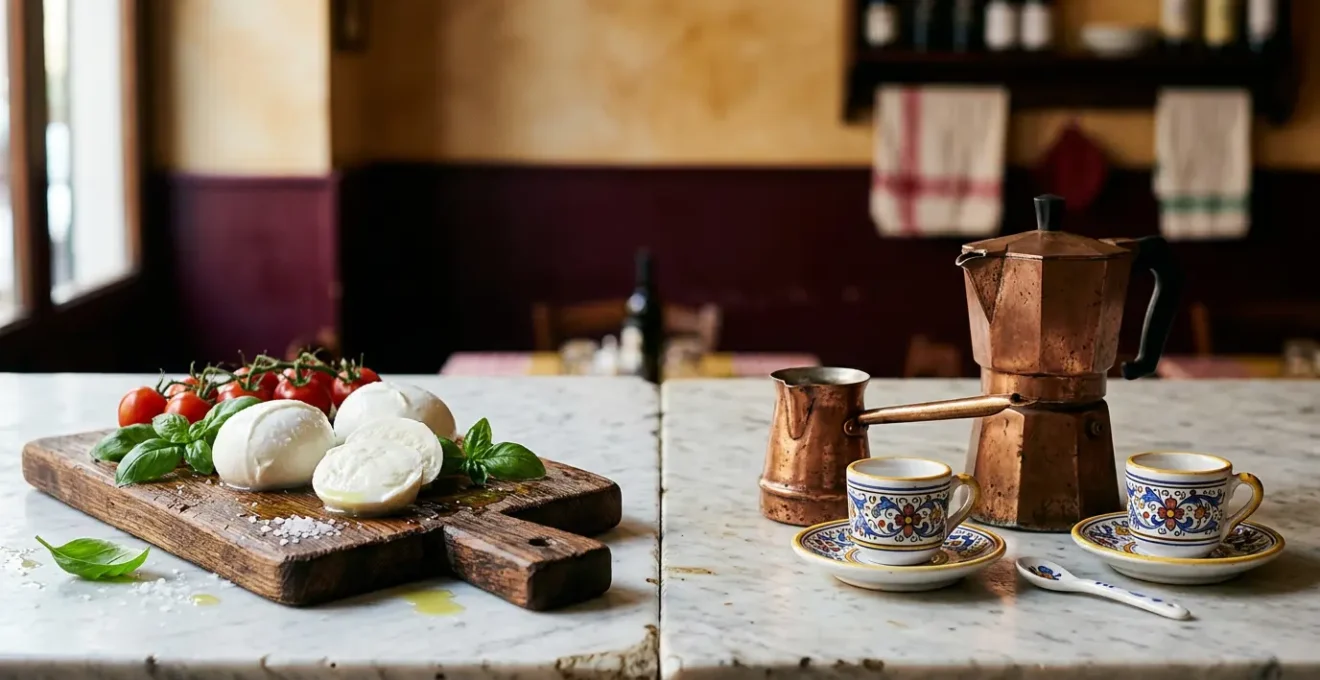
The first thing you must understand is that true Italian food is about freshness. It’s about ingredients that were alive and well this morning. And nothing tells this story better than mozzarella. Not the plastic-wrapped rubber balls you find in the supermarket, but the warm, milky, hand-pulled kind. On Arthur Avenue, this isn’t a luxury; it’s the standard. Places like Casa Della Mozzarella aren’t just shops; they are temples to this philosophy. Since 1993, they have been crafting cheese every single day using methods brought over from Southern Italy.
The process is a dance of hands in hot water, stretching the curds until they are silky and perfect. It’s what Zagat has called the best in the city for over a decade. This is what you look for: a product so fresh it embodies the very soul of Italian craftsmanship. It’s the difference between a meal and an experience. As one customer rightly said, it sets a standard that is almost impossible to match.
This place makes the best mozzarella in the world. I dare you to find a place that makes it better than here.
– Verified customer review, TripAdvisor review of Casa Della Mozzarella
This commitment to daily, artisanal quality is the first clue you’re in a place that respects tradition. It’s a living culture, not a performance.
How Little Italy Shrank to Three Blocks: The History of Expansion
My heart aches a little to say it, but the Little Italy you see on Mulberry Street today is a ghost of what it once was. In the 1920s, this was our world, a bustling neighborhood of nearly 50 square blocks. At its peak in 1910, almost 10,000 Italians called it home. But after the war, families started moving out to find more space in the outer boroughs, chasing the American dream. Then, the 1965 Immigration Act opened doors for other communities, and as Chinatown expanded, our old neighborhood shrank.
Today, Manhattan’s Little Italy is just a few blocks on Mulberry Street. It’s a sad truth, but the numbers don’t lie; a U.S. survey found that by 2011, only 5% of the residents were Italian-American. What’s left feels, as one writer so perfectly put it, like a performance of the past. It’s beautiful, and it’s important to remember, but it is not the thriving community it once was.
Little Italy may always endure as an open-air theme park of nineteenth- and twentieth-century European immigration to the Lower East Side.
– Bill Tonelli, New York magazine
Understanding this history is not about disrespect. It’s about seeing with clear eyes. You are visiting a historical district, a memory lane. The real, bustling Italian-American life has largely moved, and much of it went north to the Bronx.
San Gennaro Festival: Religious Tradition or Fried Dough Trap?
Ah, the Feast of San Gennaro. It started with such pure intentions in 1926. Neapolitan immigrants, homesick and faithful, built a small chapel on Mulberry Street for their beloved patron saint. It was a one-day affair, a holy day. They’d pin money to the ribbons on the saint’s statue during a solemn procession, and as historical records show, this money was then distributed to poorer people in the neighborhood. It was about community and faith.
Now? It’s an 11-day street fair. Of course, there are sausage-and-pepper heroes and piles of fried dough. It became so commercial that in 1995, Mayor Giuliani almost shut it down because of corruption. It has since been cleaned up and is run by a non-profit, Figli di San Gennaro, that does good work for charity. But you have to look past the carnival games to find the soul. The true feast is still there, hidden in plain sight. It’s the Solemn High Mass at the Shrine Church of the Most Precious Blood. It’s the candlelit procession afterward, when the statue is carried through the streets. That is the real San Gennaro. The rest is just a party.
So, go to the festival, by all means. Eat a cannoli. But if you want to find its heart, find the church. Find the procession. That’s where the tradition lives, quietly, beneath the noise.
The “Checkered Tablecloth” Warning: Signs of an Overpriced Menu
Now, listen to me closely, because this will save you from a lot of bad pasta and heartache. There are signs, little warnings that a restaurant is for tourists, not for family. I call it the “Checkered Tablecloth” warning, but it’s more than that. It’s a feeling. It’s the restaurant that tries too hard to look “Italian,” like a movie set. The food in these places is an afterthought. The real, authentic spots are confident. They don’t need to shout; they know you’ll come back if the food is good.
They don’t have a host on the sidewalk trying to pull you in. They don’t have a menu with 50 items and pictures of the food—a cardinal sin! And they certainly don’t serve “Fettuccine Alfredo,” which is an American invention. A real Italian place has a shorter, focused menu because the chef is an expert in those specific dishes. They have pride. I’ve made a little list for you. Study it. It’s your shield against tourist traps.
Your Nonna’s Authenticity Checklist
- Menu Length Test: Is the menu short and focused (10-15 items)? Good. Or is it a novel with everything from pizza to steak? Bad.
- The Photo Menu Sin: Do you see glossy pictures of spaghetti? Run. Authentic places assume you know what food looks like.
- Language Authenticity: Look for regional names (e.g., Tagliatelle al Ragù). If the menu is full of generic or Americanized names, be wary.
- Aggressive Hawking: Is someone outside begging you to come in? A good restaurant never has to beg. Their reputation speaks for them.
- The Parmigiano-Reggiano Test: Do they bring a real wedge of cheese to the table or a shaker of powder? The wedge is a sign of respect for the food and for you.
Remember these rules, and you’ll eat well. You’ll find the quiet, confident places where the food speaks for itself, full of flavor and tradition.
Sunday Dinner: Why You Can’t Get a Table at 2 PM in the Bronx
If you want to understand the soul of Arthur Avenue, try to get a table for 10 people at 2 PM on a Sunday without a reservation. You can’t. And that’s a beautiful thing. This isn’t because of tourists; it’s because of pranzo della domenica—the sacred Sunday family meal. While Mulberry Street became a destination, Arthur Avenue in Belmont is now the largest Little Italy in New York City, and it functions as the city’s true Italian-American heartland.
On Sunday afternoons, restaurants like Zero Otto Nove and Tra Di Noi are not just restaurants; they are extensions of family dining rooms. You will see three, sometimes four generations around a single table. The air is thick with the scent of “Sunday gravy” that has been simmering since dawn, and the sound is a symphony of animated conversations in a mix of Italian and Bronx-accented English. The waitstaff aren’t just servers; they’re part of the family, describing specials with passion while the next table over chimes in with their own recommendations.
This weekly ritual is the lifeblood of the community. It’s a reaffirmation of family, culture, and identity. You can’t get a table because those seats are filled by the same families, week after week, year after year. And that, my dear, is more authentic than any checkered tablecloth could ever be.
The “Red Sauce” Trap: How to Spot Fake Italian Restaurants in Little Italy
Now, let’s talk about “red sauce.” Some food snobs will tell you that a “red sauce joint” is fake Italian. Don’t listen to them. They don’t understand our history. Red sauce is not “fake Italian”—it is a proud and distinct culinary tradition: Italian-American. It was born right here in New York between the 1880s and 1930s, created by our immigrant ancestors who were adapting old-country recipes to new-world ingredients and newfound prosperity.
In Italy, the food is regional. A light tomato sauce here, an olive oil base there. Portions are moderate. In America, our ancestors created something new: rich, long-simmered Sunday gravy full of meat, served in generous portions over spaghetti. Dishes like Chicken Parmigiana and Baked Ziti are ours. They are a celebration of making it in a new land. To dismiss them is to dismiss our story. The key is understanding the difference, not looking down on it.
This table helps explain the distinction. As a recent comparative analysis of these culinary traditions shows, both are valid, but they are not the same.
| Characteristic | Regional Italian | Italian-American Red Sauce |
|---|---|---|
| Sauce Base | Light tomato sauces, olive oil-based, regional variations (ragù Bolognese, pesto Genovese) | Rich, long-simmered tomato-based ‘Sunday gravy’ with multiple meats |
| Portion Size | Moderate, balanced courses (primo, secondo) | Generous, abundant portions reflecting immigrant prosperity |
| Pasta Shapes | Region-specific (tagliatelle in Emilia-Romagna, orecchiette in Puglia) | Spaghetti, rigatoni, penne with interchangeable sauces |
| Meatball Style | Small polpette, often in soup | Large, rich meatballs as main course or with pasta |
| Key Dishes | Cacio e pepe, carbonara (guanciale + egg), regional specialties | Chicken parmigiana, baked ziti, spaghetti and meatballs |
| Cultural Origin | Authentic regional Italian traditions | Italian-American adaptation developed in NYC, 1880s-1930s |
So, don’t fall into the “red sauce trap” of thinking it’s inauthentic. Instead, appreciate it for what it is: the delicious, hearty food of the Italian-American experience.
Beyond the Parade: Where to Find Authentic Cultural Celebrations, Not Just Parties
The soul of a people isn’t just in the food they eat, but in the traditions they keep. While the Columbus Day Parade on Fifth Avenue is the largest celebration of our culture, it’s just one day. The true spirit is found in the smaller, more intimate neighborhood feasts that happen all year round. In New York, there are more than 35 such festivals, each a thread in the rich tapestry of our heritage. These are not just parties; they are deeply-rooted cultural and religious events that connect us to our history and to each other.
These are the celebrations that haven’t been completely taken over by tourists. They are for the community, by the community. You have the “Dancing of the Giglio” in East Harlem, a breathtaking feat of strength and faith. You have the Feast of St. Anthony in the Bronx, a five-day affair that brings Arthur Avenue to life with processions and music. Even on Mulberry Street, the Feast of St. Anthony of Giovinazzo in May is a beautiful, traditional procession.
Here are a few to mark on your calendar if you want to see the real thing:
- May: Feast of St. Anthony of Giovinazzo (Little Italy, Manhattan) – A religious procession up Mulberry Street.
- June: Feast of St. Anthony of Padua (Belmont, Bronx) – A five-day authentic celebration on Arthur Avenue.
- August: Feast of Our Lady of Mount Carmel & Dancing of the Giglio (East Harlem) – A spectacular tradition performed for over a century.
- September: Ferragosto (Arthur Avenue, Bronx) – A wonderful street party celebrating the harvest season with local vendors.
These events are where you’ll find the true Italian soul on display—not for show, but for real.
Key takeaways
- Arthur Avenue is for Living: For a taste of living, breathing Italian-American culture, fresh artisanal food, and the sacred Sunday family dinner, the Bronx is your destination.
- Mulberry Street is for Remembering: Visit Manhattan’s Little Italy for a walk through history and a glimpse of grand festivals, but be armed with knowledge to avoid the tourist traps.
- Authenticity is in the Details: Real Italian soul is found in fresh mozzarella made that morning, in short menus, in religious processions, and in the distinction between regional Italian and proud Italian-American cuisine.
Authentic vs. Fusion: Which New York Restaurants Actually Honor Traditional Recipes?
So, where does this leave us? In a city with nearly 2.6 million Italian-Americans, our culinary story is not a single narrative but a beautiful, evolving epic. To understand where to eat, you must understand that there are different philosophies at play. I see it as three tiers: The Museum, The Bridge, and The Laboratory.
“The Museum” is found on Arthur Avenue. Places like Tra Di Noi are preservationists, serving family recipes that have been passed down for generations and have not changed. They are guardians of tradition, serving perfect cavatelli with broccoli rabe or baked rigatoni exactly as their grandparents made it. This is culinary history you can eat.
“The Bridge” represents respectful innovation. These are restaurants that use traditional techniques but aren’t afraid to incorporate modern or local ingredients. They understand the rules of Italian cooking so well that they know how to bend them without breaking them. They honor the spirit of the recipe while giving it a fresh voice.
Finally, there is “The Laboratory.” These are often downtown restaurants, the avant-garde chefs who deconstruct Italian food and reassemble it in new and exciting ways. They are experimenting, pushing boundaries, and asking “what if?” This isn’t your nonna’s cooking, but it’s a vital part of the city’s culinary conversation.
There is no “best” tier. Each has its place. The question is, what are you looking for? Do you want to taste a memory? Or do you want to taste the future? Knowing the difference is the final step in your education.
So now you know. The soul of Italy in New York is not in one place. It’s in a warm ball of mozzarella in the Bronx, in a quiet prayer during a festival on Mulberry Street, and in a plate of Sunday gravy shared with family. Go, eat, and explore. And don’t be a tourist. Be family.