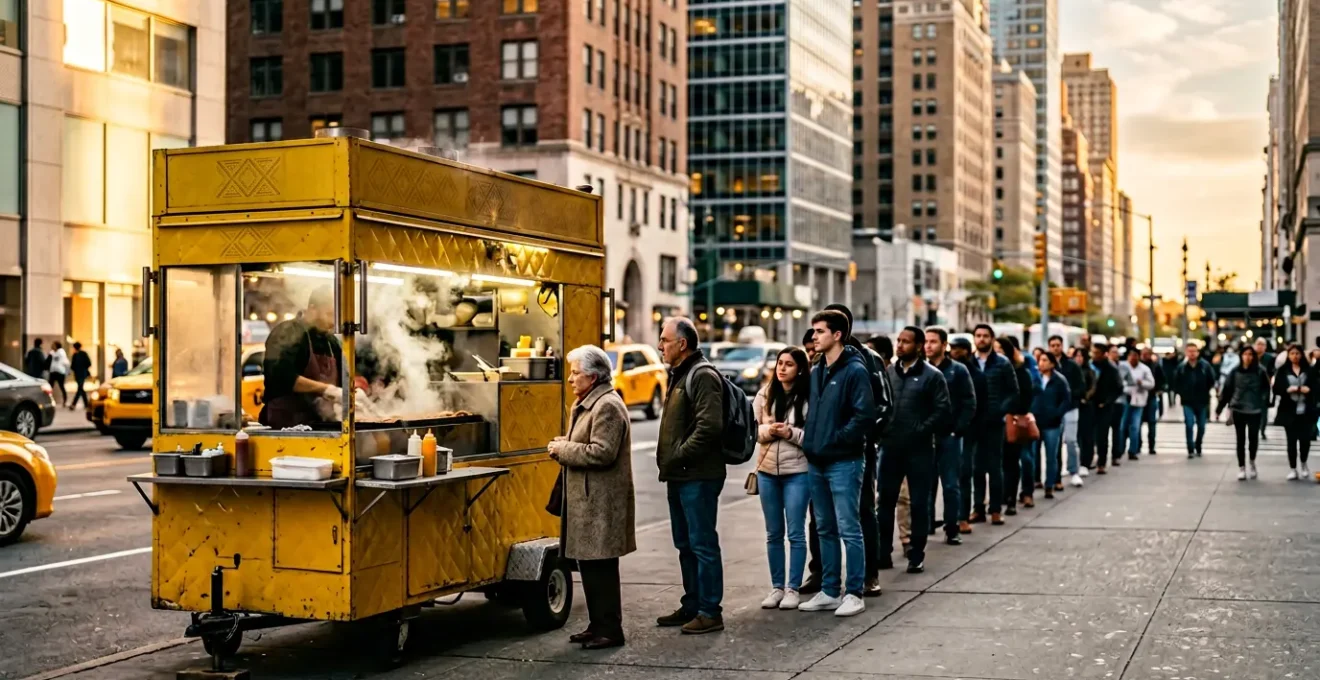
The 45-minute wait for Halal Guys is not a question of patience, but of economics; its value is only unlocked by mitigating risk and maximizing your flavor return on investment.
- The red and white sauces are a calculated flavor system, where the extreme heat of one is designed to be managed by the cooling effect of the other.
- The original cart’s value is tied to its authenticity and the performance of its line, a quality often diluted in franchises and poorly mimicked by imposters.
Recommendation: Calculate your personal ROI. For pure cost-per-calorie value, the platter is superior. For time, leverage strategic off-peak timing to reduce the wait, treating it as a variable you can control.
The scene is a New York City institution, as recognizable as a yellow cab: a sprawling, serpentine line of hungry office workers and curious tourists, all waiting under a yellow and red umbrella. The air smells of grilled chicken, turmeric rice, and a vague, urban sizzle. This is the queue for The Halal Guys. For decades, the promise of a foil platter loaded with chicken, gyro, and rice, all drenched in that iconic white sauce, has been enough to command waits of 45 minutes or more. The question that hangs in the air, as heavy as the scent of grilling meat, is a pragmatic one: is it still worth it?
Many will offer simple advice: “go during off-hours,” or “the white sauce is worth it alone.” But this simplistic view ignores the complex calculus that every person in that line is unconsciously performing. This is not a simple transaction of money for food. It is an investment of your most valuable, non-renewable resource: time. To answer the question properly, we must move beyond a simple taste test and adopt the mindset of a queue theorist. We must analyze the variables, calculate the risks, and determine the true return on investment (ROI) of that 45-minute wait.
This analysis will deconstruct the Halal Guys experience into its core components. We will dissect the engineered flavor profile of its sauces, question the “order ahead” myth, and confront the schism between the original cart and its sprawling franchise empire. We’ll provide a field guide to identifying imposters and run a cost-benefit analysis on the platter versus the sandwich. This isn’t just about deciding if you should get in line; it’s about providing a strategic framework to determine if the flavor payout justifies the temporal cost, every single time.
This guide breaks down the essential variables in the Halal Guys queue equation, providing an analytical framework to help you decide whether to commit your time. Below is a summary of the critical factors you’ll need to consider.
Summary: A Strategic Analysis of the Halal Guys Queue
- The White Sauce vs. Red Sauce Danger: How to Not Burn Your Tongue
- The “Order Ahead” Myth: Can You Really Beat the Cart Queue?
- Franchise vs. Original Cart: Does Expansion Kill the Flavor?
- The “Royal” Imposters: How to Identify the Real Halal Cart
- Platter vs. Sandwich: Which Offers More Calories per Dollar?
- When to Arrive at the Night Market to Avoid hour-long Lines
- The “Notify” Button Strategy: How to Snag Tables at 4 PM
- The “Dirty Water” Dog: Why We Still Eat Them Despite the Health Inspection Grades?
The White Sauce vs. Red Sauce Danger: How to Not Burn Your Tongue
The first variable in the Halal Guys equation is its flavor system, a high-risk, high-reward binary of white and red sauce. To the uninitiated, they are mere condiments. To the analyst, they are a carefully engineered system of sensory overload and management. The white sauce is a creamy, tangy, mayonnaise-based enigma that provides a cooling, fatty mouthfeel. It is the baseline, the foundation of the experience.
The red sauce, however, is not a friendly, ketchup-like accompaniment. It is a weaponized form of capsaicin delivery. According to The Halal Guys’ own information, the hot sauce lands in the range of 100,000-130,000 Scoville Heat Units. This places it far beyond common hot sauces and firmly in the territory of habanero peppers. It is an outlier designed to create a memorable, if painful, experience. The key to a successful platter is not choosing one over the other, but understanding their interplay. The white sauce is the antidote; the red sauce is the controlled danger. Applying too much red sauce is a rookie error that nullifies the flavor of the entire meal and torpedoes your time investment.
To fully grasp the intensity, a direct comparison is necessary. Most commercially available hot sauces are designed for flavor with a hint of heat. The Halal Guys’ red sauce is designed for heat, period. The following table, drawing on comparative data, puts its potency into perspective.
| Sauce/Pepper | Scoville Heat Units (SHU) | Comparison to Halal Guys |
|---|---|---|
| Halal Guys Red Sauce | 100,000-130,000 | Baseline |
| Jalapeño Pepper | 3,000-10,000 | 40x milder |
| Sriracha Hot Sauce | 1,000-3,000 | 100x milder |
| Cholula Hot Sauce | 1,000-3,000 | 100x milder |
The correct strategy is to request the red sauce on the side or apply it in single drops. Your 45-minute wait can be rendered worthless by a single, overzealous squeeze of a bottle. Mastering the sauce ratio is the first step to ensuring a positive return on your time.
The “Order Ahead” Myth: Can You Really Beat the Cart Queue?
In a world of apps and digital solutions, the most common question from a first-timer is, “Can’t I just order ahead?” This is the “Order Ahead” Myth, a tempting but ultimately flawed belief that technology can circumvent the physical reality of the queue. For the original 53rd & 6th cart, the answer is a resounding no. The line is the system. There is no secret app, no digital backdoor. This analog nature is a core part of its chaotic charm and a massive variable in your time-investment calculation.
The queue itself becomes a form of social proof. A line 40-people deep doesn’t just signal a long wait; it signals that the product at the end is valuable enough for 40 other people to invest their time. This psychological effect can trap the undecided, creating a self-perpetuating cycle of long lines. As Cititour NYC’s food analysis once noted, for an experience this iconic, people are willing to wait up to an hour (maybe two) for a taste. This willingness is what the business model is built on.
The line is not just a wait; it’s a shared urban experience. Strangers commiserate, regulars offer advice, and a sense of collective anticipation builds. It’s a pre-meal ritual that, for some, enhances the eventual flavor payout. For the impatient analyst, however, it is pure, unadulterated friction.
As the image suggests, the human element is central to the process. You are not waiting on an algorithm but on a small team working in a confined space. The speed of the line is dictated by the dexterity of the server, the clarity of the customer’s order, and the occasional bottleneck of a complex payment. There is no “optimization” beyond the crew’s own well-practiced rhythm. Accepting this is crucial: you cannot beat the cart queue. You can only decide if you want to join it.
Franchise vs. Original Cart: Does Expansion Kill the Flavor?
The Halal Guys is no longer just a single cart on a Manhattan street corner. It’s a global phenomenon. According to its own franchise information, the brand boasts over 100 locations globally with 400+ more units in development. This explosive growth introduces the most significant variable for the modern consumer: franchise vs. original. The core of this debate is a classic business problem: can you scale an authentic, street-level experience without losing the “magic”?
For the queue theorist, a franchise location presents a different set of calculations. The wait time is often drastically reduced or eliminated. You can order ahead via apps. The environment is climate-controlled and sterile. On paper, it’s a more efficient transaction. However, this efficiency comes at the potential cost of authenticity and, some argue, flavor. The brand’s success, as industry analysts point out, depends on maintaining consistency. But is the “consistent” flavor of a franchise the same as the “original” flavor forged in the chaos of a Midtown street?
The original cart operates with a certain theatricality. The sizzle of the grill, the chop of the cleaver, the banter of the crew—it’s a performance. This sensory input arguably primes the palate and enhances the perceived taste. A franchise, by necessity, standardizes these processes. The chicken may be cooked on a regulated flattop, the rice held in a commercial-grade warmer. The result is a product that is reliably good but rarely transcendent. The risk is lower, but so is the potential reward. Waiting in line at the original cart is a bet that you will experience something unique, a flavor that cannot be perfectly replicated in a suburban strip mall.
Choosing a franchise is a strategic decision to prioritize convenience over the potential for an peak experience. It’s the safe bet. For tourists, the original cart is a pilgrimage. For a local on a lunch break, a nearby franchise might offer 80% of the flavor for 10% of the wait, a trade-off that makes perfect economic sense. The question is whether that remaining 20% of “authentic flavor” is worth the 45-minute investment.
The “Royal” Imposters: How to Identify the Real Halal Cart
The success of The Halal Guys created an entire ecosystem of imitators. This is the risk of the “imposter cart,” a critical threat to your time and money investment. A 45-minute wait is bad; a 45-minute wait for a subpar, inauthentic product is a catastrophic failure of planning. From a queue theorist’s perspective, mitigating this risk is paramount. You must be able to positively identify your target.
The proliferation of these copycats is a testament to the brand’s power. Many feature similar yellow and red color schemes, use regal-sounding names (“The Royal Halal Food,” “The Best Halal”), and park in close proximity to the original. They are parasitic operations, designed to siphon off confused or impatient customers from the main line. Falling for one is the ultimate rookie mistake.
Case Study: The Copycat Economy
The Halal Guys’ success created an entire micro-economy of imitators in New York City. As documented in analyses of NYC’s street food scene, the original cart, founded in 1990 at 53rd Street and Sixth Avenue, became so iconic that numerous copycat operations emerged. The brand’s white sauce became a subject of intense speculation, with food publications attempting to decode its recipe. The proliferation of similar-looking carts demonstrates both the brand’s cultural impact and the competitive nature of NYC’s street food market, where authentic halal food transformed from a niche religious requirement to a mainstream culinary category. This competitive pressure makes brand identification a crucial skill for any consumer.
So, how do you identify the genuine article? The Halal Guys have a standardized uniform and branding that acts as a quality signal. Look for these key identifiers:
- The Uniform: The staff will be wearing bright yellow polo shirts or jackets with the official “The Halal Guys” logo.
- The Bags: Your food will be served in a bright yellow plastic bag, also emblazoned with the logo. This is one of their most famous brand identifiers.
- The Location: The original, most famous cart is located on the southwest corner of 53rd Street and 6th Avenue in Manhattan. While they have other carts, this is the mothership.
Do not be swayed by a shorter line at a cart a few feet away. That shorter line is a red flag. The long queue, as frustrating as it is, is also your most reliable indicator of authenticity.
Platter vs. Sandwich: Which Offers More Calories per Dollar?
Once you’ve committed to the wait and verified the cart’s authenticity, the final strategic decision comes at the window: platter or sandwich? From an analytical standpoint, this isn’t a question of preference but of value. We must analyze the “Calories per Dollar” and “Grams of Protein per Dollar” to determine the optimal order. Assuming a standard price for each, the nutritional data provided by The Halal Guys becomes our primary dataset for this calculation.
The platter is the iconic offering: a bed of turmeric-laced rice and iceberg lettuce, topped with your choice of protein (or a combination), and finished with a slice of pita. The sandwich is a more mobile option, with the ingredients stuffed inside the pita. While they contain similar components, their composition and portioning are different, leading to a clear divergence in value.
Before we crunch the numbers, it’s worth noting the textural and flavor experience. The platter allows for deconstruction. You can craft each bite with a different ratio of rice, chicken, and sauce. The sandwich homogenizes the experience. All ingredients are compressed, melding into a single, cohesive taste. The platter is an analytical experience; the sandwich is a gut-feel one.
Now for the data. According to the official nutritional guide, the differences are stark. Let’s compare the Regular Combo Platter with the Combo Sandwich, as they are the most direct competitors.
| Item | Serving Size | Total Calories | Protein (g) | Carbs (g) | Fat (g) |
|---|---|---|---|---|---|
| Regular Combo Platter | 18 oz (510g) | 790 | ~50 | 96 | 23 |
| Small Combo Platter | 14 oz (386g) | 572 | 34 | 73 | 16 |
| Chicken Sandwich | 10 oz (278g) | 419 | 41 | 47 | 7 |
| Combo Sandwich | 10 oz (278g) | 516 | 35 | 58 | 16 |
The verdict is clear. The Regular Combo Platter offers significantly more of everything: more calories, more protein, and more carbohydrates for what is typically a marginal price increase over the sandwich. At nearly double the serving size (510g vs 278g), the platter provides a far better ROI from a pure volume and nutritional standpoint. If your goal is to maximize the value extracted from your 45-minute wait, the platter is the only logical choice.
When to Arrive at the Night Market to Avoid hour-long Lines
While The Halal Guys cart is a daytime and evening fixture, the principles of crowd avoidance are universal. To optimize your wait time, you must think like a seasoned strategist navigating a chaotic night market. The goal is to identify patterns in crowd behavior and exploit the lulls that inevitably occur, even at the most popular spots. Waiting is for amateurs; the analyst finds the temporal seam.
The common wisdom is to “go early” or “go late,” but this is imprecise. The “early” crowd creates the initial peak, and the “late” crowd often collides with post-bar rushes. The true opportunity lies in the micro-troughs between these macro-peaks. For a food cart like The Halal Guys, which has predictable rush hours (lunch from 12-2 PM, dinner from 6-8 PM), the windows of opportunity are just outside these blocks.
Furthermore, external factors play a massive role. A slight drizzle can cut a line in half. A major event nearby can either drain the area of potential customers or flood it. A queue theorist doesn’t just check the time; they check the weather, the local event calendar, and even social media for real-time mentions. It’s about gathering intelligence to make a more informed temporal investment. The following list distills these universal principles into a concrete action plan for any popular street food vendor.
Action Plan: Strategic Food Cart Timing
- Target the ‘Second Wave’ Window: Arrive 60-90 minutes after the peak lunch or dinner rush begins. The initial surge has been served, and you slot in before the next big wave.
- Monitor Weather Conditions: Light, intermittent rain is your best friend. It dramatically reduces crowds. Come prepared with an umbrella for a significantly shorter wait.
- Work Backwards from Closing: For late-night service, the shortest lines are often in the final hour before closing, not at 3 AM when bars let out. The crew is motivated to clear the line quickly.
- Avoid Peak Tourist Times: Carts near major attractions like Times Square are busiest on weekends from late afternoon to evening. A weekday lunch is a much better bet.
- Leverage Late-Night Hours: The original cart often operates until 4 or 5 AM. The period between 2 AM and 4 AM, after the initial post-bar rush, is often a sweet spot for minimal waiting.
Applying these principles transforms you from a passive waiter into an active strategist. You are no longer subject to the queue; you are gaming it.
The “Notify” Button Strategy: How to Snag Tables at 4 PM
The Halal Guys cart has no “notify” button. It exists in the analog world of physical queues. However, the *mindset* of the “Notify Button Strategy”—a tactic used to snag last-minute reservations at popular restaurants—is directly applicable. The core principle is about leveraging alternative channels and precise timing when the primary channel (the line) is saturated. If you’ve decided the 45-minute wait is an unacceptable cost, these are your off-queue acquisition tactics.
The most direct equivalent is leveraging the franchise network. As we’ve established, a brick-and-mortar Halal Guys location is a different entity, but it serves the same core product. These locations are integrated into the digital ecosystem. You can use their native apps, or third-party delivery services like Uber Eats and DoorDash, to effectively create your own “notify” button. During peak hours, these apps may quote wait times of 45-90 minutes for delivery, but this is a different kind of waiting—one you can do from your desk or couch.
This approach is about re-framing the problem. Instead of “how do I shorten the physical line?” it becomes “how do I acquire the product with minimal personal friction?” The answer often lies in paying a premium for delivery or settling for the slightly different experience of a franchise location. It’s a pure cost-benefit analysis: is the delivery fee and potential dip in quality worth saving 45 minutes of your time standing on a sidewalk?
For the committed analyst, here is a breakdown of the off-queue strategies, borrowing from the world of high-demand restaurant reservations.
Action Checklist: Off-Queue Acquisition Tactics
- Leverage Delivery App Wait Times: Monitor services like DoorDash or Uber Eats. A quoted 60-minute delivery time is still 60 minutes, but it’s passive waiting, allowing you to remain productive.
- Target Franchise Locations: Use the official Halal Guys app or website to order ahead for pickup at a brick-and-mortar store. This is the most efficient way to get the food without any wait.
- Understand Cancellation Waves: Metaphorically, for delivery, this means checking apps just after peak lunch/dinner rushes, when driver availability might improve and estimated times drop.
- The Human-in-the-Loop Hack: For large catering orders, calling a franchise location directly can often yield better results and more accurate timing than relying on an app’s algorithm.
- Target Weekday Afternoons for Delivery: Just as with physical lines, delivery demand troughs mid-afternoon (2-4 PM), often resulting in faster service and lower fees.
This strategic pivot acknowledges that while you can’t beat the original queue, you can choose to play an entirely different game.
Key Takeaways
- The Halal Guys’ flavor profile is a calculated system; the extreme heat of the red sauce is designed to be balanced by the cooling white sauce, and failure to respect this ratio ruins the experience.
- The long queue is a feature, not a bug, acting as social proof. Digital workarounds like “ordering ahead” do not apply to the original carts.
- A clear trade-off exists between the original cart (authenticity, peak flavor potential, long wait) and franchises (convenience, consistency, shorter wait).
The “Dirty Water” Dog: Why We Still Eat Them Despite the Health Inspection Grades?
To truly understand the phenomenon of The Halal Guys queue, one must zoom out and consider the broader psychology of New York City street food. Why do we, as rational consumers, place immense trust in food prepared in a tiny metal box on a city street? The answer has parallels in another iconic street food: the “dirty water” hot dog. We eat them not in spite of their dubious context, but because that context signals a certain kind of authenticity.
The street food economy is built on a foundation of perceived legitimacy, and in NYC, that is often tied to longevity and scarcity. It’s a little-known fact that mobile food vending permits are notoriously difficult to obtain. For years, the number of permits was strictly capped, creating a black market and a system where, as some in the vendor community claim, people have been on waiting lists for over 20 years. This high barrier to entry means that a vendor who has a permanent, long-standing spot is perceived as legitimate. They have navigated the system; they have earned their place.
This creates a powerful brand halo. The Halal Guys, having operated from their 53rd & 6th location since 1990, are the ultimate example of this. They are not a transient operation; they are a landmark. This history imbues the food with a level of trust that a newer, less established vendor cannot replicate. We trust The Halal Guys for the same reason we trust a hot dog vendor who has been on the same corner for 30 years. Their continued existence is the best health inspection grade of all.
The city is slowly attempting to rectify the permit scarcity, with regulations from the NYC Health Department aiming to add thousands of new permits. But this will take years. For now, the old system of trust, based on visual cues and reputation, still reigns. The long line at The Halal Guys is not just for chicken and rice; it’s a vote of confidence in an institution, a belief that this specific cart, out of all the others, is the one that has earned the right to be there.
So, is the 45-minute wait worth it? The answer, unsatisfyingly, is: it depends on your personal utility curve. If you value a peak, authentic, and performative food experience, and are willing to invest the time to mitigate risks (sauce ratio, imposter carts), then yes. The original cart offers a return that cannot be matched by a franchise. If you prioritize efficiency, convenience, and predictability, then no. The franchise and delivery network provides a “good enough” solution at a fraction of the temporal cost. The question isn’t whether the chicken over rice is good. The question is what you are willing to pay for it—in minutes. Calculate your variables, and choose your queue accordingly.