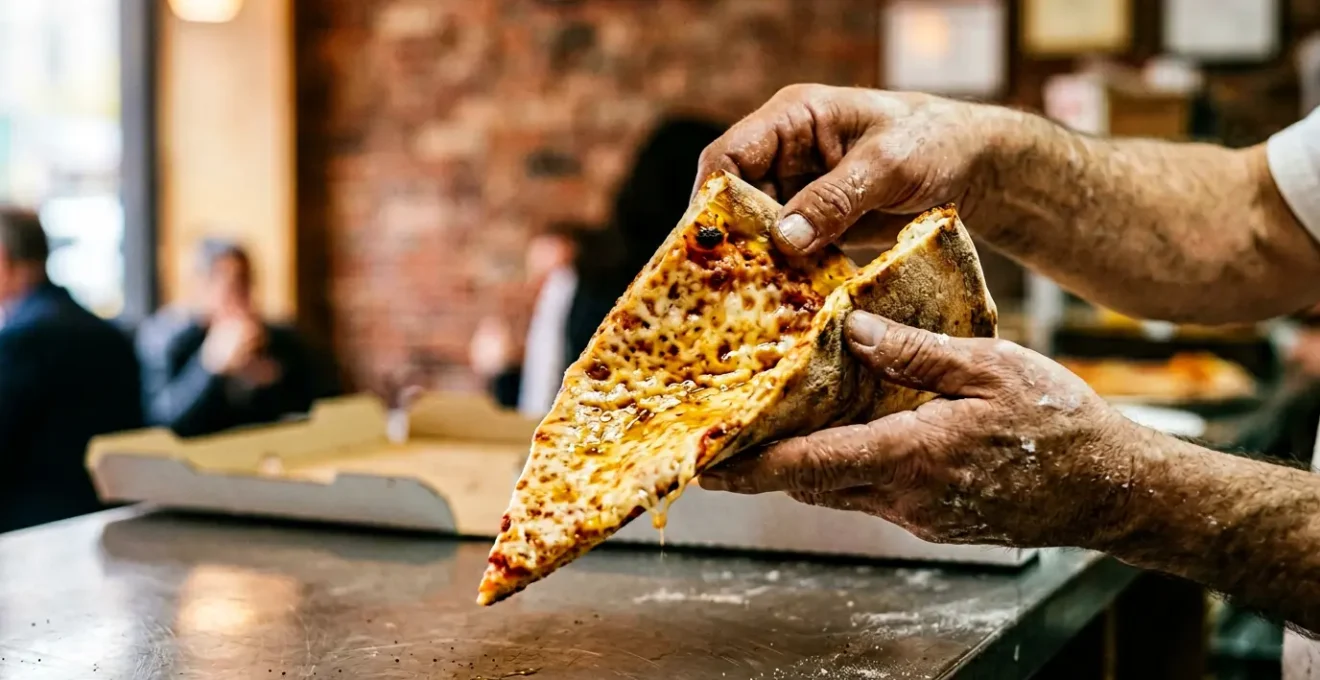
You think folding a New York slice is just a local custom? Think again. It’s a non-negotiable act of structural engineering. This guide explains the physics behind the ‘Fold Method,’ proving why using a fork is not just a social faux pas, but a technical failure to handle a perfectly designed piece of culinary art. Forget etiquette; it’s time for a lesson in applied science.
Listen up. Every day, I see it. Tourists, newcomers, well-meaning people standing in front of my counter, holding a perfect, wide slice of New York pizza like it’s a mysterious artifact. They stare at its glorious, cheesy expanse, then at its drooping tip, and panic. That’s when the unforgivable happens: they reach for a fork and knife. Let me be clear: in New York, that’s not just a social blunder, it’s an insult to the craft. You wouldn’t drive a Ferrari in first gear, and you don’t eat a New York slice with utensils.
Many will tell you, “You just have to fold it,” but they rarely explain why. It’s not an arbitrary rule of etiquette. It’s a functional necessity born from the very design of the slice. The wide, thin-crust pizza is an engineered product, and the Fold Method is its operating manual. But if the fundamental key isn’t just etiquette, but rather physics, what does that mean for the rest of the pizza experience? It means everything—from the amount of toppings you choose to how you reheat leftovers—is part of a system.
This isn’t just another guide telling you what to do. This is a lesson from behind the counter. We’re going to break down the science of the fold, the thermodynamics of reheating, and the economics that dictate why your slice is the way it is. By the end, you’ll understand that eating a New York slice correctly is an act of respecting its inherent design. It’s time to stop committing pizza crimes and start eating like you belong here.
In this guide, we will deconstruct the unwritten laws of the New York slice. The following sections provide a complete masterclass, from structural mechanics to economic realities, ensuring you handle your next slice with the respect it deserves.
Summary: The Unspoken Rules of the New York Slice
- The “Tip Sag”: Why You Must Fold to Support the Cheese
- The Napkin Dab: Social Faux Pas or Health Hack?
- Why Extra Toppings Ruin the Crisp of a Thin Crust
- Dollar Slice vs. Coal Oven: The Difference in Chew and Char
- Skillet vs. Microwave: How to Revive Yesterday’s Slice Perfectly
- The Price of Mozzarella: How Inflation Hits the $3 Slice
- Why Authentic Ingredients Cost More Than the Dollar Slice
- How Family-Run Pizzerias Survive Rent Hikes in Gentrified Brooklyn Neighborhoods?
The “Tip Sag”: Why You Must Fold to Support the Cheese
The first and most critical failure I see is the hesitation in the face of the “Tip Sag.” A fresh, hot, wide slice of New York pizza has a natural tendency for its tip to droop under the weight of the sauce and cheese. This is not a flaw; it’s a feature. An amateur sees a floppy mess. A pro sees an opportunity to apply basic physics. Folding the slice lengthwise along its central axis is not a suggestion; it is a command rooted in structural engineering.
When you create a U-shaped channel with the crust, you are transforming a flimsy, two-dimensional plane into a rigid, three-dimensional structure. This principle is so effective that it has a name in mathematics: Gaussian curvature. The science is clear: Gauss’s Theorema Egregium proves that folding a surface in one direction forces rigidity along the perpendicular axis. In simple terms, your fold creates a “crust-beam” that can support the payload of cheese and toppings all the way to your mouth, preventing the dreaded cheese-slide or sauce-drip. The slice was designed to be folded.
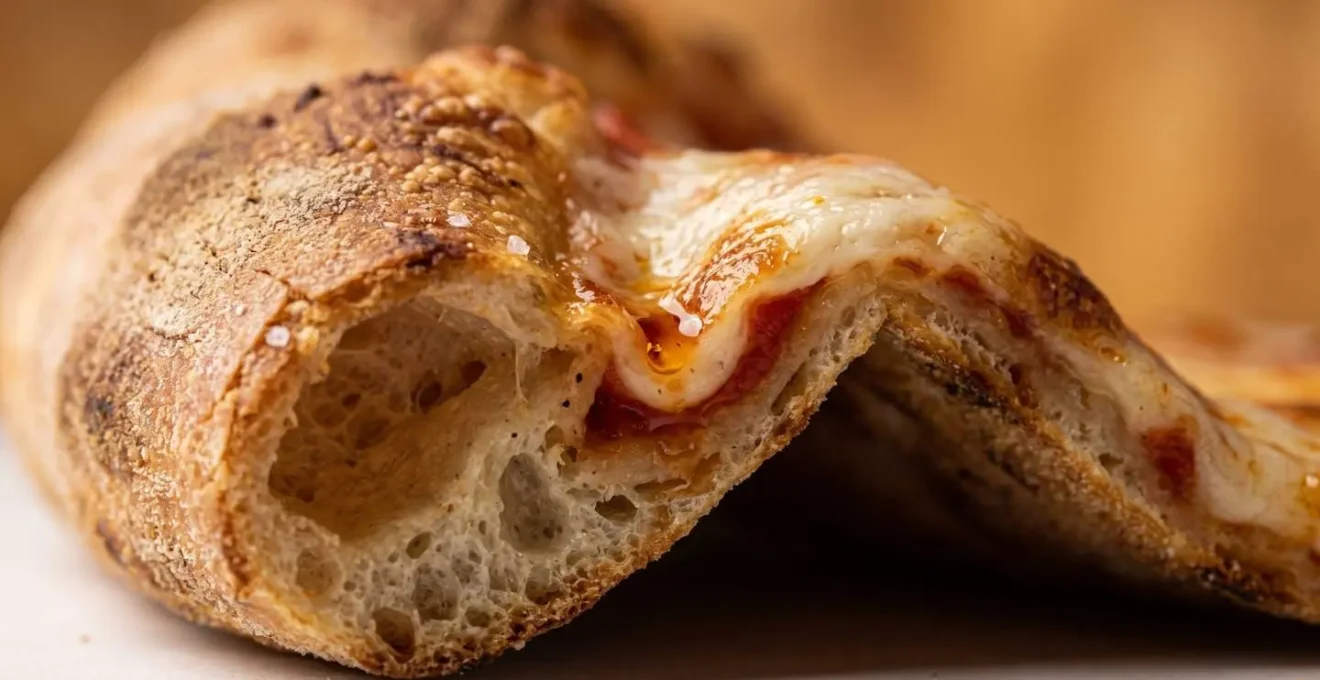
As you can see, this simple action provides the necessary structural integrity. Refusing to fold is like refusing to use a handle on a coffee mug; you are ignoring the built-in user interface. It leads to mess, frustration, and a sub-optimal bite. The first bite should be the tip, and the fold is the only way to deliver it intact.
The Napkin Dab: Social Faux Pas or Health Hack?
Now, let’s talk about a more nuanced topic: the napkin dab. You’ll see people gently blotting the surface of their slice to soak up the glistening pools of orange grease. Is this a cardinal sin on par with using a fork? Or is it a savvy health move? As a purist, my heart sinks a little every time I see it. That grease is flavor. It’s a savory blend of oils from the pepperoni and the full-fat mozzarella. Dabbing it away feels like you’re rejecting part of the experience I worked to create.
However, unlike the fork-and-knife atrocity, the dab has some quantifiable merit. It’s not just a perception; you are actually removing calories. In fact, a study found that blotting a slice can significantly reduce its caloric and fat content. The test revealed you could remove an average of 40.5 calories and 4.5 grams of fat per slice. This makes the dab a calculated decision rather than a clueless blunder. It’s a compromise between indulgence and moderation.
So what’s my final verdict as a pizzeria owner? The dab is a forgivable misdemeanor. It acknowledges you understand the pizza should be eaten by hand, even if you’re a little afraid of the full, unadulterated experience. It shows a lack of commitment, but it’s not an act of outright disrespect. Unlike the fold, which is a matter of structural necessity, the dab is a matter of personal preference. I won’t kick you out of my shop for it. But I might give you a knowing, slightly disappointed look.
Why Extra Toppings Ruin the Crisp of a Thin Crust
“Load it up!” I hear this all the time. Customers want every topping under the sun: extra cheese, mushrooms, peppers, onions, sausage. On a thick, deep-dish pie, maybe. But on a classic New York thin crust? You’re not ordering a pizza; you’re commissioning a disaster. The New York slice is a marvel of balance, and its greatest enemy is excess weight and moisture. The crisp-yet-pliable crust is the foundation, and you are overloading it to the point of structural failure.
The primary culprit is water. Toppings, especially vegetables like mushrooms and peppers, release a tremendous amount of steam in a hot oven. Even the cheese is a factor. For example, industry data shows that fresh mozzarella has a 52% water content, which turns to steam and attacks the crust from above. When you pile on too much, you create a soggy, waterlogged mess that no amount of folding can save. The crust steams instead of bakes, turning it into a limp, wet napkin. It’s a violation of the sacred topping-to-crust ratio.
A true New York slice is minimalist by design. It’s about the harmony between the tangy sauce, the creamy mozzarella, and the crisp, flavorful crust. One or two toppings, max. Anything more is a declaration that you don’t trust the quality of the core ingredients. To avoid this culinary tragedy in your own cooking, you must be disciplined.
My Pizzeria’s Golden Rules: The Topping Audit
- Apply a thin layer of oil on the dough before the sauce to create a moisture barrier.
- Minimize the amount of sauce and toppings; for a 12-inch thin crust, use no more than 1/3 cup of sauce and 80 grams of cheese.
- Test your sauce for syneresis (weeping) on a plate for 10 minutes; if it pools, it’s too wet for a thin crust.
- Pre-drain or even pre-cook watery vegetables like mushrooms or marinated items before adding them to the pizza.
Dollar Slice vs. Coal Oven: The Difference in Chew and Char
Not all slices are created equal. The slice you get for a dollar is a different species from the one baked in a traditional coal-fired oven, and this difference dictates how you should handle it. The distinction comes down to one thing: heat and cooking time. A typical gas-powered deck oven, used for dollar slices, operates at around 500-600°F. A coal oven, however, burns with blistering intensity. Professional coal-fired ovens reach temperatures of 800°F to 1,000°F, cooking a pizza in just a few minutes.
This intense, dry heat creates a completely different crust. The dollar slice, cooked slower, is more uniform, pliable, and chewy. It’s practically *designed* for the Fold Method; it’s a necessity. The coal-oven crust, on the other hand, is defined by its “char” and “leopard-spotting.” The exterior is incredibly crisp, almost brittle, while the inside remains light and airy. Folding a fresh-from-the-oven coal slice can sometimes cause the crust to crack. It often has enough structural integrity to be eaten flat, though a gentle fold is still acceptable.
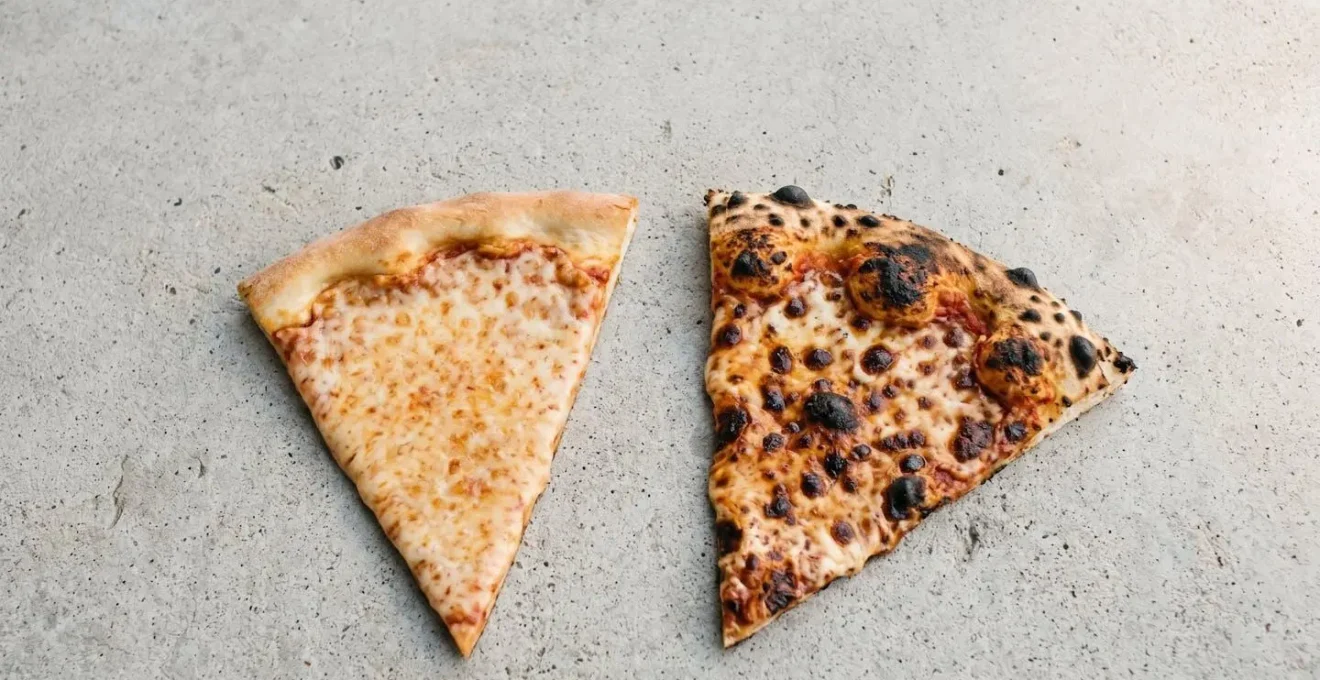
Understanding these differences is key to appreciating each style for what it is. The dollar slice is a triumph of function and portability. The coal-oven slice is a masterpiece of texture and flavor. To clarify the distinction, a recent comparative analysis breaks down the core characteristics of each.
| Characteristic | Dollar Slice (Deck Oven) | Coal Oven Premium |
|---|---|---|
| Oven Temperature | 500-600°F | 800-1,000°F |
| Cook Time | 8-12 minutes | 2-5 minutes |
| Crust Texture | Uniform, pliable, more ‘chew’ | Crisp exterior, airy interior, more ‘char’ |
| Foldability Index | 10/10 (mandatory fold) | 6/10 (optional, may crack) |
| Flavor Profile | Standard, consistent | Smoky, caramelized, charred notes |
| Cheese Behavior | Melted, some grease release | Blistered, less water release |
Skillet vs. Microwave: How to Revive Yesterday’s Slice Perfectly
Let’s talk about the morning after. You have a cold, leftover slice in your fridge. What you do next separates the civilized from the savages. If your first instinct is to throw it in the microwave, just stop. Stop right there. A microwave is a texture-killing machine. It uses radiation to excite water molecules, which steams the crust from the inside out, turning your once-glorious slice into a hot, soggy, chewy tragedy. It’s a crime against leftovers.
The only truly acceptable method for reheating a New York slice is the skillet method. This two-step process respects the original texture by applying two different types of heat: conductive heat for the bottom and steam for the top. It resurrects the slice, bringing back the crispy bottom and perfectly melted cheese. It takes three minutes, and it is non-negotiable.
Here is the one and only way to do it. Do not deviate from this sacred procedure:
- Place your cold slice in a hot, dry, non-stick skillet over medium heat. This allows the bottom crust to re-crisp through direct contact (conductive heat). Let it toast for 2-3 minutes.
- Once the bottom is crisp, add a few drops of water to the pan—away from the pizza, not on it.
- Immediately cover the skillet with a lid. The trapped steam will gently re-melt the cheese and warm the toppings without making the crust soggy. This should take about 30-60 seconds.
- Remove the slice once the cheese is gooey and the bottom is perfectly crisp. You have now achieved the holy grail of reheating: a crispy bottom and a melted top.
This method replicates the conditions of a pizza oven on a small scale. The microwave is a shortcut to disappointment. The skillet is the path to leftover-pizza enlightenment. Choose wisely.
The Price of Mozzarella: How Inflation Hits the $3 Slice
You might wonder what economics has to do with how you eat your pizza. The answer is: everything. The price of a slice is a delicate ecosystem, and the biggest driver of that cost is often the cheese. When you see the price of a plain slice creep up from $2.75 to $3.25, it’s not just greed. It’s often a direct result of the soaring price of high-quality, low-moisture mozzarella. This isn’t the fresh, watery mozzarella you put on a caprese salad; it’s a drier, aged cheese specifically designed to melt perfectly without releasing too much water.
As inflation hits dairy farmers and distributors, the cost of this essential ingredient skyrockets. As a pizzeria owner, I have two choices: raise prices or switch to a cheaper, inferior cheese. Cheaper cheese often means higher moisture content and more oil. This creates a greasier, floppier slice. Suddenly, the Fold Method isn’t just a good idea—it becomes an absolute necessity to manage the extra grease and lack of structural integrity.
The economic pressure to cut corners on ingredients is immense. A higher price tag on a slice is often a sign that the owner is refusing to compromise on quality. They are paying more for that superior mozzarella, the expensive flour, and the good tomatoes because they respect the final product. So next time you complain about the price of a slice, remember you might be paying for the very thing that makes it great: its quality and structure.
Why Authentic Ingredients Cost More Than the Dollar Slice
Let me break it down for you. You walk past a spot selling slices for a buck and then you see my sign, where a plain slice costs three or four times that. You ask, “What’s the difference?” The difference is everything. The dollar slice is a marvel of efficiency and cost-cutting. My slice is a testament to authenticity and quality. It’s a completely different product, built from the ground up with superior components.
It starts with the flour. I use a specific high-gluten flour that costs a premium. This is what gives the crust its characteristic chew and the strength to hold up to the toppings. Your dollar slice is likely made with cheaper, all-purpose flour, which results in a softer, more bread-like crust. Then there’s the sauce. I use imported San Marzano tomatoes, prized for their low acidity and rich flavor. They cost significantly more than the generic tomato paste or puree used in budget operations.
And finally, we’re back to the cheese. Not just any mozzarella, but a specific whole-milk, low-moisture block that has been aged to achieve the perfect melt and minimal oil separation. This cheese provides flavor and that iconic “cheese pull,” but it comes at a price. The dollar slice uses cheaper part-skim or mozzarella substitutes that are often oilier and less flavorful. You are not paying for a brand; you are paying for the tangible quality of every single ingredient. One is fuel. The other is food.
Key Takeaways
- The Fold Method is a law of physics (Gaussian curvature) required to give a thin slice structural integrity, not a mere suggestion.
- Overloading a slice with toppings introduces excess moisture, which steams the crust and causes a structural failure; minimalism is key.
- Reheating a slice in a microwave is a crime against texture. The only acceptable method is a hot skillet to re-crisp the bottom and melt the top.
How Family-Run Pizzerias Survive Rent Hikes in Gentrified Brooklyn Neighborhoods?
So we’ve covered physics, culinary science, and economics. But the final piece of the puzzle is culture. All these rules—the fold, the minimalist toppings, the disdain for forks—are part of a cultural tradition kept alive by thousands of family-run pizzerias across the city. These shops are more than just businesses; they are community pillars, and they are under siege. Skyrocketing rents in neighborhoods from Williamsburg to Bushwick are putting immense pressure on these multi-generational establishments.
How do they survive? They survive on loyalty and authenticity. They survive because they refuse to compromise on the quality that earned them that loyalty in the first place. They don’t switch to cheaper cheese or frozen dough. They double down on the craft. They survive because generations of New Yorkers understand the difference and are willing to pay for it. This tradition is a two-way street. The pizzeria provides a product of integrity, and the customer respects it—both by paying for it and by eating it correctly. A Time Out New York survey found that over 60% of New Yorkers are pro-fold; it’s an ingrained part of our shared identity.
When you eat a slice from a family shop, you’re not just a consumer; you are a participant in a cultural ecosystem. You are helping to keep a tradition alive in the face of relentless gentrification. Using a fork and knife isn’t just wrong on a technical level; it’s a sign that you don’t understand or value the culture you’ve stepped into. You’re treating an authentic piece of New York as generic fast food.
So, the next time you order a slice, remember what you’ve learned. Handle it with the confidence and respect it deserves. And for the love of all that is good, leave the fork and knife on the table. Support your local pizzeria, honor the craft, and become part of the tradition, one perfectly folded slice at a time.