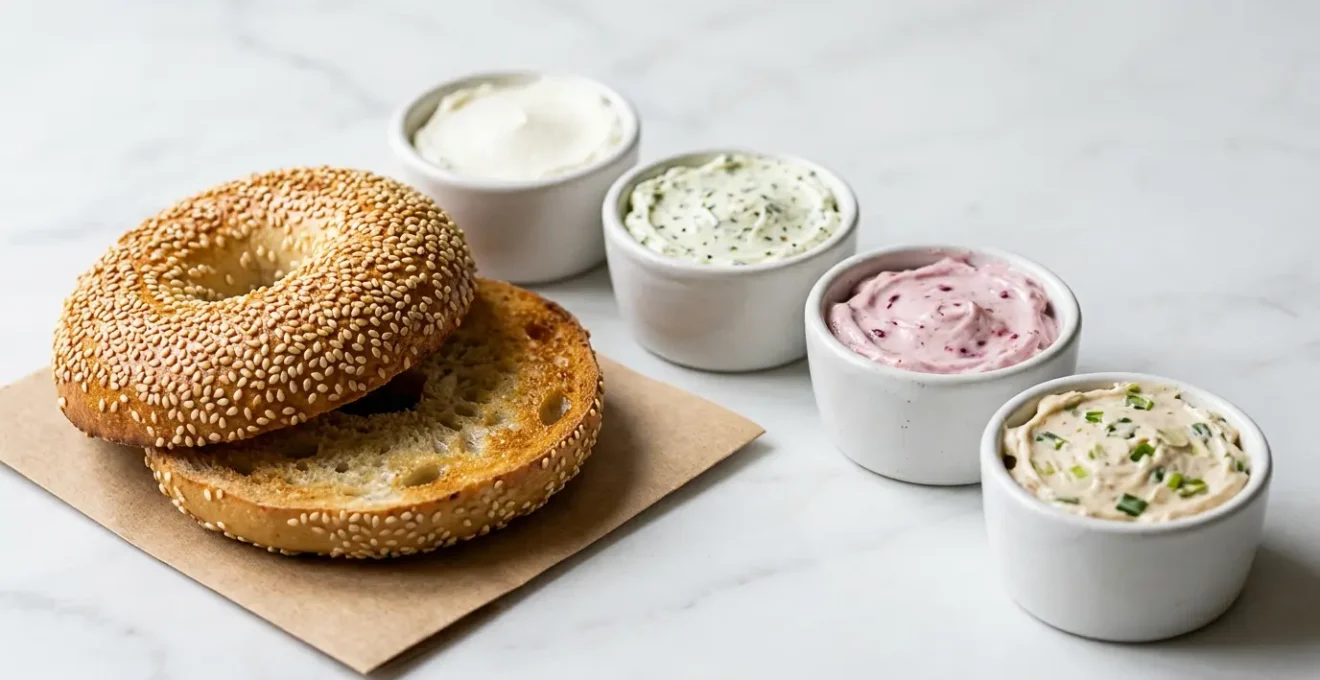
The perfect sesame bagel experience isn’t about a single flavor, but about mastering its “flavor architecture”—the interplay of texture, fat, and contrast.
- Savory spreads like scallion or herb provide a sharp, necessary counterpoint to the nutty sesame, while sweet-leaning cream cheeses often clash.
- The bagel’s own structure is critical; a hand-rolled bagel with its “flavor pockets” interacts with schmear completely differently than a machine-made one.
- Modern vegan cream cheeses, particularly those not based on tofu, can now rival dairy in providing the creamy, fatty vehicle needed for a balanced bite.
Recommendation: Think beyond cream cheese. The salty, fatty profile of cured meats like lox, prosciutto, or even bresaola offers a superior textural and flavor complement to a sesame bagel.
The sesame bagel sits on your plate, a perfect canvas of toasted, nutty potential. Yet, too often, we approach this masterpiece with a lack of imagination, reaching for the same uninspired swipe of plain cream cheese. It’s a safe choice, a reliable choice, but it’s rarely a revelatory one. The breakfast eater, bored with the standard schmear, knows this frustration all too well. The aisles offer endless tubs of flavors, from strawberry to jalapeño, but these often feel like random shots in the dark.
Many guides will simply list options: plain is a classic, scallion is a go-to, lox is for a special occasion. This approach, however, misses the entire point. It treats the bagel and its topping as two separate entities rather than a single, unified culinary experience. But what if the secret to elevating your sesame bagel wasn’t in finding a magic flavor, but in understanding a new philosophy? What if the key was to think like a flavor architect?
This isn’t just about what tastes good; it’s about *why* it tastes good. It’s about deconstructing the bite into its core components: the bagel’s texture, the schmear’s fat content, and the crucial role of textural and flavor counterpoints. This guide will move beyond simple suggestions to provide a framework for engineering the perfect bagel experience. We will explore the ideal schmear ratio, dissect the world of vegan alternatives, and even venture into the savory realm of cured meats to build a breakfast that is anything but plain.
To navigate this exploration of taste and texture, this article breaks down the essential components for the perfect pairing. Discover the science and art behind creating a truly memorable sesame bagel experience by diving into the topics that matter most.
Contents: A Flavor Architect’s Guide to the Sesame Bagel
- The “Schmear” Ratio: How Much is Too Much Cream Cheese?
- Tofu vs. Cashew Spreads: Which Vegan Cream Cheese Doesn’t Taste Like Chalk?
- Why Your Fresh Deli Cream Cheese Goes Bad in 3 Days
- DIY Scallion Spread: How to Replicate the Deli Taste for Cheap
- Philadelphia vs. New York Style: The History of the Cultured Curd
- Beyond Cream Cheese: The Best Salted Cured Meats for Everything Bagels
- Where to Buy Fresh Mozzarella That Was Made This Morning
- Hand-Rolled vs. Machine-Made: Why You Can Taste the Difference in a NYC Bagel?
The “Schmear” Ratio: How Much is Too Much Cream Cheese?
The debate over the perfect amount of cream cheese is less about volume and more about function. The “schmear” is not just a topping; it’s a structural and flavor medium. Its primary role is to provide a fatty, creamy base that lubricates the palate and acts as a vehicle for both its own flavor and that of the bagel. A thin, pathetic scrape fails this duty, leaving you with a dry, one-dimensional bite. Conversely, an over-the-top “glob” overwhelms the delicate, nutty notes of the sesame seeds, turning the bagel into a mere delivery system for dairy.
The ideal ratio is what we’ll call the “structural schmear”: enough cream cheese to create a distinct layer, approximately half the thickness of the bagel slice itself. This provides the necessary richness and mouthfeel that consumers crave. This isn’t just an opinion; even in the plant-based world, the desire for substance is paramount. In fact, a desire to “Increase richness” was the top request for cream cheese in a major blind taste test of non-dairy products.
This richness is what allows other flavors to shine. A proper schmear provides the cooling, fatty counterpoint needed to balance sharper flavors. As the Bagel Mill culinary team notes, “The nuttiness of a sesame bagel pairs well with scallion cream cheese for a fresh, slightly sharp contrast.” This contrast only works if there’s enough cream cheese to stand up to the assertive scallion, proving that the right ratio is fundamental to the entire flavor architecture.
Tofu vs. Cashew Spreads: Which Vegan Cream Cheese Doesn’t Taste Like Chalk?
For years, the term “vegan cream cheese” was synonymous with a chalky, gritty tragedy, often tasting more of its base ingredient—usually tofu—than anything resembling a creamy spread. The primary failure was an inability to replicate the essential role of dairy fat as a flavor vehicle. Tofu spreads often have a watery, thin consistency that fails to deliver a satisfying, rich mouthfeel. This textural mismatch is immediately apparent and dooms the pairing from the start.
However, the plant-based world has evolved dramatically. The new generation of vegan cream cheeses has largely moved away from tofu towards nut and oat bases, with a focus on emulating the texture of dairy. Cashew-based spreads, in particular, offer a higher fat content that results in a smoother, creamier consistency with a natural sheen, far closer to the real thing. The visual difference is a clear indicator of the textural experience to come.
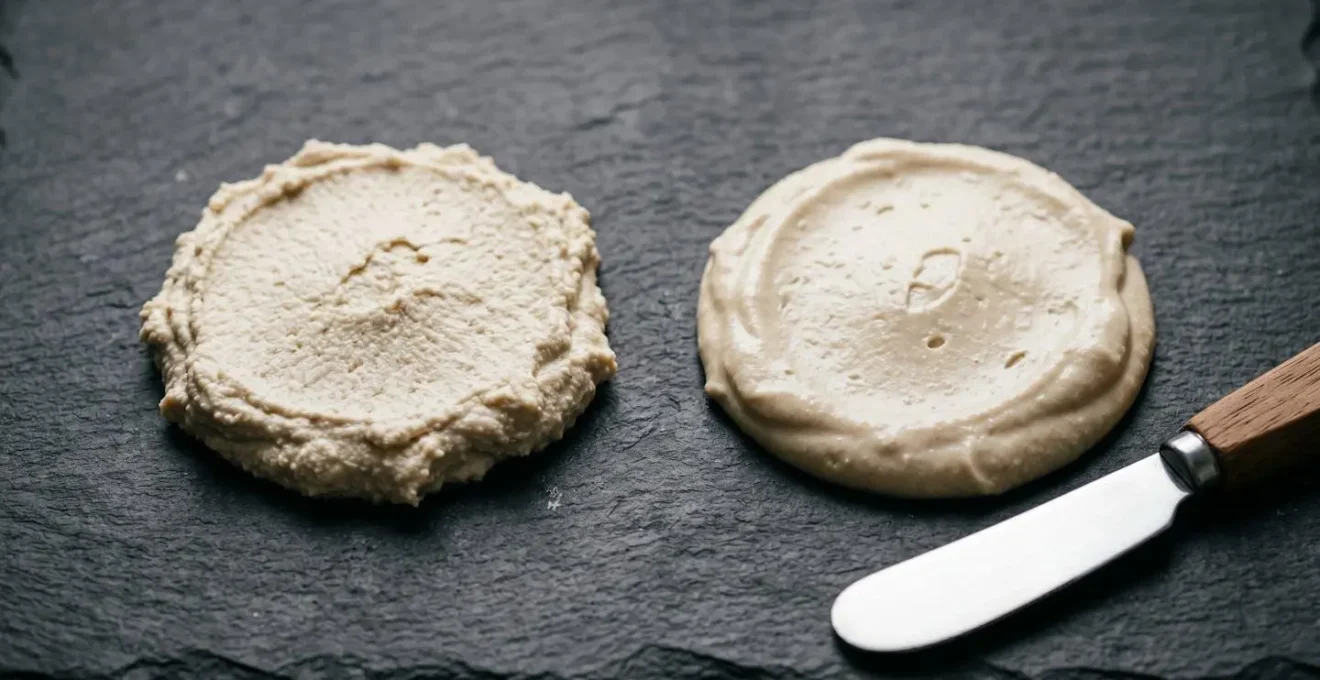
As you can see, the cashew-based spread on the right has a more uniform, luxurious texture compared to the slightly grainier tofu-based alternative. This isn’t just aesthetic; it’s functional. A comprehensive taste test of 9 vegan cream cheese brands confirmed that ingredient choice is paramount. The study found that an oat-based cream cheese from Wayfare had a texture “extremely close” to dairy, while the classic tofu-based Tofutti, despite its longevity, had a texture and taste described as “off.” For a sesame bagel, choosing a modern, fat-forward vegan spread is crucial to avoid a chalky disaster and achieve a truly complementary pairing.
Why Your Fresh Deli Cream Cheese Goes Bad in 3 Days
That tub of freshly whipped scallion cream cheese from your local deli tastes transcendent on day one, pretty good on day two, and suspiciously tangy by day three. This rapid decline isn’t your imagination; it’s a direct result of what makes it so delicious in the first place. Unlike its supermarket counterparts, deli cream cheese is a “fresh” cheese with minimal preservatives, often whipped with air and other ingredients, dramatically increasing its perishability.
The key difference lies in the production method. Commercial brands like Philadelphia use a “hot-pack” method, pasteurizing the cheese at a high temperature (around 170°F) and sealing it while hot. This process kills off bacteria and creates a vacuum seal, giving it a long shelf life. In contrast, most deli cream cheese is “cold-packed.” It’s either made in-house or sourced from a producer who ships it in large, unsealed tubs. The deli then whips it, adding ingredients and exposing it to air and potential contaminants. The result is a product with a much shorter lifespan.
According to food safety data, cold-packed cream cheese is good for just 2-3 weeks unopened, a stark contrast to the 3-6 month shelf life of hot-pack varieties. Once opened and whipped at the deli, that clock speeds up significantly. As the culinary experts at Food Republic explain, “As a fresh, unaged cheese, cream cheese tastes best when it is first opened, and quickly loses freshness as it dries out or absorbs odors from the fridge.” That off-taste you detect on day three is the beginning of spoilage, a sign that your window for perfect bagel enjoyment has closed.
DIY Scallion Spread: How to Replicate the Deli Taste for Cheap
Paying a premium for that tub of deli-made scallion cream cheese can feel steep, especially when you realize how simple and inexpensive it is to replicate—and even improve—at home. Taking control of the process allows you to master your own flavor architecture, adjusting the scallion’s sharpness, the creaminess of the base, and ensuring ultimate freshness. The key isn’t a secret ingredient, but a series of small, crucial techniques that separate amateur efforts from a truly deli-worthy spread.
The foundation of any great flavored spread is the base cream cheese itself. Always start with a full-fat block of cream cheese, not the whipped variety in a tub. The block provides the dense, rich starting point necessary for a luxurious final texture. The following steps, adapted from professional bakers and deli masters, will guide you to creating a superior scallion spread that holds its own against any store-bought version. For more flavor inspiration, you can explore guides on making various homemade cream cheese flavors.
Your Blueprint for Deli-Style Scallion Spread
- Soften cream cheese: Bring a full-fat block to room temperature (no more than 2 hours) to ensure smooth, lump-free blending.
- Whip the base: Use a hand mixer or stand mixer to blend the cream cheese until it is perfectly smooth and airy before adding any other ingredients.
- Prepare the scallions: Finely chop fresh scallions (both green and white parts) and let them sit with a pinch of salt for 10 minutes. This “maceration” step draws out excess water, preventing a soggy spread.
- Combine and chill: Gently fold the salted scallions into the whipped cream cheese. For best results, chill the finished spread for at least 2 hours to allow the flavors to meld and mature.
- Store for freshness: Keep your homemade spread in an airtight container in the fridge. Always use a clean utensil for serving to prevent contamination and extend its life.
By following this simple blueprint, you not only save money but also create a product that is fresher and more flavorful than most pre-packaged options. Your sesame bagel will thank you.
Philadelphia vs. New York Style: The History of the Cultured Curd
The term “cream cheese” seems universal, but the curd itself tells a tale of two cities—or rather, two philosophies. On one hand, there is the global standard: Philadelphia. Developed in New York but named for Philadelphia to evoke a sense of quality, it represents an industrial triumph. It’s known for its remarkable consistency, smooth texture, and mild flavor, achieved through a stabilized, hot-pack process. It’s the reliable, predictable base that has become the benchmark for cream cheese worldwide.
On the other hand, there is the more elusive “New York style” cream cheese. This isn’t a brand but a method, rooted in the city’s dairy and bagel shop traditions. It’s typically a fresh, cultured product with a looser, often whipped texture and a more pronounced tangy flavor profile. This tang is a hallmark of a more active culturing process, which creates a more complex and less one-dimensional taste. It’s the difference between a mass-produced pop song and a live jazz improvisation—one is perfect and clean, the other is vibrant and full of character.
The heart of this difference lies in the traditional methods that predate industrial stabilization. The process of making a true cultured cheese involves allowing curds to drain naturally, concentrating the flavor and creating a distinct texture that simply cannot be replicated on a massive scale. This artisanal approach is the soul of what many consider authentic “bagel shop” cream cheese.

This image captures the essence of that traditional process—the slow, patient craft of creating a cultured curd. The resulting cheese has a deeper flavor profile that can stand up to a hearty bagel, providing a tangy counterpoint that Philadelphia’s mildness can’t quite match. For a sesame bagel, a New York-style cultured cream cheese offers a superior flavor architecture, adding its own layer of complexity to the nutty base.
Beyond Cream Cheese: The Best Salted Cured Meats for Everything Bagels
While the title points to everything bagels, the principle of pairing savory proteins with a schmear is a universal truth in the bagel world, and it applies perfectly to the nutty canvas of a sesame bagel. The ultimate textural and flavor counterpoint to a rich, creamy schmear is not another flavor *in* the cream cheese, but the salty, fatty, and chewy bite of a well-chosen cured meat. This elevates the bagel from a simple breakfast to a substantial, sandwich-like experience, building a far more complex flavor architecture.
The cream cheese, in this scenario, reverts to its purest role: a cooling, tangy fat that balances the salt and spice of the meat. Plain, scallion, or horseradish cream cheese are the best choices here, as they support the main flavor without competing. A detailed analysis of bagel upgrades highlights how different meats interact with cream cheese to create a harmonious sensory payload. The key is to match the intensity of the meat with the right type of schmear and to consider how the sesame bagel’s nutty notes will fit into the equation.
| Cured Meat | Recommended Cream Cheese Type | Flavor Bridge Principle | Sesame Bagel Compatibility |
|---|---|---|---|
| Lox (smoked salmon) | Plain or scallion | Fatty richness balanced by tangy cream cheese; capers add acidity | Excellent – nutty sesame complements fish oils |
| Pastrami | Plain or horseradish | Peppery spice tempered by cool, neutral cream cheese | Very Good – sesame adds textural contrast |
| Prosciutto | Honey-walnut or fig | Salty-sweet balance; cream cheese adds creamy richness | Good – sweet cream cheese enhances sesame nuttiness |
| Hot Soppressata | Plain | Spicy heat cooled by neutral, fatty cream cheese | Very Good – sesame provides nutty foundation |
| Bresaola | Lemon-dill or herb | Earthy meat complemented by bright, herbal cream cheese | Excellent – sesame won’t overpower delicate beef |
This matrix demonstrates a clear principle: the meat is the star, and the cream cheese is its perfect supporting actor. For a sesame bagel, the classic lox or the delicate, earthy bresaola are particularly outstanding choices, as their flavors don’t overwhelm the bagel’s inherent nuttiness.
Where to Buy Fresh Mozzarella That Was Made This Morning
The quest for ultimate freshness—whether it’s mozzarella made this morning or the perfect bagel topping—is what separates a good breakfast from a great one. While warm, fresh mozzarella is a delight in its own right, the principle of peak freshness is most famously embodied in the world of bagels by another iconic pairing: lox and cream cheese. This combination is not merely a topping; it’s a testament to the power of high-quality, fresh ingredients working in perfect harmony.
The undisputed king of the bagel-and-meat world is lox, a Cured (but not smoked) or cold-smoked salmon. When draped over a generous schmear on a sesame bagel, it creates a flavor architecture that is almost unimprovable. The key to its success lies in the interplay of fats. The omega-3-rich oils in the salmon meld with the dairy fat of the cream cheese, creating a luxurious, mouth-coating texture. The salt from the cure is tempered by the cool, tangy schmear, while the nutty sesame provides a foundational crunch and earthy note.
This isn’t just a nostalgic favorite; it is a technically perfect pairing. According to the culinary editors at Tasting Table, this synergy is the very definition of indulgence. As they put it, “The creaminess of the cream cheese and the fattiness of the lox work together in perfect harmony to make a breakfast bite that feels deeply indulgent.” Adding traditional accouterments like capers (for a briny pop), red onion (for a sharp bite), and fresh dill only enhances this flawless structure, adding more layers of complexity to an already perfect pairing.
Key Takeaways
- Think in terms of “Flavor Architecture”: The goal is a balanced structure of fat, texture, and contrast, not just finding a single “best” flavor.
- The Bagel is Half the Battle: A hand-rolled bagel with a chewy crust and open crumb creates “flavor pockets” that fundamentally change the schmear experience.
- Go Beyond the Schmear: The salty, fatty profile of cured meats like lox, bresaola, or even prosciutto often provides a more satisfying and complex pairing than flavored cream cheese alone.
Hand-Rolled vs. Machine-Made: Why You Can Taste the Difference in a NYC Bagel?
The final, and perhaps most overlooked, element of the flavor architecture is the bagel itself. We obsess over toppings, but the foundation’s quality dictates the entire experience. The critical distinction lies between a traditional hand-rolled bagel and its ubiquitous machine-made counterpart. The difference is not just romanticism; it’s a matter of physics and gluten structure that profoundly impacts how the bagel interacts with cream cheese.
A detailed analysis of the structural differences between bagel types reveals the science. Hand-rolling the dough creates a stronger, more developed gluten network. When boiled and baked, this results in a bagel with a taut, chewy crust and a light interior characterized by shiny, elongated, and irregular holes. These are not flaws; they are “flavor pockets.” These pockets don’t just absorb the cream cheese; they trap it, creating bites with varying concentrations of schmear. This textural dynamism is a key feature of a superior bagel experience.
Machine-made bagels, in contrast, require a softer dough to function in the machinery. This results in a uniform, cake-like crumb with small, evenly distributed holes. The texture is softer, less chewy, and lacks the structural integrity to create flavor pockets. The cream cheese is absorbed evenly, leading to a more monotonous, one-note bite. As bagel expert Peter Shelsky noted for Atlas Obscura, “The bagels prized by New Yorkers, with their puffy insides and shiny exteriors, are still best crafted by hand.” For a sesame bagel, the superior chew and flavor-trapping ability of a hand-rolled specimen makes it the undeniable champion, ensuring every bite is a perfect blend of nutty crunch, chewy dough, and creamy schmear.
Armed with these principles of flavor architecture—from the schmear ratio to the very structure of the bagel itself—it’s time to approach your next breakfast not as a routine, but as a delicious experiment. Seek out a hand-rolled bagel, be discerning about your schmear’s freshness and texture, and don’t be afraid to venture beyond the tub of cream cheese. Evaluate the possibilities and engineer the sesame bagel experience you truly deserve.