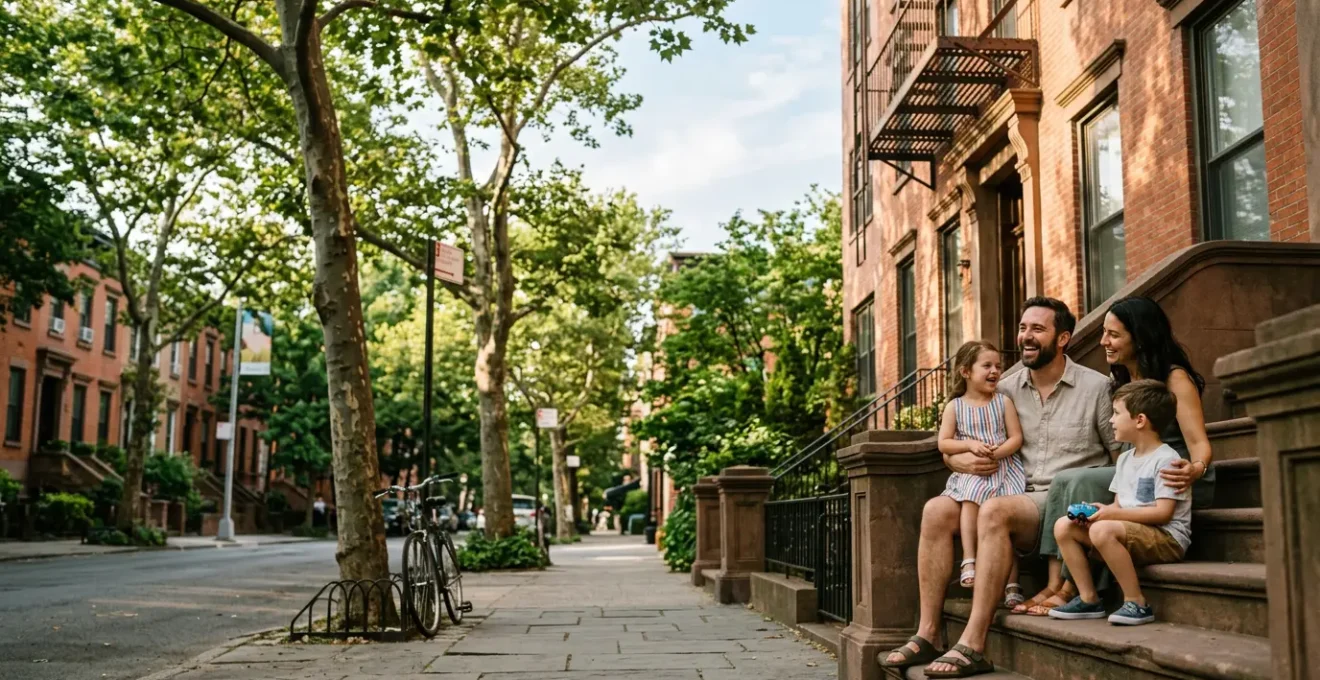
Raising a family in New York City doesn’t mean sacrificing a sense of community. The secret isn’t finding the perfect “family-friendly” neighborhood, but actively building your own ‘Chosen Family.’ This guide shows you how to master the unwritten rules of the city’s micro-communities—from playgrounds to childcare—and transform from a resident into a true community architect, creating a supportive village right here in the five boroughs.
I remember the moment vividly. Pushing a stroller through a sea of anonymous faces, I felt a pang of doubt. I loved the electric hum of New York, the endless opportunities, the culture pulsing from every street corner. But for my kids? I yearned for that mythical “village”—the friendly nods from neighbors, the impromptu park playdates, the feeling that someone had your back. The common advice felt like a compromise: move to the suburbs or resign yourself to a few sterile “mommy and me” classes. For years, I believed the chaos was the price of admission for raising a family here.
But I was looking at it all wrong. The magic of New York is that it’s not one massive, impersonal metropolis; it’s a mosaic of a thousand tiny villages. Finding your place isn’t about stumbling upon the right one. It’s about learning how to build it. The key isn’t geography; it’s a mindset shift. It’s about becoming a community architect, intentionally weaving a network of friends who become your ‘Chosen Family.’ This isn’t just about finding playdates; it’s about creating the social infrastructure that makes this huge city feel like home.
This guide isn’t another list of “best family neighborhoods.” Instead, it’s a playbook from a parent who’s been in the trenches for 15 years. We’ll decode the city’s practical challenges, explore the unwritten social rules that turn strangers into allies, and give you a framework to not just survive, but truly thrive as a family in the greatest city in the world. You can have the culture and the community, the opportunity and the village. You just have to know how to build it.
In this guide, we’ll walk through the essential building blocks for creating your New York City village, from mastering daily logistics to making the biggest decisions for your family’s future.
Table of Contents: How to Create Your NYC Village
- How to Navigate the Subway with a Stroller Without Hating Humanity
- The Unwritten Rules of NYC Playgrounds Every Parent Must Know
- Nanny vs. Daycare in NYC: Which Option Makes Sense for Dual-Income Families?
- Where to Find “Village” Vibes Inside Massive Boroughs Like Queens
- When to Escape the Concrete Jungle: 3 Nature Spots Accessible by Train
- Brooklyn vs. Queens: Which Borough Offers Better Public Schools for Young Kids?
- The “Silent Gap”: Why Grandparents and Grandkids Can’t Communicate
- Which NYC Borough Fits Your Lifestyle Best: A Decision Framework for Relocation?
How to Navigate the Subway with a Stroller Without Hating Humanity
Let’s start with the first test of any NYC parent’s resolve: the subway. It can feel like an impossible obstacle course designed by someone who has never met a child. The noise, the crowds, the stairs… oh, the stairs. It’s easy to feel defeated before you even leave your apartment. The reality is, navigating the subway with a stroller is less about strength and more about strategy. It’s your first lesson in becoming a community architect: learning to work with the city, not against it, and accepting the help of your fellow New Yorkers.
The hard truth is that the system isn’t built for us. It’s a jarring fact that only 32% of NYC subway stations are accessible, meaning elevators are a luxury, not a given. This single statistic changes your entire approach. You can’t just show up and hope for the best. You need a plan. This means investing in a lightweight stroller (under 15 pounds is a godsend) that you can realistically carry up a flight of stairs, because you will have to. But it also means learning to read the human landscape. You’ll be surprised how many strangers will offer a hand. Say yes. This isn’t a sign of weakness; it’s your first step in building micro-connections.
Mastering the subway is a rite of passage. It teaches you to be prepared, to be flexible, and to see the kindness in strangers. Once you’ve conquered a crowded 4 train at rush hour with a toddler and a stroller, you’ll feel like you can do anything. Here’s how to make it manageable:
- Get the Right Gear: A lightweight, easy-to-fold stroller is non-negotiable. Think of it as your all-terrain vehicle for the urban jungle.
- Plan Your Route Digitally: Use the MTA app or Citymapper before you leave. They have accessibility filters that show you which stations have elevators and if they are currently in service. This is your lifeline.
- Master the “Stair Assist”: When a kind stranger offers to help you carry the stroller, accept! The unspoken rule is they take the front (heavier) end, and you take the handles. It’s a small, fleeting moment of community in action.
- Position Yourself on the Platform: Wait near the conductor’s car (usually in the middle of the train). They are more likely to see you and hold the doors for an extra second.
It’s about turning a moment of stress into an opportunity for a shared, human experience. That’s the New York way.
The Unwritten Rules of NYC Playgrounds Every Parent Must Know
If the subway is the training ground, the playground is where you truly start building your village. These patches of rubber mulch and steel are the de facto community centers for families with young children. This is where you’ll meet the parents who will become your emergency contacts, your sounding boards, and your 9 AM coffee companions. But like any social ecosystem, NYC playgrounds have their own intricate, unwritten rules. Understanding this etiquette is key to moving from a silent observer to an active member of the micro-community.
The number one rule is to be present. This doesn’t just mean watching your child; it means being open to interaction. A simple “He loves that slide!” to another parent can be the start of a real friendship. It’s a space of shared experience, and acknowledging that is the first step. You’ll also learn that playground toys are communal property by default. Don’t bring a beloved toy unless you’re prepared for it to be used (and potentially lost) by half the kids there. Instead, see it as an offering, a way to break the ice.

These small interactions, as shown above, are the threads you’ll weave into a real social safety net. The most important thing to remember is that everyone is in the same boat. We’re all trying to keep our kids safe, happy, and entertained. Leading with empathy and a friendly smile goes a long way. Violating these norms—like helicopter parenting other people’s children or being stingy with snacks (after asking, of course)—is the quickest way to be unofficially ostracized. The playground is a social dance, and learning the steps is essential.
- Supervise Actively: Your phone can wait. Engage with your child and be ready to gently mediate turn-taking on the swings. It shows other parents you’re a team player.
- Share the Wealth: If you bring toys or snacks, bring enough to share or be prepared for them to be considered community goods. And always, always ask a caregiver before offering food to their child. Allergies are serious.
- Respect the “No Adults Without Kids” Rule: Many NYC playgrounds enforce this. It’s about creating a safe space for children, and respecting that boundary shows you’re part of the protective fabric of the community.
- Use Positive Language: Model the behavior you want to see. Instead of “Don’t do that!” try “Let’s try climbing this way.” It sets a collaborative, respectful tone for the whole playground.
By contributing to this positive, shared environment, you’re not just parenting your child; you’re helping to build the village for everyone.
Nanny vs. Daycare in NYC: Which Option Makes Sense for Dual-Income Families?
Once your child is old enough, the childcare decision looms large. For many dual-income families, this feels like a purely financial and logistical choice. But in the context of building your village, it’s one of the most critical decisions you’ll make. Your choice between a nanny and daycare isn’t just about cost; it’s about choosing your social infrastructure. It will fundamentally shape the community you and your child grow into for the next several years.
Daycare offers a built-in community. Your child enters a cohort of kids, and you are instantly connected to a group of local families navigating the same stage of life. These are the parents you’ll see at drop-off and pick-up, the families you’ll invite to birthday parties, and the people who will understand exactly what you’re going through. The “Community Multiplier” effect is high. A nanny, on the other hand, offers flexibility and one-on-one attention but can be more isolating. Building community with a nanny requires more deliberate effort, such as organizing meetups or, ideally, creating a nanny share.
A nanny share is the gold standard for blending the benefits of both. By sharing a nanny with another family, you not only split the cost but also create an instant, intimate ‘Chosen Family.’
Case Study: The Park Slope Nanny-Share Success
One family in Park Slope perfectly illustrates this. By structuring a nanny-share, they effectively created what they called a “chosen family” dynamic. This arrangement, which they sourced through local parent networks, did more than just reduce costs. It forged a deep bond between the two families, who now coordinate everything from weekend plans to vacation schedules and provide backup childcare for each other. The key, they noted, was treating the partnership as a long-term community investment, aligning on parenting philosophies and committing to open communication. It became the bedrock of their social life.
The financial breakdown is stark and often makes the decision for you, especially if you have more than one child. While daycare costs per child can be staggering, a nanny’s rate is often flat, making it more economical for two or more kids. This table breaks down the core differences from a community-building perspective.
| Factor | Daycare (NYC) | Full-Time Nanny (NYC) |
|---|---|---|
| Monthly Cost (Infant) | $2,400 – $3,100 | $4,600 – $6,000 |
| Community Multiplier | High – Built-in cohort of local families for playdates and networks | Variable – Depends on nanny-share structure or arranged meetups |
| Cost for 2 Children | $4,800 – $6,200 (doubles) | $4,600 – $6,000 (flat rate) |
| Social Radius | Immediate neighborhood – connects you with local families | Flexible – can be nanny’s community or specialized center location |
| Backup Care | Built-in – center remains open if teacher is sick | No backup – parent must find alternative care |
| Best For | Single child families seeking community and peer interaction | Two+ children or families needing flexible schedules |
This data, based on an analysis of New York childcare costs, highlights the trade-offs. The decision hinges on what you prioritize: the ready-made community of daycare or the flexibility and potential for a deep, family-like bond in a nanny share.
Either way, view this choice as an active step in your role as a community architect, not just a line item on your budget.
Where to Find “Village” Vibes Inside Massive Boroughs Like Queens
So, how do you actually find these pockets of community? It’s not about looking for a specific zip code. It’s about learning to spot the indicators of a healthy, engaged neighborhood. A “village vibe” isn’t an accident; it’s the result of active residents and strong local institutions. You can find it in the high-rises of Long Island City just as you can on the tree-lined streets of Forest Hills. You just need to know what to look for.
The key is to look beyond real estate listings and search for signs of social infrastructure. These are the “third places” where community happens organically: the independent bookstore where the owner knows your name, the coffee shop with a chaotic but beloved community bulletin board, the library with a passionate children’s librarian who organizes engaging story times. These are the places that serve as the neighborhood’s living room. A neighborhood with a high density of these places is one where community is valued.
Another strong indicator is the presence of an active block association or neighborhood group. Do you see flyers for a stoop sale, a park cleanup day, or a holiday block party? These are signs of a community that actively works to connect with each other. It shows that residents are invested not just in their own apartments, but in the collective well-being of their block.
Case Study: Building a Village in Long Island City
Long Island City (LIC) is a perfect example. What was once an industrial zone transformed into a vibrant family neighborhood, not by accident, but through deliberate effort from its residents. In a landscape of seemingly anonymous glass towers, parents created a village atmosphere. They established informal parent networks at the waterfront parks, organized regular playgroups with stunning Manhattan views, and used local cultural hubs like MoMA PS1 as gathering points for family outings. This proves that a “village” is about people, not just brownstones.
To help you in your search, think of it like a litmus test. When you explore a potential neighborhood, don’t just look at the apartments; look for these signs of life.
Your Village Vibe Checklist: How to Spot a Strong Community
- Active Block Associations: Look for signs of organized neighborhood events, cleanups, or seasonal celebrations. This shows an engaged and invested resident base.
- Beloved Local Institutions: Are there independent bookstores, family-run cafes, or multi-generational businesses where staff and regulars are on a first-name basis?
- Thriving “Third Places”: Check out the local library, coffee shops, and parks. Are they vibrant hubs with community bulletin boards and regular gatherings, or are they empty and sterile?
- “Stoop Culture”: Walk the residential streets. Are there front stoops, porches, or benches where neighbors are likely to interact naturally? Or is the only entry point an impersonal lobby?
- Multi-Generational Presence: Do you see a mix of young families, older residents, and everything in between? This indicates long-term commitment and stability in the neighborhood.
Your perfect village is out there. This checklist will help you recognize it when you see it.
When to Escape the Concrete Jungle: 3 Nature Spots Accessible by Train
Part of what makes living in New York City sustainable for families is knowing how and when to escape it. The relentless energy that draws us here can also wear us down. Building a healthy family life in the city means embracing the beautiful paradox of being a New Yorker: our deep appreciation for nature often comes from its very absence. The good news is, you don’t need a car to decompress and let your kids run free in the woods.
The Metro-North and LIRR train lines are your secret passages to a different world. For the price of a train ticket, you can trade sirens for birdsong and skyscrapers for towering trees. These day trips are more than just a change of scenery; they are a crucial release valve. They reset your family’s nervous system and remind you that the “concrete jungle” is surrounded by actual jungles (or at least, beautiful state parks). Making these escapes a regular part of your family rhythm is essential for long-term happiness here.

The journey itself is part of the magic. Watching the dense urban landscape slowly dissolve into lush greenery from the train window is a form of therapy. It’s a tangible transition from one state of being to another, and it helps everyone, especially little ones, to shift gears. Planning these escapes gives the whole family something to look forward to and punctuates the urban routine with moments of natural wonder. Here are three reliable, train-accessible escapes:
- Cold Spring, NY (Metro-North): A charming 19th-century town nestled on the Hudson River. The train drops you right in the heart of Main Street, filled with ice cream shops and antique stores. From there, it’s a short walk to trailheads leading into Hudson Highlands State Park for some incredible, kid-friendly hikes with breathtaking river views.
- Bear Mountain State Park, NY (Metro-North): Take the train to Peekskill and a short taxi ride to the park entrance. Bear Mountain offers everything a family could want: a beautiful lake with paddle boats, a swimming pool, a lovely merry-go-round featuring hand-carved local animals, and miles of trails, including a portion of the Appalachian Trail.
- Fire Island, NY (LIRR): Take the LIRR to Sayville and a ferry to a world without cars. Walking the boardwalks of communities like Sailor’s Haven, with the ocean on one side and the bay on the other, is the ultimate urban detox. It’s a perfect beach day escape that feels a world away from the city.
These trips aren’t a rejection of the city; they’re what makes loving the city possible, year after year.
Brooklyn vs. Queens: Which Borough Offers Better Public Schools for Young Kids?
For many families, the public school decision is the ultimate test of their commitment to New York City. It’s a notoriously complex and often stressful process. The question of “Brooklyn vs. Queens” isn’t just about test scores; it’s about finding a school community that aligns with your family’s values. The school your child attends will become the epicenter of your social world, so choosing one is about much more than academics. It’s about choosing your tribe.
As one parent wisely noted in an interview, the reality of the system is stark and hyper-local.
NYC public schools are zoned by what neighborhood you live in, and the difference between neighborhoods can be glaring and even within the neighborhoods some schools are great and others are not.
– Brooklyn parent interviewed by Luna Magazine, Luna Magazine article on raising kids in New York City
This is the fundamental truth. There is no “best” borough, only the best school zone *for you*. The school’s culture is a direct reflection of its neighborhood. This is where the stereotypes often hold a grain of truth. Certain Brooklyn neighborhoods are known for a specific kind of high-achieving, intense parental involvement, while many Queens neighborhoods foster a more laid-back, multicultural community spirit. Neither is inherently better; they just offer different social dynamics.
School Culture Showdown: Brownstone Brooklyn vs. Family-Friendly Queens
A comparison of school communities reveals these distinct vibes. In Brooklyn’s brownstone belt (like Park Slope or Carroll Gardens), you’ll often find hyper-involved PTAs with massive fundraising goals and a competitive atmosphere around gifted-and-talented programs. It’s a culture of intense engagement. In contrast, Queens neighborhoods like Bayside or Forest Hills often feature wonderfully diverse, multi-ethnic school communities. The emphasis may be less on cutthroat competition and more on celebrating cultural diversity as a learning asset. For example, Astoria alone has around 20 schools, with places like P.S. 122 known for both academic rigor and deep community involvement. The key distinction is the social currency: in some Brooklyn circles, it’s about achievement; in many Queens communities, it’s about inclusive cohesion.
This choice directly impacts your village-building. Do you thrive in a high-energy, high-achieving environment where parents are deeply involved in supplementing school budgets? Or do you prefer a more relaxed, diverse community where potlucks and cultural fairs are the main social events? Your answer will guide you to the right borough and, more importantly, the right neighborhood school zone for your family to put down roots.
You’re not just choosing a school; you’re choosing the community that will help shape your child for years to come.
The “Silent Gap”: Why Grandparents and Grandkids Can’t Communicate
One of the quiet challenges of raising a family in New York is the distance. The “silent gap” isn’t always about a generational divide in communication styles; often, it’s a literal, physical gap. The grandparents, aunts, uncles, and cousins who form the traditional “village” are often hundreds, if not thousands, of miles away. This reality is at the very heart of why becoming a community architect here is not just a nice idea—it’s an absolute necessity.
When you don’t have a built-in family support system, you have no choice but to create one. This is what I call the ‘Chosen Family.’ It’s a mosaic of friends and neighbors who become your emergency contacts, your holiday dinner guests, your “can you watch the baby for an hour” lifelines. They are the people who show up. This is a near-universal experience for transplant parents in NYC, and it’s a powerful, bonding force.
Hailey Andresen, a fellow Brooklyn parent, articulated this experience perfectly in an interview, and it has stuck with me ever since.
I know very few people who actually were born and raised in New York City, so we’re all just kind of going at life without too many family members close by. This can absolutely have its challenges, but it’s truly taught me the importance of finding my village and making family out of friends.
– Hailey Andresen, Brooklyn parent and Household Mag founder, Extra Space Storage interview on raising families in NYC
This is the secret. The lack of biological family nearby is the catalyst that forces you to build a community that is arguably even more intentional and, in some ways, stronger. You choose these people. You invest in these relationships because you have to, and that shared vulnerability and reliance creates an incredibly powerful bond. You learn to lean on each other for everything from last-minute babysitting to emotional support during a toddler’s sleep regression.
This gap, this distance from grandparents, is not a deficit. It’s an opportunity. It’s the space where you build your own traditions, your own support system, your own unique New York City family. It’s what makes raising kids here such a uniquely challenging and deeply rewarding experience. You are not alone in this; you are surrounded by people doing the exact same thing.
Your village isn’t waiting for you back home; it’s waiting to be built, right here on your block.
Key Takeaways
- Building a community in NYC is an active skill, not a passive search. You must become a “community architect.”
- Childcare is a foundational community decision. Daycare offers a built-in network, while a nanny-share can create an intimate “Chosen Family.”
- Evaluate neighborhoods based on their “social infrastructure”—the third places, active associations, and stoop culture that foster connection.
Which NYC Borough Fits Your Lifestyle Best: A Decision Framework for Relocation?
Ultimately, all these pieces come together in the big decision: where to live. But by now, you understand that this question isn’t “Which borough is best?” but “Which borough’s community archetype best fits my family’s vision for a village?” You’re no longer just looking at square footage and commute times; you’re looking for a place where your family can build deep, lasting connections. This requires a framework that prioritizes lifestyle and community over simple statistics.
Each borough, and even each neighborhood within it, offers a different flavor of family life. Park Slope, Brooklyn offers the quintessential “stoop-and-stroll” lifestyle, with intense community engagement centered around Prospect Park. Bayside, Queens, provides a more suburban, “backyard BBQ” feel, where families trade walkability for green space and a quieter pace. The Upper West Side in Manhattan is for the “doorman and deli” family that prioritizes unparalleled access to culture above all else. Your job is to honestly assess what your family truly values.
This decision matrix can help you clarify your priorities and see how different neighborhoods align with them. It’s a starting point for a more intentional search.
The following table provides a framework for comparing different neighborhood archetypes across the city, focusing on the factors that truly contribute to a sense of community.
| Borough/Area | Community Archetype | Density of Third Places | Walkability to Parks | Median Home Price Range | Best For |
|---|---|---|---|---|---|
| Park Slope (Brooklyn) | ‘Stoop-and-Stroll’ family | High – cafes, bookstores, local shops | Excellent – Prospect Park access | $1M – $2M+ | Families seeking intense community engagement and cultural activities |
| Bayside (Queens) | ‘Backyard BBQ’ family | Moderate – Bay Terrace Shopping | Good – waterfront parks, Alley Pond | $442K – $1.5M | Families wanting a suburban feel with yards while staying in NYC |
| Upper West Side (Manhattan) | ‘Doorman and Deli’ family | Very High – museums, restaurants | Excellent – Central Park adjacent | $1.5M – $4M+ | Families prioritizing cultural access and convenience over space |
| Astoria (Queens) | ‘Village in the City’ family | High – diverse restaurants, parks | Excellent – Astoria Park | $2,200-$3,800/mo rent | Families seeking diversity, culture, and tight-knit urban community |
| Forest Hills (Queens) | ‘Suburban Compromise’ family | Moderate – Austin Street corridor | Excellent – Forest Park access | $580K – $1M+ | Families wanting tree-lined streets and quiet while maintaining city access |
But data can only take you so far. The most crucial step is the “Weekend Test Drive.” You have to experience a neighborhood’s rhythm firsthand. Spend a full weekend there, from a Saturday morning coffee run to a Sunday afternoon at the playground. This immersive experience will tell you more than any spreadsheet.
- Saturday Morning (8am-12pm): Grab coffee at a local spot. Walk residential streets and observe the morning routine. How many people are out walking dogs, saying hello on their stoops?
- Saturday Afternoon (2pm-5pm): Hit the main playground during peak hours. This is your primary research. Observe the parent dynamics. Are they cliquey or welcoming? Strike up a conversation.
- Saturday Evening: Have dinner at a family-friendly restaurant. Walk the commercial streets as the sun sets. Does the neighborhood feel safe and vibrant, or does it empty out?
- Sunday: Visit a farmer’s market or local library. See where the community gathers. This is your chance to feel the pulse of the neighborhood’s social life.
Your perfect New York City village exists. By being intentional, observant, and brave enough to say hello, you will find it—or better yet, you’ll build it yourself.