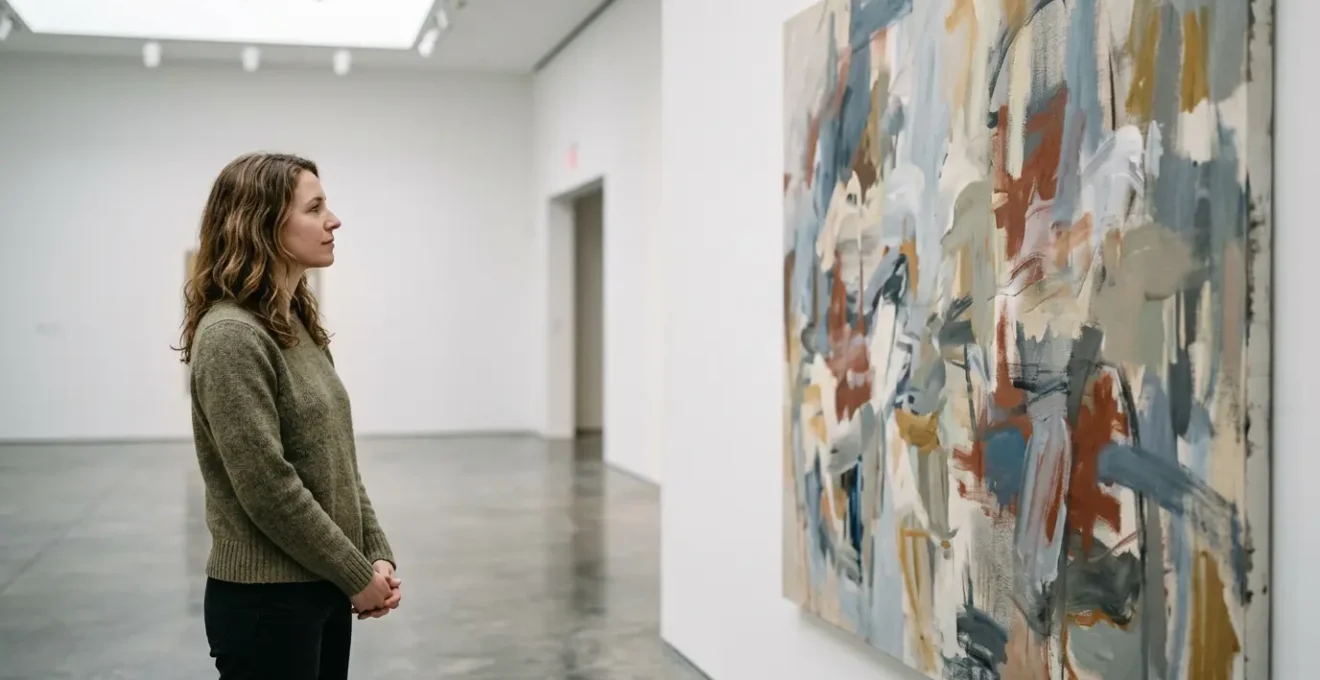
The biggest barrier to enjoying Chelsea’s art galleries isn’t a lack of art knowledge—it’s the fear of breaking unwritten social rules.
- Galleries operate on a “social script” where your presence and thoughtful attention are the expected currency, not your wallet.
- Practical tools, like a planned route and pre-vetted questions, replace anxiety with a clear sense of purpose.
Recommendation: Focus on understanding the context and your role as an engaged observer, not on being a potential buyer. This shift in perspective is the key to unlocking the entire experience.
The polished concrete floors, the cavernous white walls, the silent, impeccably dressed staff—walking into a Chelsea art gallery can feel like stepping onto a stage without a script. For many art-curious individuals, the “imposter syndrome” is overwhelming. You’re drawn to the creativity, but terrified of the elitist atmosphere. The common advice, “just walk in, it’s free,” completely misses the point. It fails to address the real fear: the fear of looking foolish, of not “getting it,” of asking the wrong question or wearing the wrong shoes.
This anxiety stems from not knowing the unwritten rules of engagement. The art world, especially at the gallery level, operates on a complex social code. It’s a subtle performance, and when you don’t know your lines, you feel like an outsider. But what if the key to unlocking this world wasn’t a degree in art history, but simply a copy of the script? What if you could learn the cues, understand the motivations, and navigate the space with the quiet confidence of a regular?
This is not a guide about what art to like. This is a guide that decodes the social dynamics of the gallery scene. We will move beyond generic tips and instead reveal the ‘why’ behind the intimidating facade. We will provide you with a practical route, demystify the taboo topic of money, explain the purpose of an opening night, and even use analogies from seemingly unrelated worlds—like theatre and nightlife—to give you a framework for confident participation. By the end, you won’t feel like an imposter; you’ll feel like an informed participant in New York’s cultural conversation.
To help you navigate this journey from outsider to insider, this guide is structured to build your confidence step-by-step. Below is a summary of the social codes and practical tools we will explore.
Summary: How to Visit Chelsea Art Galleries Without Feeling Like an Imposter?
- The “High Line” Route: How to Hit 5 Top Galleries in 2 Hours
- How to Ask “How Much is This?” Without Being Laughed At
- Thursday Night Openings: How to Drink Free Wine and Spot the Artist
- Why That Blank Canvas Costs $50,000: Art Valuation 101
- Is the Wine Really Free? The Unspoken Rules of Gallery Hospitality
- Off-Broadway vs. Broadway: Where to Find the Next “Hamilton” Before It Blows Up
- Selfie Bait vs. Public Art: What Makes a Structure Meaningful?
- Navigating Brooklyn’s Underground Rave Scene: Safety Tips for Solo Partiers
The “High Line” Route: How to Hit 5 Top Galleries in 2 Hours
The first step to overcoming gallery intimidation is having a plan. Wandering aimlessly can amplify feelings of being lost. A curated route gives you purpose and transforms a daunting neighborhood into a manageable checklist. The High Line isn’t just a park; it’s the perfect spine for a gallery tour, offering a scenic and stress-free path between some of the world’s most influential art spaces. This route is designed for efficiency and experience, allowing you to see a diverse range of art in a short amount of time.

The beauty of this plan is its structure. Think of each gallery as a chapter in a book and the walks along the High Line as your moment to process. These elevated sections act as a “palette cleanser”, giving you a mental break and a literal breath of fresh air before diving into the next white cube. This rhythm prevents the common feeling of being overwhelmed by too much visual information.
Here is a strategic path to get you started:
- Begin at the High Line’s Gansevoort Street entrance and take a moment to be near the impressive Whitney Museum.
- Exit at 20th Street for a quick visit to a major gallery like David Zwirner or nearby giants.
- Rejoin the High Line and walk north to the 23rd or 24th Street exits, where you’ll find a dense cluster of top-tier galleries, including Gagosian.
- Continue to 25th Street to explore more renowned spaces like Pace Gallery and Hauser & Wirth, which are hubs of activity.
- Finish your tour by returning to the High Line at 26th Street, feeling accomplished.
This isn’t just a walk; it’s a structured exploration. By following a map, you are no longer a lost tourist; you are a navigator. You have a mission, and that sense of purpose is the first armor against imposter syndrome.
How to Ask “How Much is This?” Without Being Laughed At
Nothing feels more “insider” than the topic of money in an art gallery. The absence of price tags is an intentional part of the social script. It creates a barrier, subtly suggesting that if you have to ask, you can’t afford it. This is a power play, but it’s one you can easily navigate. The secret is knowing the right way to ask. Blurring out “How much?” can feel clumsy. The goal is to signal that you understand the protocol, even if you’re just curious.
Instead of a direct question about a single piece, it’s often smoother to ask for the materials for the entire exhibition. This positions you as someone interested in the artist’s work as a whole. As the Austin Gallery notes in its guide on gallery etiquette, a simple, low-pressure phrase works best:
Simply ask a staff member, ‘Could I get the price list for this show?’ or ‘I’m interested in learning more about this piece — is there a price sheet available?’ Most galleries have one readily available.
– Austin Gallery, How to Talk to Artists: Confidence, Etiquette & the Right Questions
The staff member at the front desk (often called a gallerist or gallery assistant) will simply hand you a printed sheet or email it to you. There’s no judgment. This list is your key to the financial side of the show. It contains the title, dimensions, medium, and price of every piece. And yes, for established collectors, prices are often negotiable. While you may not be ready to haggle, it’s empowering to know that discounts are part of the business; a range of 5% to 15% is standard for collectors who have a relationship with the gallery. Knowing this demystifies the process, transforming it from a secret handshake into a standard business practice.
Thursday Night Openings: How to Drink Free Wine and Spot the Artist
If a typical gallery visit feels like a quiet library, a Thursday night opening is a full-blown party—and you’re invited. From 6 to 8 p.m., Chelsea transforms. Doors are propped open, wine is poured, and a river of people flows from one gallery to the next. For a novice, this is the single best way to experience the scene. The crowd provides anonymity, and the social buzz lowers the barrier to entry. You’re not a solitary, scrutinized viewer; you’re part of a collective event.
The Unofficial Invitation: Chelsea’s Thursday Night Ritual
The vast majority of Chelsea openings on Thursday nights are completely open to the public. There’s no bouncer or guest list for most. This tradition is a core part of the neighborhood’s art ecosystem, designed to create buzz and draw a crowd. The pattern is consistent almost year-round, pausing only for major holidays and a collective break in August. For the few “super-galleries” that do require an RSVP, you can often get on the list simply by subscribing to their email newsletter online.
The key is to understand the purpose of the event. The gallery is creating an atmosphere of celebration and accessibility. Your role is to participate. The artist is almost always present, though they might not be obvious. Look for the person who is being greeted by a constant stream of well-wishers or is in deep conversation near their work—that’s often them. You don’t need to speak to them, but simply identifying them helps you understand the event’s focal point.

The wine glass in your hand is more than a drink; it’s a social prop. It gives your hands something to do and makes you look like you belong. The trick is to treat it as such—a tool for navigating the social space, not an open bar. Holding a glass, you can linger in front of a piece of art with purpose. The bustling environment gives you the freedom to observe, listen to snippets of conversation, and absorb the energy of the art world without any pressure to perform.
Why That Blank Canvas Costs $50,000: Art Valuation 101
Perhaps the most baffling aspect of the art world for a newcomer is the pricing. How can a seemingly simple painting cost more than a luxury car? The answer has very little to do with the cost of paint and canvas. The price is determined by a concept called “institutional value.” This value is built not in the artist’s studio, but through a strategic career path managed by the gallery.
Think of the gallery as a market-maker. They are investing in an artist’s career, and every step they orchestrate adds to the artwork’s value. This is the difference between the primary and secondary markets.
Primary vs. Secondary Market: Building an Artist’s Value
The primary market is the first sale of an artwork, directly from the gallery representing the artist. The price is carefully set to build the artist’s long-term career. The gallery works to secure credentials: an MFA from a top school, prestigious artist residencies, inclusion in group shows, and eventually, a solo exhibition. The ultimate prize is a museum acquisition. Each step is like adding a line to a resume, and each line increases the price of all their work. The secondary market is any resale of that work, like at an auction. Here, prices can skyrocket if the artist has become famous, reflecting the success of the gallery’s initial market-building strategy.
This is why work sold in a top gallery commands a premium. It’s not just a painting; it’s a financial asset backed by a curated career. In fact, due to this built-in institutional validation and the gallery’s role, primary market prices are often significantly higher than what an unrepresented artist could ever ask for. Research shows that gallery prices are often set at a premium, sometimes 20-50% higher than auction estimates for similar works by emerging artists, because the gallery is selling the artist’s future, not just a single object. Understanding this shifts your perspective from “that’s a crazy price” to “I see the system behind that price.”
Is the Wine Really Free? The Unspoken Rules of Gallery Hospitality
The complimentary wine at a gallery opening is a classic part of the social script, but its purpose is often misunderstood. It’s not just a nice gesture; it’s a strategic tool of hospitality. It lowers inhibitions, encourages guests to linger, and creates a convivial atmosphere. However, there’s an implicit transaction taking place, one that operates within an “attention economy.”
The gallery isn’t running a charity bar. They are offering a small luxury in exchange for your engagement. Your “payment” is the time you spend looking at the art, the energy you add to the room, and the potential you represent as someone who might talk about the show later. As one industry observer puts it, the exchange is clear:
The wine isn’t free; you ‘pay’ for it with your attention. The gallery is offering a gesture of welcome in exchange for your thoughtful presence and engagement with the art.
– Art Gallery Circuit, Chelsea Gallery Tours Overview
Navigating this requires a certain etiquette. Abusing the hospitality by treating the opening as a pre-game for your night out is a rookie mistake and instantly marks you as an outsider. The goal is to participate gracefully. Use the wine as a social lubricant, not as the main event. Holding a glass gives you a reason to pause, to contemplate, and to move through the space with a sense of purpose. It’s a prop that helps you play your part as an engaged viewer.
Your Action Plan: Mastering Gallery Hospitality
- Observe Entry Points: When you arrive, locate the serving area but don’t rush to it. First, observe the flow of the room and take a quick lap to see the art.
- Collect Your Prop: Approach the bar, accept one glass of wine, and immediately move away from the high-traffic area to allow others access.
- Check for Coherence: Your primary purpose is to see the art. Use the glass as a prop to feel more comfortable while you do so. Consciously spend more time looking at the walls than at the bottom of your glass.
- Assess Your Engagement: Check your own intent. Are you mentally present and looking at the work, or just waiting to see a friend? Your thoughtful presence is the expected currency.
- Plan Your Integration: Plan to gallery-hop. Spend 15-20 minutes engaging with the art and atmosphere in one space before moving to the next. This shows respect for each gallery’s offering.
Off-Broadway vs. Broadway: Where to Find the Next “Hamilton” Before It Blows Up
To truly feel like an insider, it helps to reframe what a Chelsea gallery is. Think of the art world in terms of theatre. Museums like the MoMA or the Met are Broadway: they present the blockbuster hits, the established masterpieces, the “Hamiltons” of the art world that everyone already knows are great. A Chelsea gallery, on the other hand, is Off-Broadway. This is where the new, risky, and experimental work debuts. It’s where you can discover the next “Hamilton” before it ever hits the big stage.
This analogy is incredibly empowering for a novice visitor. It shifts your role from that of a student trying to understand the classics to that of a scout or a tastemaker looking for the future. You are not late to the party; you are arriving early. The art you see in Chelsea is, by definition, what is happening right now in the cultural conversation. Some of it will be brilliant and go on to museum collections. Some of it will be forgotten. The excitement lies in not knowing which is which.
When you walk into a gallery with this mindset, the pressure to “get” everything vanishes. You wouldn’t expect every Off-Broadway play to be a masterpiece, and the same is true for gallery shows. Your job isn’t to judge every piece against art history, but to react to it. Does it interest you? Confuse you? Excite you? By engaging with work at this nascent stage, you are participating in the process of cultural validation. Your attention, your conversations, and your presence are all part of the ecosystem that helps elevate an artist from Off-Broadway to the main stage.
Selfie Bait vs. Public Art: What Makes a Structure Meaningful?
Once you’re inside the gallery, another challenge arises: how do you look at the art? Without a guide, it’s easy to feel lost. A useful framework can be borrowed from the world of public sculpture: the distinction between “selfie bait” and meaningful art. “Selfie bait” is a work designed for superficial, photographic consumption. It’s visually appealing, instantly gratifying, and perfect for Instagram, but the engagement often stops there. Meaningful art, whether a public sculpture or a painting in a gallery, asks for more.
This isn’t to say visually fun art is bad, but to feel confident, you need to learn to look for deeper layers. When you approach a piece in a gallery, ask yourself questions that go beyond its “Instagrammability.”
- What is it made of? Look closely at the materials. Is it oil on canvas, or something unexpected like rust, fabric, or digital media? The artist’s choice of material is a fundamental part of the message.
- What was the process? Can you see the artist’s hand at work? Are there thick, expressive brushstrokes, or is the surface perfectly smooth and machine-like? The process tells a story of its own.
- What is the context? Read the small label next to the art. The title, date, and materials list are your first clues. Then, grab the press release or price list from the front desk. It often contains a short essay explaining the artist’s intent.
By engaging in this simple three-step inquiry, you are moving beyond a passive, “selfie bait” level of viewing. You are becoming an active investigator. You are looking for the artist’s intent and conceptual underpinnings—the very things that make a work meaningful. You don’t have to like it, but you will begin to understand it on its own terms. This active looking, this shift from consumer to detective, is a skill that builds immense confidence.
Key Takeaways
- Galleries are social spaces with scripts; learning the script is key to confidence.
- Asking about price is normal; use phrases like “May I see the price list?” to show you understand the protocol.
- The value of art is driven by “institutional value” (artist’s career, museum shows), not just materials.
Navigating Brooklyn’s Underground Rave Scene: Safety Tips for Solo Partiers
At first glance, the sterile “white cube” of a Chelsea gallery seems like the polar opposite of a dark, thumping underground rave in Brooklyn. But a final, powerful metaphor lies in the comparison. Both are exclusive social scenes with their own gatekeepers, unwritten rules, and distinct atmospheres. The skills required to confidently navigate one are surprisingly transferable to the other.
Think about it. To safely enjoy a solo night out at an underground party, you need situational awareness. You observe the crowd, understand the vibe, and respect the space. You learn the social codes: where to stand, how to interact, and when to give people their space. You don’t walk in and immediately start talking to everyone; you watch, you listen, and you find your place within the ecosystem. This is exactly the right approach for an art gallery.
Your first few gallery visits should be about observation. Use your “social safety skills.” Pay attention to how people move through the space. Notice how they interact with the art—some stand close, some far away, some for long periods. Listen to the quiet hum of the room. By applying this “street smart” mentality, you are gathering data and learning the environment’s specific code. You are equipping yourself with the knowledge to act, not just react. The intimidation fades because you’ve taken the time to understand the dynamics at play, just as you would in any new and unfamiliar social setting.
The feeling of being an imposter comes from a fear of the unknown. But you now know the script. You know the motivation behind the prices, the purpose of the free wine, and how to approach the art with an investigative eye. You have the tools to be a safe, solo partier in the world of contemporary art.
The only thing left is to go. Take the route, walk into a gallery on a Thursday night, and put this new knowledge to the test. Your journey from imposter to insider starts with that first step through the door.