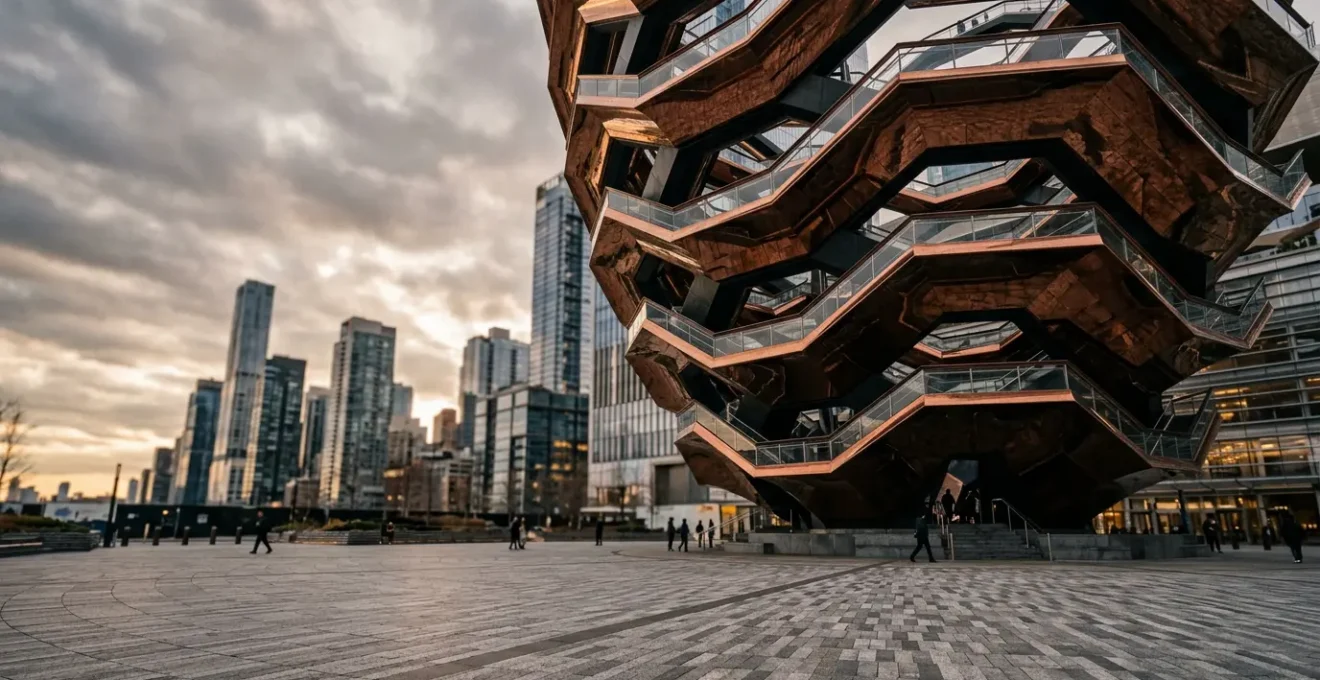
Futuristic architectural icons in New York City are consistently failing public safety and usability tests not because of isolated errors, but due to a systemic failure in the design process itself.
- Spectacular designs often prioritize a singular, photogenic vision while ignoring fundamental user needs like accessibility and physical safety.
- A “feedback vacuum,” where projects bypass public and expert review, leads to foreseeable risks and massive hidden costs for maintenance and retrofitting.
Recommendation: Instead of accepting these structures as-is, the public and city planners must demand rigorous, user-centric auditing before a single blueprint is approved.
For a New Yorker, the skyline is a constant story of ambition. New structures pierce the clouds, shimmering with glass and steel, promising a glimpse of the future. The Vessel at Hudson Yards was the epitome of this promise: a gleaming, climbable sculpture intended to be the city’s Eiffel Tower. Yet, its story, and others like it, has become a cautionary tale. Citizens interact with these mega-structures not just as art, but as environments, and as a public safety auditor, it’s clear these environments are often failing their most basic tests.
The common critique points to isolated flaws: barriers are too low, a facade is too reflective, or a plaza feels sterile. But this misses the forest for the trees. These are not one-off mistakes. They are symptoms of a deeper, systemic design failure. It’s a process that champions spectacle over service, an approach where a top-down, singular vision from a developer and a star architect is executed in a feedback vacuum, devoid of the rigorous, user-centric auditing that should be non-negotiable for any space intended for public use.
This analysis moves beyond the headlines of melting cars and tragic closures. We will audit these architectural “icons” through a public safety lens, dissecting not just the failures themselves but the flawed processes that birth them. We will explore how a lack of foresight in accessibility, physics, and even basic maintenance reveals an operational blindness that ultimately costs the city and its people. By understanding this systemic breakdown, we can begin to demand a new standard for urban development—one that serves the public, not just the portfolio.
This article provides a comprehensive audit of these modern architectural challenges. We will examine specific failures, from accessibility to structural integrity, to understand the root causes and explore what makes a public space truly successful.
Summary: An Auditor’s Report on NYC’s Architectural Failures
- Stairs vs. Elevators: Why Some “Icons” Exclude the Disabled
- Reflective Glass and Melting Cars: When Architects Forget Physics
- Selfie Bait vs. Public Art: What Makes a Structure Meaningful?
- Who Cleans the Mirror? The Hidden Upkeep of Shiny Structures
- The East River Skyway: Will the Next Big Idea Actually Get Built?
- The Hidden Indoor Parks: How to Use Corporate Atriums for Free
- How Engineers Stop Pencil Towers from Toppling in High Winds
- Why New York’s City Planning Favors Supertalls Over Public Parks?
Stairs vs. Elevators: Why Some “Icons” Exclude the Disabled
The most fundamental test of any public space is its accessibility. If a segment of the population cannot use it, it is not truly public. Yet, some of the most celebrated futuristic designs seem to treat accessibility as an afterthought, a checkbox to be ticked rather than a core design principle. The Vessel is a primary exhibit of this failure. While it boasts 80 interlocking staircases, a staggering fact is that only 3 of the Vessel’s landings are ADA-accessible via a single, small elevator. This design choice doesn’t just inconvenience people with disabilities; it fundamentally excludes them from the core experience of the structure, which is to climb and explore its myriad paths.
This isn’t just a failure of compliance; it’s a failure of empathy. When the primary path is stairs, the design communicates a clear, albeit subconscious, message about who is and isn’t welcome. This creates a hierarchy of users, where those who can climb are given the full experience, and others are relegated to a limited, peripheral one. As one critic of architectural exclusion noted, this approach establishes a “language that disabled people are not important enough.”
The primary entrance to the purpose-built building consisted of a flight of stairs, this alone subconsciously sets up a language that disabled people are not important enough to use the main entrance.
– Zeid Hassan, Why Do Architects Keep Failing Disabled People
A proper user-centric audit during the design phase would have immediately flagged this. It would have involved simulating the user journey of a person in a wheelchair, a parent with a stroller, or an elderly person with limited mobility. The conclusion would have been unavoidable: a single, often-congested elevator is not an equitable solution. This failure to design for all users from the outset is a hallmark of a process that values a dramatic visual over genuine public service.
Reflective Glass and Melting Cars: When Architects Forget Physics
When the drive for a sleek, futuristic aesthetic overrides a basic understanding of physics, the consequences can be dramatic and dangerous. The allure of seamless, reflective glass facades is powerful, creating buildings that act as mirrors to the sky and city. However, when these surfaces are concave, they can become massive, uncontrolled solar concentrators—a lesson learned the hard way in London with the building at 20 Fenchurch Street, notoriously nicknamed the “Walkie-Talkie.”
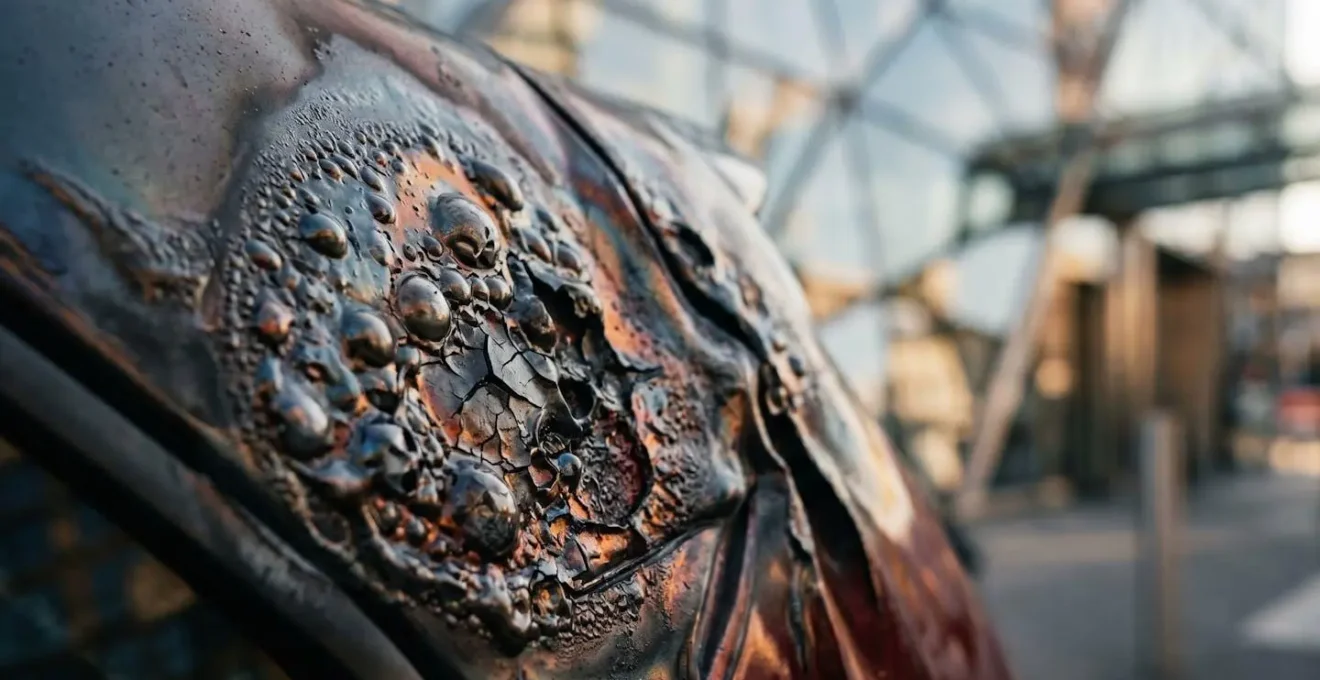
In 2013, the building’s curved facade focused sunlight into a concentrated beam on a nearby street. The results were alarming. The intense ray was documented melting parts of a Jaguar, blistering paint, and damaging storefronts. An audit of the incident revealed that spot temperatures up to 117°C (243°F) were recorded at street level, turning a public walkway into a hazardous zone. The developer ultimately had to pay for damages and install costly sun-shading fins to mitigate the effect, a fix for a problem that was entirely foreseeable. This is a classic example of operational blindness, where the visual design is approved without adequately stress-testing its real-world physical impacts on the surrounding environment.
This isn’t an isolated “freak accident.” It’s a systemic design failure. Any audit process should include environmental simulations: how will the structure interact with sun, wind, and rain at different times of the day and year? Forgetting to ask these questions turns public spaces into live experiments, with citizens as unwitting test subjects. The pursuit of a shiny object cannot justify ignoring the fundamental laws of nature, especially when public safety is at stake.
Selfie Bait vs. Public Art: What Makes a Structure Meaningful?
Beyond physical safety, there’s a question of civic purpose. What makes a structure a beloved public landmark versus an empty, Instagrammable backdrop? The Vessel, designed as a “centerpiece,” has been widely criticized for being the latter—a piece of “selfie bait” that offers a photo opportunity but little else. It functions as an object to be consumed visually rather than a space to be inhabited. As one architecture critic bluntly put it, the structure is an extractive force in the city.
An object with no function, the Vessel gives nothing back to the city – it only extracts from it. No wonder the public similarly cares little about it.
– Matt Shaw, The Vessel shows us how bad the vampiric ultra-wealthy are at making public space (Dezeen)
This critique gets at the heart of what makes public space successful. Sociologist Ray Oldenburg coined the term “third places” to describe the environments outside of home (the first place) and work (the second place) that are vital for community life. These are spaces for regular, informal, and voluntary gatherings—the parks, cafes, and squares where community is built. A structure like the Vessel, with its rigid, one-way circulation and lack of seating, programming, or shelter, fails to meet any of these criteria. It is a thoroughfare, not a destination; a spectacle, not a service.
A meaningful public structure invites lingering. It provides shade, seating, and a reason to stay. It facilitates interaction rather than just observation. The failure to incorporate these basic human-centric elements is another sign of a feedback vacuum in the design process. The goal was to create an “icon,” but it seems no one asked what makes an icon meaningful to the people who live with it every day. The result is a hollow spectacle, a space that people move through, but not one they connect with.
Who Cleans the Mirror? The Hidden Upkeep of Shiny Structures
The initial “wow” factor of a futuristic building often conceals a mountain of long-term operational liabilities. A pristine, mirror-polished surface or a complex geometric form looks spectacular on opening day, but maintaining that appearance requires immense and perpetual investments in labor, equipment, and money. This is the operational blindness of “spectacle” architecture: a myopic focus on the initial build while ignoring the lifetime cost of ownership. The Vessel is, again, a prime example. Initially projected to cost $75 million, the project’s complexity and high-end finishes ballooned its price tag, with the $200 million final construction cost becoming public knowledge.
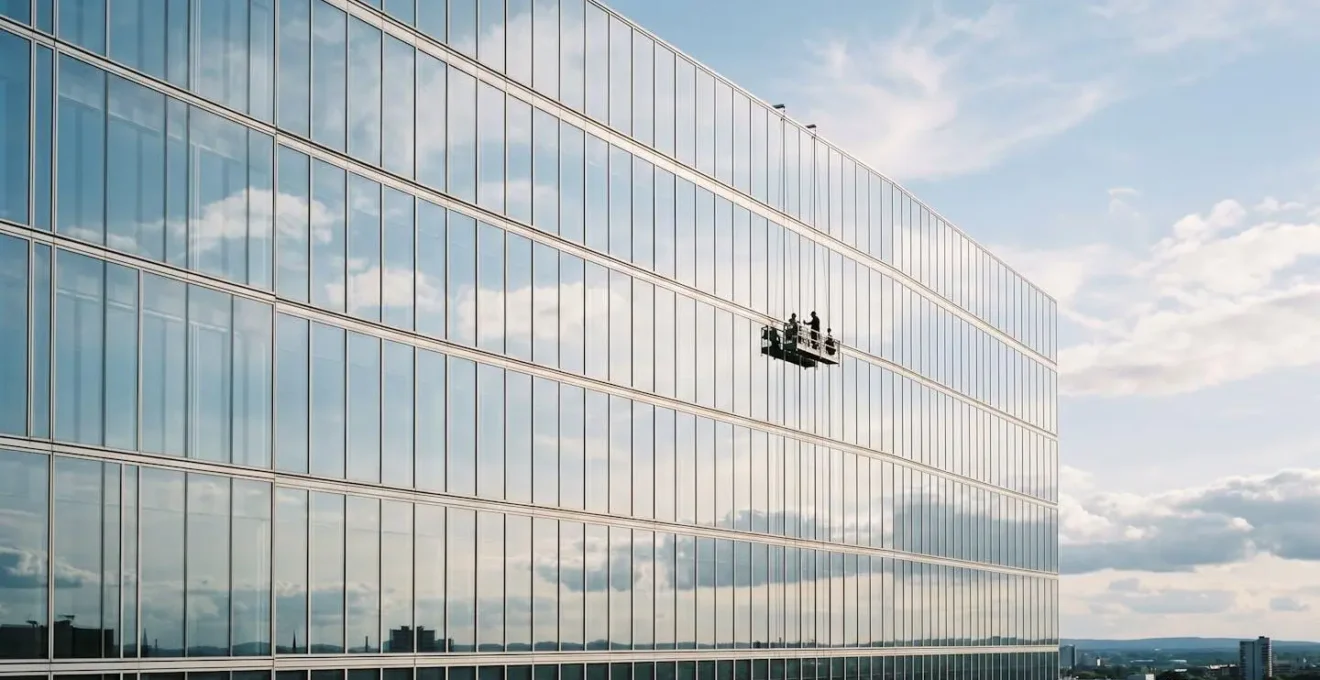
This figure doesn’t even include the relentless cost of upkeep. The structure’s 154 flights of stairs and copper-toned reflective surfaces are exposed to New York’s harsh weather. Keeping it clean and safe from corrosion is a monumental, and expensive, task. Who pays for this? If it’s a privately owned structure, the cost is borne by the developer, but it highlights a resource-intensive approach. If public funds were ever involved, it would represent a significant and ongoing drain on city resources for what is essentially a decorative object.
From a safety auditor’s perspective, maintenance is not just about aesthetics; it’s about safety. A deteriorating facade can become a hazard. Complex structures require specialized, often dangerous, cleaning and repair procedures. A responsible design process must include a “Total Cost of Ownership” audit. This would force designers and clients to confront questions like: What is the 30-year maintenance plan? What are the associated costs and labor risks? Ignoring these questions is a form of design negligence, leaving a legacy of hidden burdens long after the ribbon-cutting ceremony is over.
The East River Skyway: Will the Next Big Idea Actually Get Built?
The recurring failures of projects like the Vessel raise a crucial question for NYC’s future: how do we prevent the next big, expensive mistake? The answer lies in dismantling the “feedback vacuum” that allows such flawed concepts to be realized. The most damning aspect of the Vessel’s story is not just its design flaws, but the fact that they were entirely foreseeable and that the process actively excluded the feedback that could have prevented them.
Case Study: The Vessel’s Closed-Door Design Process
Unlike public works, the Vessel was built on private property, allowing it to bypass New York City’s robust public design review process. According to a report in Dezeen, the project was the result of a closed competition with a single client and a single designer. This process, from conception to unveiling, took just 30 months, with no input from community boards, safety experts, or the general public. As early as 2016, before it was even completed, critics like Audrey Wachs were publicly warning of the suicide risks posed by its low barriers. After four tragic deaths, the structure was closed for two years, finally reopening in 2024 only after extensive and unsightly safety netting was installed—a reactive measure for a risk that should have been proactively designed out.
This case study is the smoking gun. It proves that these are not unforeseeable accidents but predictable outcomes of a flawed system. As one critic stated, “This huge, embarrassing failure could have easily been prevented with even an ounce of community feedback.” Big ideas for the city’s future, like the once-proposed East River Skyway, must be subjected to a radically different process. A public-facing, transparent, and rigorous audit is not red tape; it is essential risk management.
Action Plan: A Checklist for Auditing New Public Structures
- User Journey Simulation: Map the experience for a diverse range of users, including those with disabilities, the elderly, and families with children. Identify all potential points of exclusion or hazard.
- Environmental Impact Analysis: Conduct simulations for solar reflection (heat gain), wind tunneling (downdrafts), and water runoff. Assess the structure’s impact on its immediate surroundings.
- “Third Place” Viability Test: Does the design include essential amenities for lingering like seating, shade, and shelter? Does it facilitate community interaction or simply passive viewing?
- Total Cost of Ownership Audit: Develop a detailed 30-year maintenance plan, including estimated costs, specialized labor requirements, and material longevity.
- Public & Expert Review Mandate: Subject the design to a formal review process with community boards, disability advocates, engineers, and public safety officials before final approval, even on private land.
The Hidden Indoor Parks: How to Use Corporate Atriums for Free
In a city starved for public space, there is a hidden network of potential oases: Privately Owned Public Spaces, or POPS. These are atriums, plazas, and small parks that developers were required to build and maintain for public use in exchange for zoning concessions, such as being allowed to build taller. In theory, this is a win-win, creating much-needed public amenities at no cost to the taxpayer. Research shows that close to 600 POPS exist across NYC, providing a significant 80 acres of public space. These spaces are legally required to be open to the public, some 24/7.
However, just like their more spectacular counterparts, these spaces often suffer from a form of systemic failure. The “service” is provided, but the quality is often lacking. A comprehensive 2000 study found that a staggering 41% of these POPS were of “marginal quality,” failing to provide the welcoming atmosphere they promised. Many are poorly maintained, hard to find, or designed in a way that subtly discourages public use. They may lack adequate seating, have minimal lighting, or be patrolled by overzealous security, creating an environment that feels private and exclusive despite its public mandate.
As public space advocate Jerold S. Kayden notes, “Even though they are privately owned and managed, POPS must be open for use by the public.” The gap between this legal requirement and the on-the-ground reality is another example of a design and management process that prioritizes the developer’s obligation over the public’s experience. While POPS represent a valuable existing framework for creating public space, they require vigilant oversight and advocacy to ensure they live up to their promise and don’t become another form of token, non-functional public space.
How Engineers Stop Pencil Towers from Toppling in High Winds
The visible failures of futuristic designs—inaccessibility, solar glare—are often matched by invisible ones. For the super-slender “pencil towers” that have begun to dominate the midtown skyline, the primary battle is against the wind. Engineers employ sophisticated techniques, including massive tuned mass dampers and aerodynamic profiling, to prevent these impossibly thin structures from swaying excessively or toppling in high winds. The engineering is a marvel of precision. However, the impact of these mega-structures on the wind at street level is a different story, and one that is often overlooked in the design phase.
Just as a concave facade can focus sunlight, a poorly placed tower can create powerful and unpleasant wind tunnels at its base. The “Walkie-Talkie” building in London was again a case study in this, with the City of London Corporation receiving increased complaints about severe downdrafts after its completion. This is a common problem with tall buildings, but one that is supposed to be mitigated through wind tunnel testing during the design phase. Yet, the reality often differs from the assessment, as a city official admitted.
The wind outcome at street level experienced post-construction on a number of projects differs somewhat to the conditions we were expecting from the one outlined in the planning application wind assessments.
– Gwyn Richards, City of London Corporation Head of Design
This admission reveals another crack in the system. The predictive models are either inadequate or their results are not given enough weight when they conflict with the developer’s vision. A public safety audit must insist on a more robust analysis of a building’s impact on its microclimate. An unpleasant, gusty plaza is a public space failure. A wind tunnel strong enough to knock someone over is a public safety hazard. The focus on keeping the tower itself standing cannot come at the expense of making the ground around it uninhabitable.
Key Takeaways
- Public safety failures in modern architecture are rarely accidents, but predictable outcomes of a flawed, top-down design process.
- A “feedback vacuum” that excludes public and expert review is the root cause of major flaws in accessibility, physical safety, and long-term usability.
- True public value comes from “user-centric auditing”—proactively testing designs against the needs of all users, not just prioritizing a photogenic spectacle.
Why New York’s City Planning Favors Supertalls Over Public Parks?
When we connect the dots—from inaccessible icons and sun-scorching facades to wind-swept plazas and high-maintenance facades—a clear pattern emerges. These individual failures are all symptoms of a city planning philosophy that has increasingly prioritized private development over genuine public good. New York’s zoning laws and the use of “air rights” have created a powerful economic incentive to build ever-taller, luxury supertalls, while the creation of new, truly public parks and community spaces lags far behind.
The system is designed to facilitate spectacle, not service. A developer can get a zoning variance to build a record-breaking tower, promising nebulous economic benefits, while a proposal for a new community park faces a grueling battle for funding and political will. The result is a city where dazzling, often exclusive, vertical structures proliferate while horizontal public space—the parks and plazas that serve as the city’s collective backyard—becomes more precious and crowded. This is the ultimate systemic design failure: the system itself is skewed towards an outcome that benefits a few at the expense of the many.
Changing this requires a fundamental shift in perspective. A public safety and usability audit cannot just be a final check on an architect’s design; it must be embedded in the city planning process itself. The value of a new project should not be measured by its height or its “iconic” potential, but by the tangible value it adds to the public realm. Does it create a welcoming space? Is it accessible to everyone? Is it resilient and sustainable? Does it serve the community?
Until these questions become the primary drivers of city planning, New York will continue to get more shiny objects that fail the people they are meant to inspire. The next step is to move from critique to action, demanding a planning process that puts its citizens’ safety and well-being first. Evaluate your local public spaces and advocate for user-centric design in all new developments.