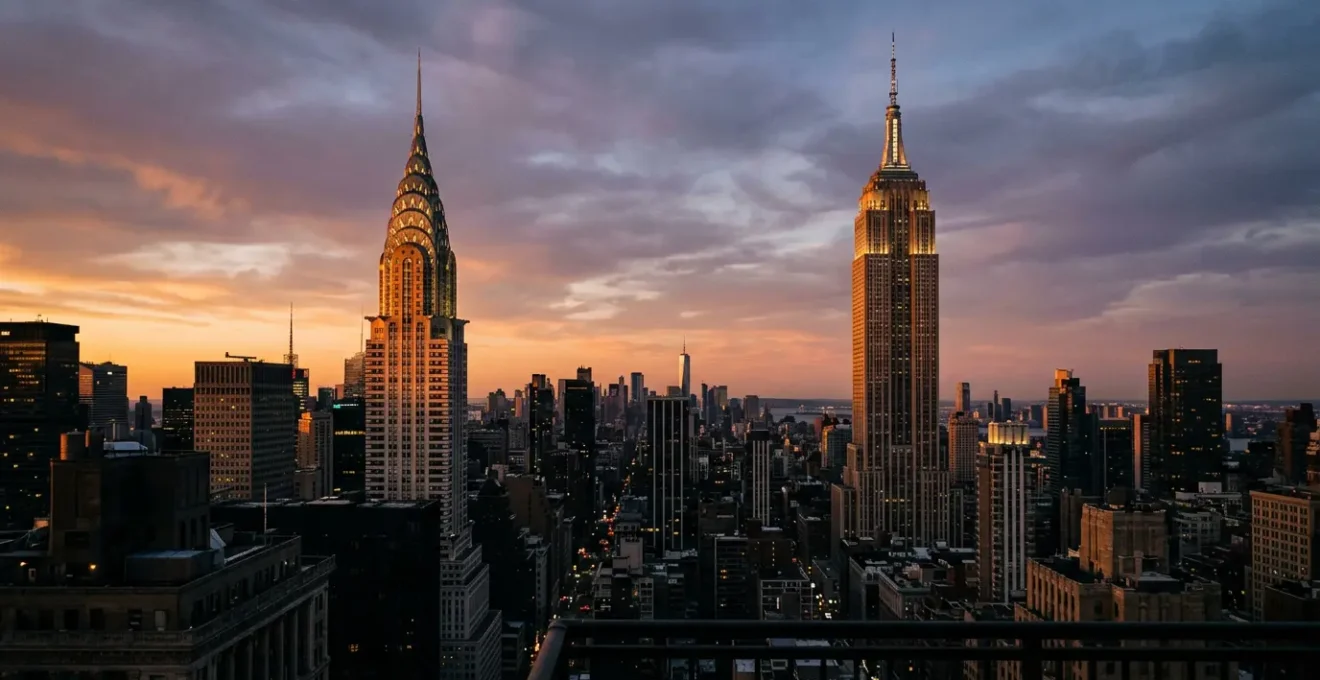
The Chrysler Building decisively wins the Art Deco style war, not through height, but through its unwavering commitment to a singular, narrative-driven aesthetic vision.
- The Empire State Building is a masterpiece of scale and commerce; the Chrysler Building is a self-referential “Gesamtkunstwerk”—a total work of art.
- From its automotive iconography to its pioneering use of materials, every element of the Chrysler serves a cohesive story, a quality the more generic Empire State lacks.
Recommendation: Judge these landmarks not by their position in the sky, but by the depth of the story they tell at street level and against the clouds. The richer narrative always wins.
For nearly a century, the debate has echoed in the canyons of Manhattan, a favorite topic among design enthusiasts and casual observers alike: which spire truly owns the Art Deco crown? The Empire State Building, that colossus of commerce and cinematic fame? Or the Chrysler Building, the glittering, elegant jewel of the Jazz Age? The typical conversation defaults to lazy metrics: height, speed of construction, and visitor numbers. We are told the Empire State was taller, a symbol of American ambition that quickly dwarfed its rival. The Chrysler is often framed as the beautiful-but-brief champion, a fleeting moment of glory.
This line of reasoning is a disservice to the very soul of architecture. It substitutes a spreadsheet for a sketchbook. To truly judge these icons, we must move beyond the platitudes of scale and ask a more incisive question: which building is the more complete, the more articulate, the more profound expression of the Art Deco philosophy? The answer lies not in who scraped the sky first, but in who did it with more purpose, poetry, and a radical commitment to a singular vision.
The argument I will unfold is this: The Empire State Building is a magnificent skyscraper, but the Chrysler Building is a masterpiece of Art Deco. The former is an expression of power; the latter is an expression of an idea. Through an examination of their lobbies, materials, iconography, and enduring cultural impact, it becomes clear that the Chrysler’s “Gesamtkunstwerk”—its total, unified work of art—achieves a level of narrative integrity and stylistic purity that its taller, more famous contemporary never quite reaches. This is not a battle of feet and inches, but a war of aesthetic soul. And in that war, the victor is clear.
This analysis will deconstruct the superficial arguments to reveal the deeper truths of design. By exploring the very materials, motifs, and mandates that shaped these icons, we will establish a new criterion for judgment, proving that in architecture, storytelling always towers over simple statistics.
Summary: The Definitive Judgment on New York’s Art Deco Soul
- Which Art Deco Lobby Can You Actually Visit Without a Badge?
- Chrome and Marble: Sourcing the Exotic Materials of the Jazz Age
- Decoding the Hubcaps on the Chrysler Building: Auto-Age Iconography
- The Bronx Art Deco District: Why You Should Take the D Train North
- The Challenge of Replacing Custom 1930s Metalwork
- The Wedding Cake Shape: How 1916 Zoning Laws Sculpted the Skyline
- When Will We Hit the Ceiling? The Future Limits of Manhattan Verticality
- Why New York’s Super-Tall Skyscrapers Are Casting Longer Shadows on Central Park?
Which Art Deco Lobby Can You Actually Visit Without a Badge?
The lobby is an architectural handshake, the first promise a building makes to its visitor. On this front, the Empire State Building appears to have an open-palm policy. Its Fifth Avenue lobby is freely accessible, a grand, golden-hued hall that welcomes a staggering number of people. Official statistics confirm it is a destination for more than 2.5 million visitors annually to its observatories, many of whom pass through its public spaces. It is, by all accounts, a successful machine for moving people, a testament to its commercial prowess. Yet, its grandeur feels somewhat generic, an overture to the main event upstairs rather than a destination in itself.
In contrast, the Chrysler Building’s lobby is a far more intimate and artistically dense experience. It’s a dimly lit, triangular jewel box of Moroccan marble, onyx, and gleaming steel, capped by a magnificent mural by Edward Trumbull. It was conceived as a showroom, a public gift that celebrated the machine age. However, in a move that speaks volumes about the tension between public heritage and private ownership, the lobby’s access has become a point of contention. As a case study in post-pandemic New York reveals, the Chrysler lobby has often been closed to casual tourists, a stark departure from the Empire State’s open doors. While this is a practical loss for the public, it highlights a critical distinction: the Chrysler’s lobby is a complete artistic statement you’re unfortunately barred from, while the Empire State’s is a functional, high-traffic corridor you’re welcome to pass through. One is a gallery, the other a gateway. For the design enthusiast, the quality of the art is what matters most.
Action Plan: Your Accessible Art Deco Lobby Tour
- Visit the Fred F. French Building for its colorful Mesopotamian-inspired decorative elements.
- Step into the Chanin Building to see its masterful bronze work and ornamental grilles.
- Explore the Daily News Building to marvel at its iconic spinning globe and compass floor.
- Walk through the 30 Rockefeller Plaza lobby to appreciate the grand murals and soaring space.
- Conclude at the Empire State Building’s Fifth Avenue lobby to experience its scale and 23-karat gold leaf ceiling firsthand.
Chrome and Marble: Sourcing the Exotic Materials of the Jazz Age
Art Deco is a style defined by its sophisticated and often daring palette of materials. It’s a celebration of both the exotic and the industrial, juxtaposing rare woods and marbles with the gleaming new alloys of the machine age. Here, the Chrysler Building demonstrates a profound level of “material honesty” that elevates its design. The most famous example is its crown, clad in Nirosta stainless steel, an alloy of 18% chromium and 8% nickel. This was not merely a decorative choice; it was a technological and symbolic masterstroke, representing the first major architectural use of this German-developed metal in America.
This paragraph introduces the complex interplay of light and metal on the Chrysler’s spire. To truly understand this design choice, it helps to visualize the material itself. The illustration below captures the precise, ribbed texture that makes the building’s crown so dynamic.

As the image reveals, the material wasn’t just applied; it was sculpted. The ribbed, sunburst patterns weren’t just for show; they were designed to catch and reflect sunlight and moonlight from every angle, making the spire an ever-changing beacon. This decision reveals a deep understanding of the material’s properties. As one contemporary analyst, E.E. Thum, noted, this choice was integral to the building’s vertical thrust:
The use of permanently bright metal was of greatest aid in the carrying of rising lines and the diminishing circular forms in the roof treatment, so as to accentuate the gradual upward swing until it literally dissolves into the sky.
– E.E. Thum, Analysis of Nirosta steel application in Chrysler Building design
This is the essence of great design: material and form in perfect synthesis. The Empire State, with its more conventional limestone façade, is handsome and imposing, but it lacks this layer of specific, technological storytelling. The Chrysler Building wears its modernity on its sleeve, or rather, on its crown.
Decoding the Hubcaps on the Chrysler Building: Auto-Age Iconography
A building that tells a story is always more compelling than one that simply occupies space. The Chrysler Building is a masterclass in architectural narrative, its entire form a soaring tribute to the automobile. This is where its “iconographic density” leaves the Empire State far behind. While the ESB has its own symbolism—that of commerce and sheer American might—it is generic. The Chrysler’s symbolism is specific, witty, and woven into its very fabric. The corner ornaments on the 31st floor replicate 1929 Chrysler radiator caps, and the famous eagles on the 61st floor are direct interpretations of a Chrysler Plymouth hood ornament.
These are not mere decorations; they are the building’s DNA. They ground its celestial ambition in the industrial reality of its namesake. This fusion of art and industry was so powerful it attracted artists who wanted to be part of the story.
Case Study: Margaret Bourke-White and the Eagle Gargoyles
The photographer Margaret Bourke-White, an icon of the machine age herself, rented a studio on the 61st floor of the Chrysler Building. Her motivation was proximity to the monumental stainless steel eagle gargoyles, which she affectionately named ‘Min’ and ‘Bill’. These eagles, designed by Chesley Bonestell, were not generic mythical beasts but were directly modeled on the 1929 Chrysler hood ornament. In a series of now-legendary photographs, Bourke-White would climb out onto the eagles, 800 feet above the street, to capture breathtaking views of Manhattan. Her work immortalized the building’s automotive-themed details, cementing its identity as both a skyscraper and a 925-foot-tall advertisement for the Chrysler Corporation. It was a perfect union of artist, subject, and architectural narrative.
This level of self-referential detail simply has no equivalent on the Empire State Building. The ESB is impressive, but it doesn’t talk about anything other than its own size. The Chrysler Building, with its hubcaps, eagles, and brickwork patterns meant to evoke motion, speaks a rich and specific language. It possesses a narrative integrity that transforms it from a mere building into a cohesive work of art.
The Bronx Art Deco District: Why You Should Take the D Train North
To truly understand the Art Deco style, one must look beyond the celebrated duopoly of Midtown Manhattan. Limiting the conversation to just the Chrysler and the Empire State is like discussing Renaissance painting by only looking at two portraits. The soul of Art Deco, its democratic and optimistic spirit, is arguably best preserved not in a corporate spire but in the grand apartment buildings lining the Grand Concourse in the Bronx. A caller on a WNYC radio show once beautifully captured the style’s spirit, saying, “Art Deco is Rhapsody in Blue by Gershwin in the form of a building.” That melody plays just as strongly, if not more so, up north.
A trip on the D train reveals a different facet of the style—Art Deco as a language for living. Here, the opulent materials and sharp geometries are applied not to corporate headquarters but to the homes of everyday New Yorkers. The Fish Building (1150 Grand Concourse) with its aquatic-themed terracotta reliefs, or the “Twin” buildings near Joyce Kilmer Park, showcase a wealth of decorative detail: intricate brickwork, colorful mosaics, and stunningly preserved lobbies. These buildings lack the vertical ambition of their Midtown cousins, but they compensate with a horizontal grace and a deep connection to the streetscape.
This excursion is crucial for any design critic because it provides essential context. It demonstrates that Art Deco wasn’t just a style for the super-rich or for corporate titans; it was a flexible, adaptable design language that could bring elegance and modernity to all five boroughs. Seeing this residential application of Deco enriches our understanding of the Chrysler and Empire State. It frames them not as isolated phenomena but as the most extreme expressions of a style that was transforming the entire city, block by block.
The Challenge of Replacing Custom 1930s Metalwork
An architectural vision is only as strong as its execution and its endurance. The Chrysler Building’s “Gesamtkunstwerk” status is powerfully affirmed by the very challenges involved in its preservation. The custom, cutting-edge materials of 1930 are the conservation challenges of today, and their resilience is a testament to the foresight of the original design. The building’s spire wasn’t just beautiful; it was engineered to be enduringly beautiful.
The American Society for Testing Materials held a long-running program to monitor the condition of the Nirosta steel panels. The data is telling: the panels were inspected every 5 years from 1929 to 1960, and the program was eventually canceled because they found such minimal deterioration. This durability is the physical proof of the wisdom of Van Alen’s material choice. It wasn’t a fleeting fashion; it was a long-term investment in a permanent gleam.
When the building finally underwent a major spire restoration from 1995-1997, the project underscored the unique nature of its construction. This wasn’t a simple repair job; it was a painstaking process of conservation that required unprecedented craftsmanship. For the first time since 1961, the entire crown, its gargoyles, and the needle were polished. Damaged steel strips were replaced, not with off-the-shelf parts, but with custom-fabricated pieces. Sections of the gargoyles had to be re-welded by specialists. The immense difficulty and the $1.5 million cost of this work, which earned the New York Landmarks Conservancy’s highest preservation award, reveals a critical truth: the Chrysler Building is irreplaceable. It is a product of a specific moment of technological optimism and artisanal skill that is nearly impossible to replicate. This difficulty is not a flaw; it is the hallmark of a true custom creation, unlike the more easily understood construction of the Empire State.
The Wedding Cake Shape: How 1916 Zoning Laws Sculpted the Skyline
Great design often emerges not from total freedom, but from creative responses to rigid constraints. The iconic “wedding cake” silhouette of New York’s Art Deco skyscrapers is a prime example of this principle. This quintessential shape was not born from an architect’s whimsical sketch but was a direct, ingenious response to a municipal regulation: the 1916 Zoning Resolution. This law was passed out of a growing fear that ever-taller buildings would turn the city’s streets into dark, sunless canyons. It mandated that buildings had to “set back” from the street as they rose, ensuring light and air could still reach the pavement below.
This paragraph explains how a legal requirement became an aesthetic signature. The following image illustrates the dramatic, ziggurat-like profile that this law created, a defining feature of the Art Deco skyline.
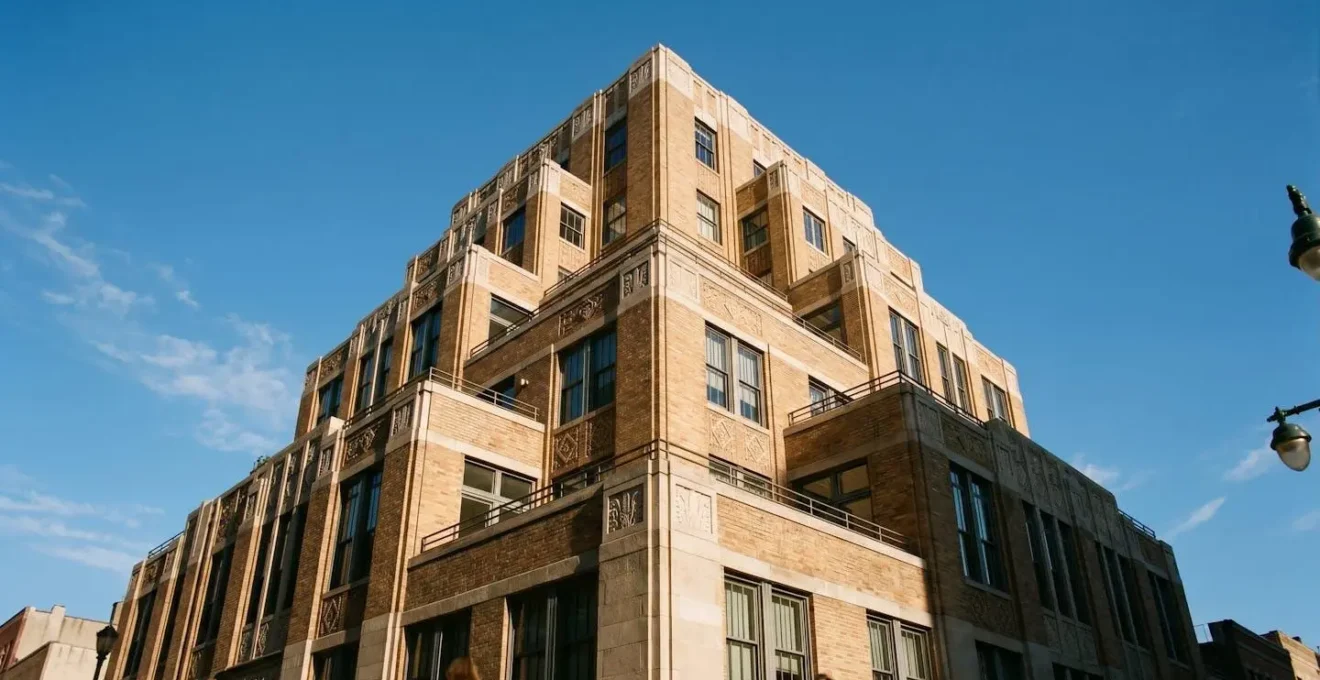
As the illustration shows, architects didn’t just comply with the law; they embraced it as a design tool. The setbacks became opportunities for terraces, dramatic shifts in massing, and platforms for elaborate ornamentation. They turned a legal requirement into a dynamic, sculptural principle, giving the skyline its rhythmic, telescoping energy. The ziggurat form, borrowed from ancient Babylonian and Egyptian architecture, was a perfect fit for the era’s fascination with the “exotic,” and the setback rule gave architects the perfect excuse to employ it. Both the Chrysler and the Empire State are masters of this form, using their setbacks to build dramatic, tapering compositions that draw the eye upward.
Understanding this context is crucial. It shows that the beauty of these buildings is not arbitrary. It is a calculated, artistic solution to a pragmatic urban problem. The “wedding cake” shape is the perfect fusion of civic responsibility and aesthetic ambition, a core tenet of the Art Deco ethos in New York. The style’s greatness lies in its ability to transform a bureaucratic constraint into pure poetry.
When Will We Hit the Ceiling? The Future Limits of Manhattan Verticality
The obsession with height is the most tedious aspect of architectural discourse. The fact that the Chrysler Building held the title of “world’s tallest building” is often cited as its main claim to fame, and its loss of that title as its great failure. This narrative misses the point entirely. The Chrysler’s brief, 11-month reign from May 1930 to May 1931, is not a story of defeat, but a powerful testament to the fact that its ambitions were never merely vertical. It was a race for style, not just for altitude.
The famous “secret spire,” hoisted into place to snatch the title from 40 Wall Street, was a brilliant piece of architectural showmanship. But the true genius of the building is not in that final, triumphant needle, but in the cohesive artistic vision of the 1,046 feet beneath it. The Empire State Building was built with a singular goal: to be, and remain, the tallest. Its design is a powerful and elegant expression of that one idea. The Chrysler Building had a more complex, more nuanced ambition: to be the most dazzling, the most symbolic, the most perfectly realized vision of the machine age.
This is why its appeal is more enduring for design connoisseurs. It represents an “auteurist vision,” a singular statement by its architect, William Van Alen. The architectural historian Anthony W. Robins captures this essence perfectly, describing the building in terms that have nothing to do with height:
one-of-a-kind, staggering, romantic, soaring, the embodiment of 1920s skyscraper pizzazz, the great symbol of Art Deco New York
– Anthony W. Robins, Architectural assessment of the Chrysler Building’s cultural significance
“Romantic,” “pizzazz”—these are the words of aesthetics, not engineering. They speak to an emotional and intellectual connection that transcends simple metrics. As we reach for ever-greater heights with today’s “supertalls,” the Chrysler serves as a vital reminder that a building’s true ceiling is not physical, but imaginative.
Key Takeaways
- True architectural merit lies in narrative integrity and cohesive design, not just impressive scale.
- The Chrysler Building’s specific, automotive-themed iconography gives it a richer story and deeper personality than the more generic Empire State Building.
- Enduring public affection and critical acclaim prove that a powerful aesthetic vision will outlast fleeting records like “world’s tallest building.”
Why New York’s Super-Tall Skyscrapers Are Casting Longer Shadows on Central Park?
The title of this section poses a literal question that has become a point of major civic debate in New York. The new generation of “supertall” towers, pencil-thin residential spires for the global elite, are indeed casting long, creeping shadows over Central Park, diminishing a precious public space. But this literal shadow prompts a more interesting, metaphorical question for our debate: what kind of *cultural* shadow do the great buildings of the past cast? And which of our two Art Deco contenders casts the longer one?
The Empire State Building casts a wide, populist shadow. It is a global icon, a movie star, a tourist must-do. Its cultural impact is immense, but it is also broad and somewhat undifferentiated. It represents New York, and America, in the most general sense. It is the landmark you take your visiting relatives to see.
The Chrysler Building, however, casts a deeper, more enduring cultural shadow within the worlds of art, design, and architecture. It is the building that other architects admire, the one that photographers obsess over, the one that represents not just New York, but a very specific and potent idea *about* New York. It is the connoisseur’s choice. The ultimate proof of this lies in public sentiment long after the race for height was lost. In a 2007 poll conducted by the American Institute of Architects, the Chrysler Building was ranked 9th on the list of America’s Favorite Architecture. This ranking, decades after it was surpassed in height many times over, is the final, irrefutable evidence. The public’s affection is not for a statistic, but for a feeling. It is for the romance, the optimism, and the sheer, unadulterated “pizzazz” of a building that knew exactly what it wanted to be.
Therefore, when you next gaze upon the Manhattan skyline, look beyond the simple hierarchy of height. See the Empire State for the magnificent monument of commerce it is, but recognize the Chrysler Building for the richer, more complete artistic statement it represents. The true winner of the style war is the one that tells the better story, and that story is written in glittering Nirosta steel.