Contrary to popular belief, the most valuable volunteer contributions to NYC food banks are rarely the most visible; operational efficiency trumps feel-good gestures every time.
- One-off holiday volunteering can cost non-profits more in training and management than the value it provides.
- Donating your specialized professional skills (e.g., accounting, logistics) delivers exponentially more impact than manual labor like sorting cans.
Recommendation: Stop asking “How can I help?” and start offering specific solutions to the food bank’s stated operational problems, aligning your unique skills with their actual needs.
The desire to help is a powerful and noble impulse. When faced with the staggering reality of food insecurity in New York City, thousands of well-meaning residents look for ways to contribute, and the local food bank or pantry seems like the most direct channel for their goodwill. The mental image is a familiar one: rolling up your sleeves for a Thanksgiving serving line or organizing a neighborhood can drive to fill the shelves. These are the classic, visible acts of charity that have defined community support for decades.
However, from an operational standpoint, these conventional methods often create as many problems as they solve. What if the surge of untrained holiday volunteers creates an efficiency bottleneck? What if that well-intentioned can drive results in a pallet of items the pantry can’t use, which must be sorted, stored, and eventually discarded at a cost? The traditional view of volunteering focuses on the volunteer’s intention. This is a mistake. To be truly effective, we must shift our focus from the intention behind the act to the operational impact of the outcome.
This is not a guide about finding a place to volunteer. This is a pragmatic look behind the curtain of non-profit food distribution. We will dismantle common myths and reframe your contribution not as charity, but as a strategic intervention. By understanding the system’s real-world challenges—from logistics and food safety to the economics of volunteer management—you can transform your desire to help into what food banks desperately need: a measurable, positive impact on their mission.
This article will guide you through the operational realities of food banking in NYC. We’ll explore the complex logistics, the true cost of volunteering, the challenges of healthy food distribution, and how you can leverage your professional skills for maximum impact. Let’s begin.
Summary: A Strategic Guide to Impactful NYC Food Bank Volunteering
- Why Canned Pumpkin Is the Worst Thing to Donate in July
- The Last Mile Problem: How Food Gets from Hunts Point to a East New York Pantry
- One-Off Holiday Volunteering vs. Weekly Shifts: Which Has Real Impact?
- Fresh Produce vs. Shelf Stable: The Challenge of Healthy Donations
- How Companies Can Offer Skills (Not Just Cans) to Help Food Banks
- Don’t Paint Fences if You’re an Accountant: High-Impact Pro Bono Work
- Is Street Food Safe? Understanding NYC’s Vendor Letter Grades
- How to Find Meaningful Volunteer Work in NYC That Fits a 9-to-5 Schedule?
Why Canned Pumpkin Is the Worst Thing to Donate in July
The community food drive is a staple of corporate and neighborhood goodwill, but it often creates a significant “operational drag” for food banks. Receiving unsolicited, out-of-season, or culturally specific items that clients don’t want requires staff and volunteer time to sort, store, and often, dispose of. A can of pumpkin puree in July or a box of matzo after Passover may seem helpful, but it clogs a system designed for high-volume, high-turnover distribution of staple goods. These donations are born from what the donor *thinks* people need, rather than what the pantry’s clients actually request.
The reality is that food banks are not empty warehouses waiting for your cans. They are complex logistical operations with established supply chains. A significant portion of their inventory comes from structured government programs and bulk purchasing. For example, a 2024 hunger report shows that over 20% of food distributed through the Feeding America network comes from The Emergency Food Assistance Program (TEFAP). This provides a predictable, steady stream of staple items tailored to nutritional guidelines, forming the backbone of their inventory.
When a food bank receives a truckload of unsorted, random donations, it disrupts this efficient flow. The most effective way to contribute goods is to check the organization’s website for their “most needed items” list and donate only those. Even better is a financial donation. A food bank can leverage its wholesale purchasing power to turn a $10 cash donation into five times that amount in groceries. This insight reveals a core principle of effective support: predictable, flexible resources are always more valuable than unpredictable, specific ones. The same logic applies to volunteering, where consistent help is more valuable than a one-time burst of activity.
The Last Mile Problem: How Food Gets from Hunts Point to a East New York Pantry
While large-scale donations are handled at massive warehouses like those in Hunts Point, the single greatest logistical challenge in NYC’s food system is the “last mile.” This is the difficult, expensive, and time-sensitive process of moving food—especially fresh, perishable items—from a central distribution hub or a donating restaurant to the hundreds of smaller, neighborhood-based pantries and soup kitchens. A pallet of yogurt is useless at a Bronx warehouse if it can’t get to a family in East New York before it expires. This is the last-mile bottleneck, and it’s where individuals can make a surprisingly large impact.

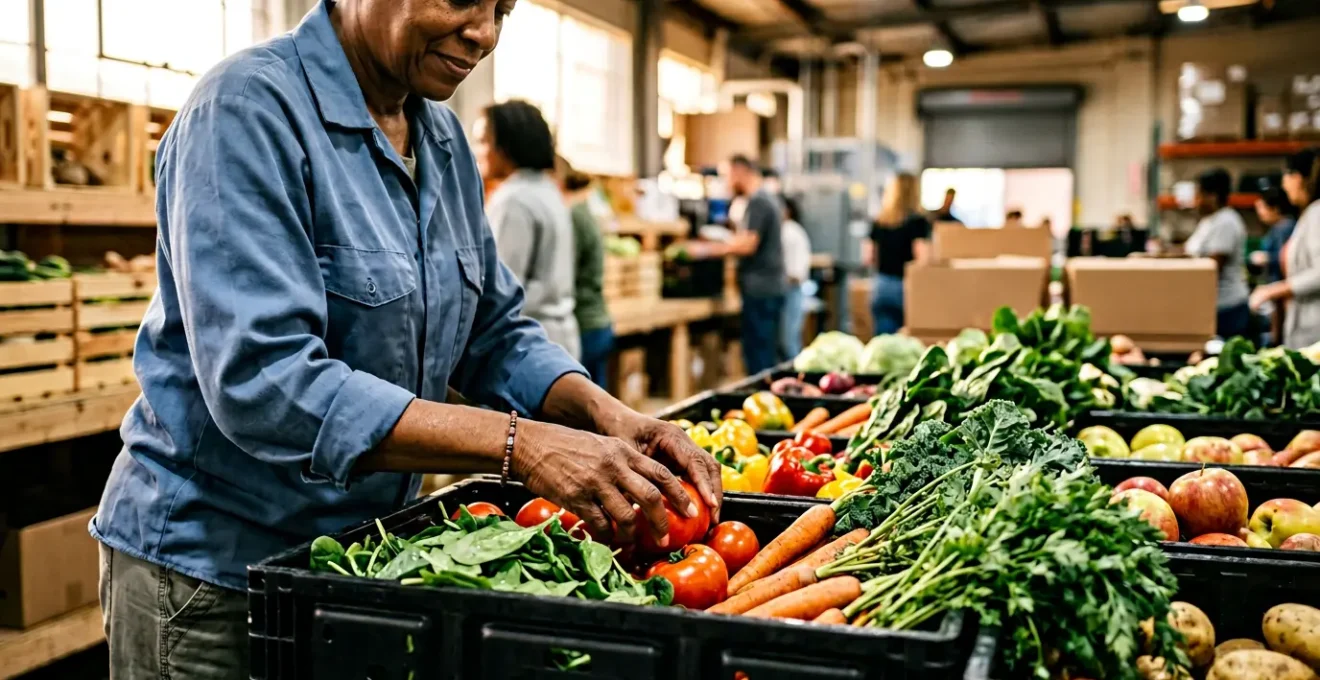
As the image above illustrates, fresh produce is fragile. It requires a “cold chain”—uninterrupted refrigeration—and rapid transit to maintain its quality and safety. Small pantries often lack refrigerated trucks or the staff to make frequent pickups. Organizations like Rescuing Leftover Cuisine (RLC) have built their entire model around solving this problem, showcasing the power of a distributed, volunteer-powered network. In just one year, their innovative approach led to 3.8 million pounds of food rescued, much of it by ordinary New Yorkers using their own cars, bikes, or even the subway.
RLC’s model treats the last mile as a series of small, manageable “gigs.” Volunteers sign up for rescues that often take less than an hour, picking up excess food from a restaurant and walking it a few blocks to a local shelter. This approach is brilliant because it’s scalable and flexible, perfectly suited for the density and transit infrastructure of NYC. It demonstrates that the most-needed volunteer work isn’t always at a massive warehouse. Sometimes, it’s simply being a human link in a complex logistical chain, ensuring that high-quality food reaches people, not a landfill.
One-Off Holiday Volunteering vs. Weekly Shifts: Which Has Real Impact?
The urge to volunteer spikes dramatically between Thanksgiving and New Year’s Day. While the intention is admirable, this seasonal flood of “one-off” volunteers can be a nightmare for a non-profit operations manager. Every new volunteer is a net cost before they become a net positive. They require orientation, training, and supervision. From a purely economic perspective, research on volunteer program economics shows there can be a $45 initial cost per volunteer in staff time and background checks. If a person only volunteers for one three-hour shift, the organization may actually lose resources on their participation.
The real value comes from consistency. A volunteer who commits to the same two-hour shift every Tuesday morning becomes a known, trusted part of the operation. They learn the system, work independently, can train others, and build relationships with staff and clients. They require minimal supervision, effectively freeing up staff time rather than consuming it. This is the difference between being a temporary guest and being a part of the team. A small, reliable commitment is exponentially more valuable than a large, unreliable one.
As the Research.com Education Division notes in their guide to non-profit training, the problem is self-perpetuating. They state:
Untrained volunteers require more supervision, make more mistakes, and leave sooner. The very problems that make you too busy for training are caused by lack of training.
– Research.com Education Division, Non Profit Volunteer Training: The Complete Guide
This is why many organizations are shifting toward models that require a minimum commitment or prioritize volunteers who can offer sustained support. Before you sign up for that single holiday shift, ask yourself if you can instead commit to a regular, less glamorous shift in the “off-season,” like February or August. That’s where the real impact lies.
Your High-Impact Volunteer Audit: A 5-Step Plan
- Signal Channels: Before offering help, first identify all the places the organization communicates its real-time needs, such as their website’s “urgent needs” list, email newsletters, or specific volunteer role postings.
- Resource Inventory: Take a specific stock of your personal assets. This isn’t just “time”; it’s “a car available on Wednesday mornings,” “professional grant-writing skills,” or “fluency in Mandarin and English.”
- Mission Alignment: Cross-reference your assets with the organization’s stated mission and current projects. If they prioritize client dignity through choice, your offer to help set up a more organized “shopping” experience is highly aligned.
- Impact vs. Activity: Differentiate between a generic activity (showing up to sort cans) and a unique, high-impact contribution (using your accounting skills to streamline their books for an audit). Frame your value in terms of problems solved.
- The Strategic Pitch: Formulate your volunteer offer as a solution to a specific gap. Instead of asking “How can I help?”, propose “I see you need help with your weekly fresh produce delivery, and I have a flexible schedule and a large vehicle. Can I help tackle that?”
Fresh Produce vs. Shelf Stable: The Challenge of Healthy Donations
For decades, the image of a food pantry was one of shelves lined with canned vegetables, pasta, and processed foods. While shelf-stable items are logistically simpler, there is a powerful movement to provide clients with healthier, fresher options. This shift is driven by a focus on client dignity and health outcomes, but it presents significant operational challenges: limited refrigeration, shorter shelf life, and the need for more frequent deliveries. Overcoming these challenges is a key goal for modern food banks, and it’s an area where volunteer support can be pivotal.
The most effective model for distributing fresh food is the “client-choice” pantry. Instead of receiving a pre-packed bag, clients shop in an environment set up like a small grocery store, choosing the items that best fit their family’s dietary needs and cultural preferences. This model drastically reduces food waste (clients don’t take what they won’t use) and profoundly increases dignity. The data is clear: 79% of pantries that increased client choice reported improved overall operations. By giving clients agency, the entire system works better.
This model empowers clients and promotes better nutrition. The benefits of a client-choice approach are numerous and well-documented:
- It provides a more dignified shopping experience that respects unique preferences.
- It has been shown to improve clients’ nutrition knowledge and cooking skills.
- It significantly increases fresh produce intake compared to pre-packed models.
- It offers social support and positive interaction with pantry staff and volunteers.
Volunteers are essential to making this model work. They are needed to stock the shelves, guide clients, and create a welcoming atmosphere. This type of volunteering is less about an industrial process (packing boxes) and more about a human one (customer service). It’s a role that requires empathy and consistency, directly contributing to a system that provides not just calories, but also health, choice, and dignity.
How Companies Can Offer Skills (Not Just Cans) to Help Food Banks
Corporate social responsibility has moved beyond the simple check-writing or the annual “volunteer day” where the whole marketing team shows up to sort cans. While these activities are visible and good for team morale, non-profits are now pushing for deeper, more impactful partnerships. Food Bank For New York City, which distributes food for over 70 million meals per year from its Bronx warehouse, has developed sophisticated corporate engagement programs that go far beyond basic tasks.
These programs recognize that a company’s most valuable asset isn’t its employees’ manual labor; it’s their collective professional expertise. Food Bank For NYC offers customized corporate shifts, but frames them within a larger context of support, often tied to a sponsorship fee that funds the underlying operations. This is a more honest transaction: the company gets its team-building event, and the food bank gets the funds and labor it actually needs, structured in a way that is productive, not disruptive. The key is that these events are planned, scheduled, and integrated into the food bank’s workflow, not dropped on them unexpectedly.
The real evolution in corporate support is skills-based volunteering. A food bank is a complex business. It has logistical, financial, marketing, and HR needs, just like any major corporation. Instead of sending their accountants to paint a fence, a company can offer pro bono accounting services to help the food bank prepare for an audit. A tech company can lend their UX designers to help redesign the pantry’s website to make it easier for clients to find information. These high-leverage contributions provide a value that can be hundreds of times greater than the equivalent hours spent on manual tasks. It’s about companies asking not “What can we do for a day?” but “What core competency can we share to build your capacity for the long term?”
Don’t Paint Fences if You’re an Accountant: High-Impact Pro Bono Work
The concept of “skills-based volunteering” is simple: donate your most valuable skill, not your most basic one. The national average value of a volunteer’s time is a useful benchmark; according to Independent Sector’s 2025 data, it’s $34.79 per hour. This is the value of one hour of general labor. But if you are a professional photographer, a lawyer, or a web developer, your billable hour is worth much more. When you perform manual labor, you are donating your time at that $34.79/hour rate. When you donate your professional services, you are leveraging your true market value for the non-profit’s benefit.

Think about it from a manager’s perspective. If a food pantry needs its website updated, it could spend hundreds of hours on grant applications to raise the $5,000 needed to hire a developer. Or, a developer could volunteer 20 hours of their time and deliver the same result, freeing up that grant money for what it’s really for: buying food. This is impact multiplication. The volunteer’s action provides a direct service while simultaneously saving the organization its most precious resources: time and money.
How do you find these opportunities? It starts with a mindset shift. Instead of searching for “volunteer” roles, think like a consultant. Analyze the organization’s public-facing materials. Does their website look dated? Is their social media presence weak? Could their annual report be designed more professionally? Identify a problem that your specific skill set can solve. Then, approach the organization not with a vague offer to “help,” but with a specific, high-value proposition: “I’m a professional translator, and I noticed your outreach materials are only in English. I can volunteer to translate them into Spanish to help you reach more of the community.” This proactive, solutions-oriented approach is what separates a good-intentioned helper from a high-impact strategic partner.
Is Street Food Safe? Understanding NYC’s Vendor Letter Grades
New Yorkers are trained to look for the letter grade posted in the window of every restaurant, cart, and cafe. An “A” grade from the Department of Health provides a clear, public signal of food safety compliance. But what about the food distributed at a pantry or soup kitchen? While they don’t have public letter grades, a robust, often invisible, system of safety standards is in place. Understanding this system is crucial for volunteers and for building trust with clients who rely on these services.
Reputable food banks and their partner agencies are held to rigorous food safety protocols, often guided by the national network Feeding America and local health departments. Staff and dedicated volunteers are typically required to obtain ServSafe certification, the same food handling and safety training used in the commercial restaurant industry. This includes proper temperature controls for storing perishable goods (the “cold chain”), preventing cross-contamination, and understanding expiration dates versus “best by” dates. The system is designed for safety and scale, ensuring that the millions of meals distributed are safe to eat.
However, the best organizations aim higher than just safety; they strive for quality and desirability. As Dr. Katie Martin, a noted expert in the field, points out, dignity is a key component of nutrition. It’s not just about providing safe calories, but about providing good food that people are happy to eat.
The best organizations don’t just meet safety standards but strive for quality and desirability, rescuing high-end food from caterers and restaurants to provide not just sustenance, but a moment of joy and dignity.
– Katie Martin, PhD, Food Bank News
This is why you see many pantries now partnering with high-end grocers or caterers to “rescue” high-quality prepared foods that are perfectly safe but would otherwise be discarded. The goal is to move beyond the stereotype of expired, low-quality donations and create a system that provides food you would be proud to serve your own family. This commitment to quality and dignity is the unofficial “A” grade of the charitable food world.
Key Takeaways
- Impact over Intention: The effectiveness of your help is measured by the operational problem it solves, not how good it makes you feel.
- Consistency over Intensity: A small, regular commitment is far more valuable to a food bank than a large, one-time effort during the holidays.
- Skills over Labor: Donating your professional expertise (accounting, legal, marketing) provides a much higher return on investment for the organization than general manual labor.
How to Find Meaningful Volunteer Work in NYC That Fits a 9-to-5 Schedule?
The biggest barrier for many working professionals isn’t a lack of desire to help, but a lack of time and flexibility. The traditional 9-to-5 volunteer shift at a warehouse is impossible for someone with a 9-to-5 job. However, the landscape of volunteering is changing, with many organizations creating flexible, high-impact roles that can be done on evenings, weekends, or even remotely. Finding meaningful work is about looking in the right places and understanding the diverse needs of the food security ecosystem.
First, it’s crucial to understand the different types of organizations and their needs. Large-scale operations like Food Bank For NYC have roles ranging from warehouse work to remote-call-center support for SNAP applications—a critical service when more than 2.9 million people in NYC count on SNAP. Smaller, neighborhood-focused organizations like NY Common Pantry or Rescuing Leftover Cuisine offer hyperlocal opportunities that can be done on foot in under an hour. The key is to match your availability and location with the right operational model.
The table below provides a starting point, comparing a few different types of opportunities available in NYC. This is not an exhaustive list, but rather a framework for thinking about how different roles require different commitments of time, skill, and location.
The following table outlines several NYC-based organizations and the types of volunteer opportunities they offer, helping you compare based on time commitment, location, and skills. This data is based on publicly available information from organizations like Food Bank For NYC.
| Organization | Time Commitment | Location | Skills Used | Evening/Weekend |
|---|---|---|---|---|
| Food Bank For NYC – SNAP Call Center | Ongoing, flexible | Remote | Bilingual, application assistance | Yes |
| Food Bank For NYC – Warehouse Repack | Single shifts | Hunts Point, Bronx | Physical, sorting/packing | Weekday mornings/afternoons |
| Rescuing Leftover Cuisine | Less than 1 hour | Various NYC neighborhoods | Transportation, logistics | Yes, 7 days/week |
| Food Bank For NYC – Mobile Pantries | Weekdays and Saturdays | Rotating locations citywide | Distribution, client service | Saturday availability |
| NY Common Pantry – Choice Pantries | Shift-based | Manhattan and Bronx | Client interaction, stocking | Limited |
Ultimately, finding meaningful work requires a proactive approach. Use these examples as a guide, research organizations in your own neighborhood, and approach them with a clear, specific offer of how your time and skills can help them solve a problem. That is the path from simply volunteering to creating a sustainable, strategic impact.
Frequently Asked Questions about Volunteering at NYC Food Banks
How do food banks ensure the safety of donated food without public letter grades?
Reputable food banks follow rigorous food safety standards guided by Feeding America and local Departments of Health. Staff and volunteers undergo ServSafe training, the same certification used in commercial food service. Over 50 million people received food assistance from the charitable food sector in 2023, demonstrating the scale and reliability of these safety systems.
Do food pantries only distribute expired or low-quality food?
No. Many pantries now rescue high-quality fresh produce, prepared foods from caterers, and restaurant-grade ingredients that would otherwise go to waste despite being perfectly safe and nutritious. The USDA’s TEFAP program purchases over 120 foods directly from US growers and producers specifically for distribution through food banks.
How can I verify a food pantry meets quality standards?
Look for pantries affiliated with Feeding America’s network, which maintains quality standards across member organizations. Client-choice pantries, where visitors select their own items like in a grocery store, also tend to prioritize quality since clients can see and choose what they receive. Ask if staff are ServSafe certified and if the pantry partners with your local food bank.