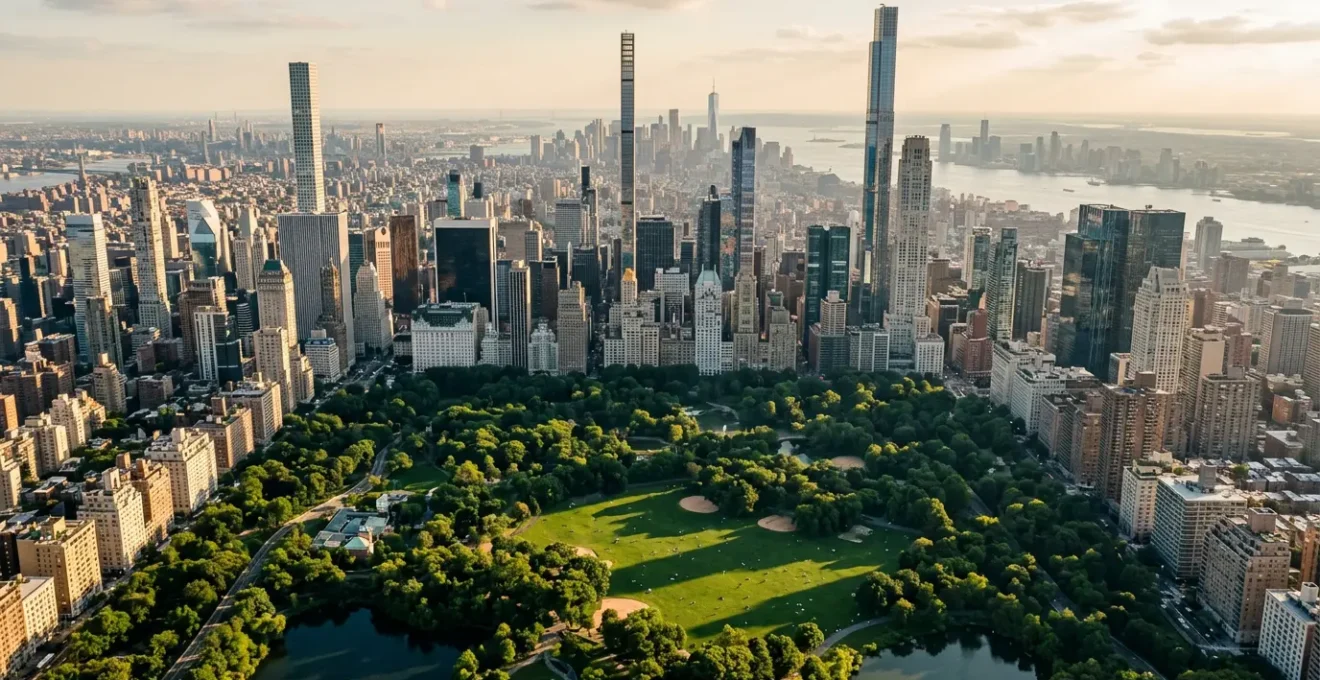
The ever-lengthening shadows over Central Park are not an accident, but the direct result of a city planning system that allows developers to literally buy the sky and bypass public review.
- Developers exploit “air rights” and “as-of-right” zoning loopholes to build far higher than standard regulations permit, effectively privatizing sunlight.
- These “pencil towers” are often financial instruments—”safety deposit boxes in the sky”—with many units sitting empty, contributing little to the city’s housing needs or local economy.
Recommendation: Understand that the changing skyline is driven by specific legal and economic policies, not just architectural ambition, which is the first step toward advocating for more equitable urban planning.
For any New Yorker who cherishes the city’s green heart, the creeping shadows are no longer a subtle shift. They are a daily, tangible reminder of the new giants piercing the skyline. Strolling through Central Park, you can feel it: a sudden chill as a sliver of darkness, impossibly long and thin, races across the Great Lawn. It’s easy to see this as an inevitable consequence of a growing city, a simple story of progress and architectural ambition. But this perspective misses the real story entirely.
The common narrative focuses on the spectacle of construction cranes and the glamour of “Billionaire’s Row.” Yet, the truth is far more complex and concerning. The transformation of Manhattan’s skyline is not an organic process. It is a carefully engineered outcome, fueled by a set of obscure legal instruments, counterintuitive economic incentives, and staggering feats of engineering designed to overcome the very laws of physics. The core issue isn’t just that the buildings are tall; it’s that the entire system is designed to make them so.
This is not a story about architecture, but about the systems that shape it. We will dissect the mechanisms that allow the sky itself to be sold, explore how developers legally sidestep environmental concerns like the shadows they create, and question the true cost of these vertical achievements. By understanding the hidden drivers—from monetized air to the city’s reliance on luxury tax revenue—we can see the shadows on the park not as an accident, but as a calculated result of policies that prioritize private wealth over public light.
This article dissects the interconnected systems—legal, engineering, and economic—that have facilitated the rise of super-tall towers and their impact on public spaces. The following sections provide an in-depth analysis of the key factors at play.
Summary: The System Behind the Skyscrapers: An Analysis of NYC’s Vertical Ascent
- How Developers Buy “Air” from Neighbors to Build Higher Than Allowed
- How Engineers Stop Pencil Towers from Toppling in High Winds
- The Carbon Footprint of Glass Towers: Are They Environmental Disasters?
- Why “Billionaire’s Row” Apartments Sit Empty for Years
- When Will We Hit the Ceiling? The Future Limits of Manhattan Verticality
- The “Right to Light”: How Developers Dodge Shadow Studies
- Wood vs. Steel: Why NYC Still Relies on Wooden Water Tanks
- Why New York’s City Planning Favors Supertalls Over Public Parks?
How Developers Buy “Air” from Neighbors to Build Higher Than Allowed
The ability for developers to construct buildings that seem to defy local zoning height limits is not due to special permissions, but to a uniquely New York concept: the buying and selling of “air rights.” In essence, New York City’s zoning laws treat the empty space above a building as a real, transferable property right. If a historic church or a low-rise building is not built to its maximum allowable height, it possesses unused development potential, or “air rights.” Developers of adjacent lots can purchase these rights, effectively stacking them on top of their own property’s allowance to build significantly higher than they otherwise could.
This practice has turned the city’s sky into a monetized commodity. It’s a market where empty space is traded to facilitate greater density and height, often with little to no public review. The scale of this market is immense; an analysis of the city’s zoning maps revealed a potential of over 3.7 billion square feet of unused air rights citywide. According to one analysis, “Air rights turn the sky above your building into a tradable, monetizable asset,” fundamentally changing the economics of development.
This system is a primary driver behind the super-talls. A developer can assemble a “cocktail” of air rights from multiple neighboring properties, aggregating them onto a single, small footprint to achieve the record-breaking heights seen on Billionaire’s Row. The result is a skyline shaped not by comprehensive urban planning, but by a series of private real estate transactions conducted far from public scrutiny.
How Engineers Stop Pencil Towers from Toppling in High Winds
The extreme slimness of “pencil towers”—some with height-to-width ratios exceeding 20:1—creates an immense engineering challenge. A building this slender acts like a massive tuning fork in the wind, prone to swaying so much that it would be uninhabitable, if not structurally unsound. To counteract this, engineers have deployed a sophisticated technology hidden within the upper floors: the Tuned Mass Damper (TMD). A TMD is, in essence, a giant, solid pendulum—a massive block of steel or concrete suspended by cables and controlled by hydraulic pistons.
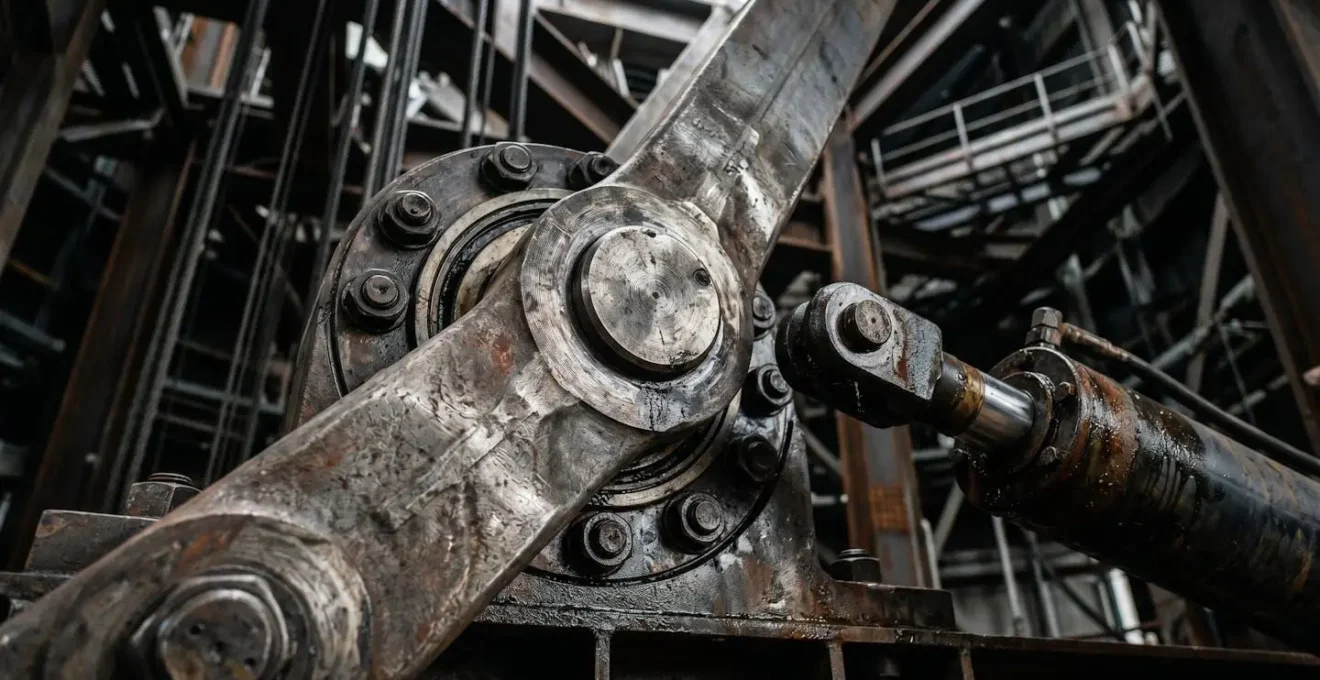
As the wind pushes the tower in one direction, this massive internal weight is engineered to sway out of phase, effectively pushing back against the building’s motion. This cancels out a significant portion of the vibration and acceleration felt by occupants. The scale of these devices is breathtaking. For instance, the 432 Park Avenue tower incorporates two 660-ton opposed pendulum dampers located in its upper mechanical floors. These hidden mechanisms are the only reason such slender structures are viable, representing a form of engineered instability where the building’s very design necessitates a massive, active counter-force just to remain stable.
This engineering solution, while brilliant, carries an environmental and financial cost. The top floors that could have offered prime views are sacrificed to house these multi-ton mechanisms, and the materials and energy required to build and maintain them add to the tower’s overall footprint. It is a testament to the extreme lengths required to enable these architectural forms.
The Carbon Footprint of Glass Towers: Are They Environmental Disasters?
The sleek, all-glass facades of super-tall skyscrapers have become a symbol of modern luxury, but they come at a significant environmental cost. From an energy perspective, glass is a poor insulator compared to a traditional wall. This leads to higher “operational carbon” emissions, as more energy is required for heating in the winter and air conditioning in the summer to maintain comfortable interior temperatures. The vast expanses of glass create a greenhouse effect that must be constantly counteracted by powerful HVAC systems.
However, the more immediate and often overlooked environmental impact is their “embodied carbon.” This refers to all the greenhouse gas emissions associated with the manufacturing, transportation, and installation of the building materials themselves. Concrete and steel, the primary structural components, are incredibly carbon-intensive to produce. But the glass itself is a major contributor. According to research from the National Glass Association, the production of flat glass is the most energy-intensive part of creating a window, with approximately 78% of embodied carbon in insulating glass units coming from this initial manufacturing stage.
When you multiply this by the thousands of custom-fabricated glass panels required for a single super-tall tower, the embodied carbon footprint becomes staggering. These buildings are effectively locked-in carbon liabilities before they even open their doors. For a city and a world grappling with the climate crisis, the proliferation of these glass giants represents a step in the wrong direction, prioritizing an aesthetic of transparency over the urgent need for sustainable and energy-efficient construction.
Why “Billionaire’s Row” Apartments Sit Empty for Years
One of the most jarring paradoxes of the super-tall boom is the profound emptiness that pervades these towers. While New York City faces a severe housing affordability crisis, a significant portion of the ultra-luxury condominiums on “Billionaire’s Row” sit vacant, often for years. These are not primary residences; they are financial instruments. For a global elite seeking a stable place to park vast sums of wealth, a multi-million dollar condo in a Manhattan skyscraper is seen as a secure asset, less volatile than the stock market and more anonymous than other investments.
This phenomenon of “hollow verticality” is well-documented. An analysis by a major brokerage firm revealed the staggering vacancy rates in the area. The study found that across seven of the most prominent towers on Billionaire’s Row, a shocking 44% of the 772 condos remained unsold or were unoccupied by a full-time resident. These are not homes in the traditional sense; they contribute little to the life of the neighborhood, with few residents to support local businesses or participate in community life. They are, as one policy analyst memorably put it, simply assets.
It is a safety deposit in the sky for some of the richest people in the world.
– Sam Stein, Community Service Society of New York senior policy analyst
This use of housing as a wealth-storage vehicle exacerbates inequality and distorts the housing market. It drives up land values, making it harder to build affordable housing elsewhere, and creates “ghost towers” that loom over the city as empty monuments to global capital, all while casting very real shadows on the public parks below.
When Will We Hit the Ceiling? The Future Limits of Manhattan Verticality
With each new record-breaking tower, the question inevitably arises: how high can we go? Theoretically, the limits are still far off. Advances in material science, like carbon fiber composites, and elevator technology, such as multi-car systems running in a single shaft, could allow for buildings a mile high or more. However, the true ceiling for Manhattan’s vertical growth is likely to be far more terrestrial and mundane: the city’s aging underground infrastructure.
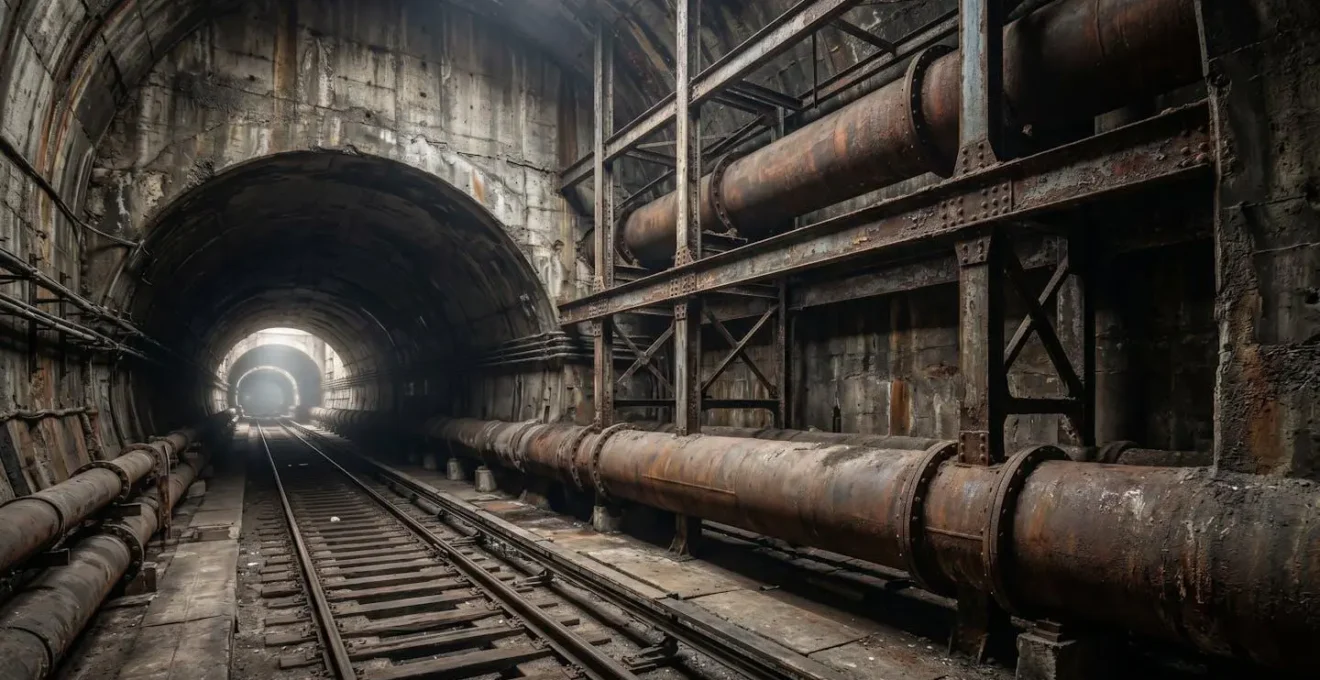
Every super-tall tower, with its thousands of potential residents and service workers, places an immense new strain on the systems buried beneath the streets. These are networks that are, in many cases, over a century old. The water mains, sewer lines, electrical grids, and, most critically, the subway system were not designed to support the hyper-density that these towers create. Adding thousands of new residential units to a small area concentrates demand on subway stations that are already overcrowded and on water and sewer systems that are fragile and prone to failure.
While developers might pay for localized upgrades, they are not responsible for the systemic overhaul required to support this new level of density. The real limit to verticality isn’t the strength of steel, but the capacity of a 19th-century water main or the number of people who can physically fit onto a Lexington Avenue line subway platform during rush hour. Until the city makes a massive, multi-generational investment in its foundational infrastructure, the sky may not be the limit—the ground will be.
The “Right to Light”: How Developers Dodge Shadow Studies
For many residents concerned about a new super-tall tower casting a permanent shadow over their home or a beloved park, the most shocking discovery is that, in New York City, there is no inherent “right to light.” Unlike some other global cities, NYC’s zoning laws do not place specific legal limits on the shadows a new building can cast. The primary regulatory tool is the Floor Area Ratio (FAR), which governs density, not form. This creates a critical loophole that developers have expertly exploited: “as-of-right” development.
Case Study: The Shadow of Central Park Tower
Central Park Tower, one of the tallest residential buildings in the world, reached its staggering height of 1,550 feet largely through as-of-right development. By meticulously acquiring and combining air rights from adjacent properties, the developers were able to proceed with their plans without triggering a comprehensive public review process. As a result, the city had no legal basis to impose restrictions on the building’s height or form, even though its shadow was projected to stretch up to a mile into Central Park during the fall and winter months. The project starkly illustrates how the current zoning code allows for developments with massive public impact to proceed with minimal public input.
If a proposed development complies with all existing zoning regulations—including any extra height gained from purchasing air rights—it is considered “as-of-right.” As the Municipal Art Society of New York notes, this means the project “does not require public or environmental review.” Developers are therefore incentivized to design projects that fit neatly within these rules to avoid the lengthy, costly, and uncertain process of public hearings and environmental impact statements. This system of zoning by loophole means that the impact of shadows on public parks or adjacent buildings is often not a legally relevant factor in a building’s approval process, leaving communities with little recourse.
Action Plan: How to Research a New Development’s Impact
- Identify the lot: Use the NYC Department of City Planning’s ZoLa map to find the specific block and lot number of the proposed development. Note the zoning designation (e.g., C5-3, R10).
- Check for permits: Search the Department of Buildings’ BISWeb database using the address or block/lot to see what permits have been filed. Look for “New Building” (NB) applications and any mentions of zoning declarations.
- Investigate air rights: Review property records on the ACRIS database for “Zoning Lot Description and Declaration” documents. This can reveal if the developer has purchased air rights from neighboring lots to increase the building’s size.
- Assess the review process: Determine if the project is “as-of-right” (fitting within existing zoning) or if it requires a public review (ULURP). This is often noted in community board meeting minutes or local news reports.
- Engage with the Community Board: Find your local Community Board and attend their land use committee meetings. This is the primary public forum for voicing concerns, even for as-of-right projects.
Wood vs. Steel: Why NYC Still Relies on Wooden Water Tanks
Perched atop thousands of buildings across the five boroughs is an icon of the New York City skyline that predates the age of glass and steel: the wooden water tank. In an era of super-tall, high-tech construction, the persistence of this seemingly archaic technology is a fascinating lesson in functional design and sustainability. These tanks, typically made of cedar or redwood, are not just relics; they are still being built and installed today because they perform their function better and more efficiently than modern alternatives.
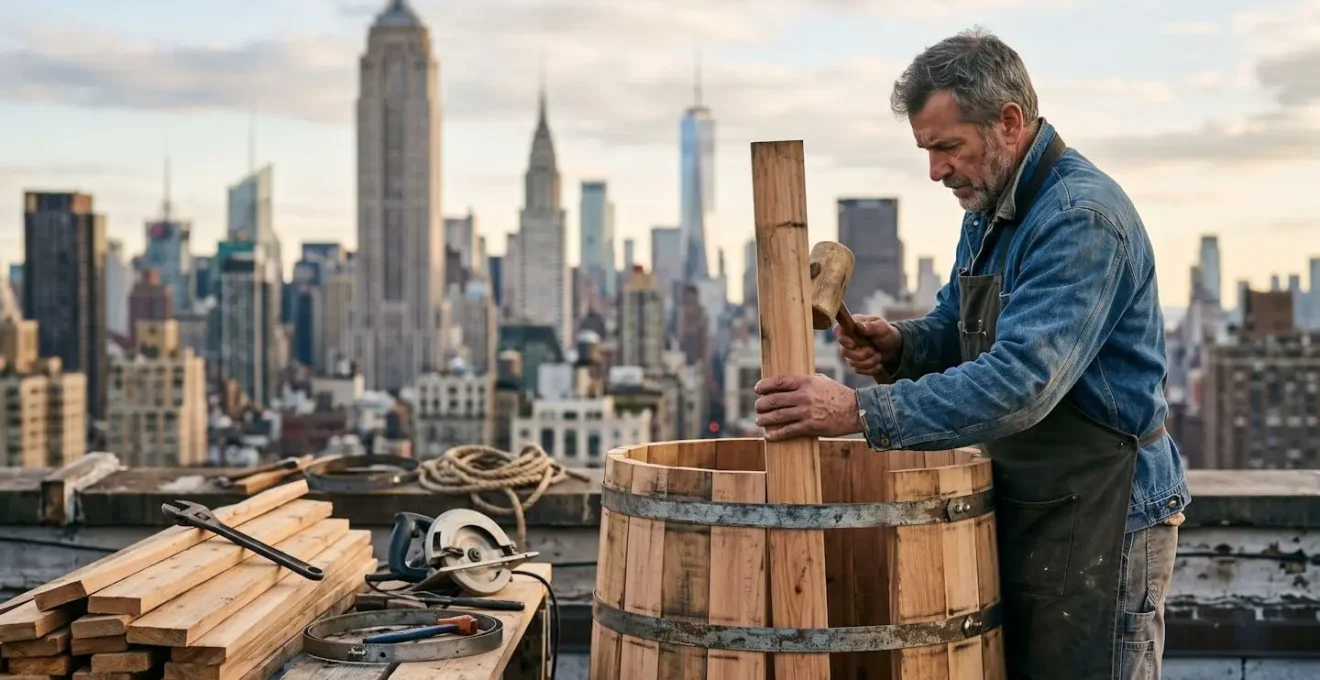
The system is elegantly simple. For buildings taller than six stories, city water pressure is insufficient to reach the upper floors. An electric pump sends water to the rooftop tank, which then uses gravity to provide reliable water pressure to the entire building. Wood is the ideal material for this purpose. It is a natural insulator, preventing the water from freezing in winter without requiring costly heating systems. The wood swells when wet, making the tank’s joints naturally watertight without chemical sealants. Furthermore, a wooden tank can be delivered in pieces and assembled on a rooftop, a feat impossible for a pre-fabricated steel tank.
This enduring, low-tech solution stands in stark contrast to the resource-intensive, complex systems of the super-talls. The wooden water tank is a model of sustainable, human-scale technology: durable, energy-efficient, and built with renewable materials by skilled craftspeople. Its continued relevance serves as a quiet counterpoint to the narrative of technological maximalism, reminding us that sometimes the most effective solution is also the simplest and most in harmony with its environment.
Key Takeaways
- The monetization of “air rights” and “as-of-right” loopholes are the primary legal and economic drivers allowing for super-tall construction, often bypassing public review.
- The extreme slimness of these towers necessitates massive engineering interventions, like multi-ton tuned mass dampers, just to ensure stability, highlighting a form of engineered instability.
- The city’s financial dependence on the enormous property tax revenues from these luxury towers creates a powerful incentive to approve them, even when they sit largely empty and negatively impact public spaces like Central Park.
Why New York’s City Planning Favors Supertalls Over Public Parks?
At the heart of the conflict between super-tall skyscrapers and public spaces like Central Park is a fundamental question of priorities. From the perspective of a park-goer, the loss of sunlight is a clear and significant degradation of a vital public amenity. From the perspective of a developer, however, it is a negligible side effect. As a spokesperson for one major developer stated in a public meeting, the shadows are considered a minor issue: “The shadows cast by tall, slender buildings… are very brief—maybe they’re 10 minutes in any one place—and cause no negative effect.”
This starkly dismissive viewpoint is, unfortunately, often implicitly supported by the city’s own planning and fiscal policies. The core reason boils down to a simple, powerful incentive: tax revenue. Super-tall luxury towers generate an extraordinary amount of property tax revenue on a very small physical footprint. For a city government perennially grappling with budget shortfalls, this revenue stream is incredibly difficult to refuse, creating a deep-seated institutional bias in favor of such developments.
Case Study: The Billionaires’ Row Fiscal Dependency
Despite the high vacancy rates, the city continues to greenlight ultra-luxury towers because of their outsized contribution to municipal coffers. These buildings are assessed at extremely high values, and their tax payments help fund essential city services like schools, sanitation, and policing. When the city faces significant budget deficits, as it often does, the pressure to approve high-revenue projects intensifies. This creates a direct trade-off: the intangible, long-term value of a sunlit park is weighed against the immediate, quantifiable, and desperately needed cash flow from a new luxury tower. In this calculation, the park almost always loses.
Ultimately, the city’s planning framework has come to favor the development of these towers because it has become fiscally dependent on them. The long shadows on Central Park are a physical manifestation of this policy choice—a choice to prioritize the generation of private wealth and public revenue over the preservation of the quality of public life and shared natural resources. Until this fundamental incentive structure is addressed, the city’s skyline will continue to be shaped by the highest bidder, not by a holistic vision for a livable and equitable city.
Understanding these interconnected systems is the first step toward advocating for a more equitable and sustainable urban future, one where the long-term health of public spaces is given as much weight as the short-term financial gains from private development in the sky.