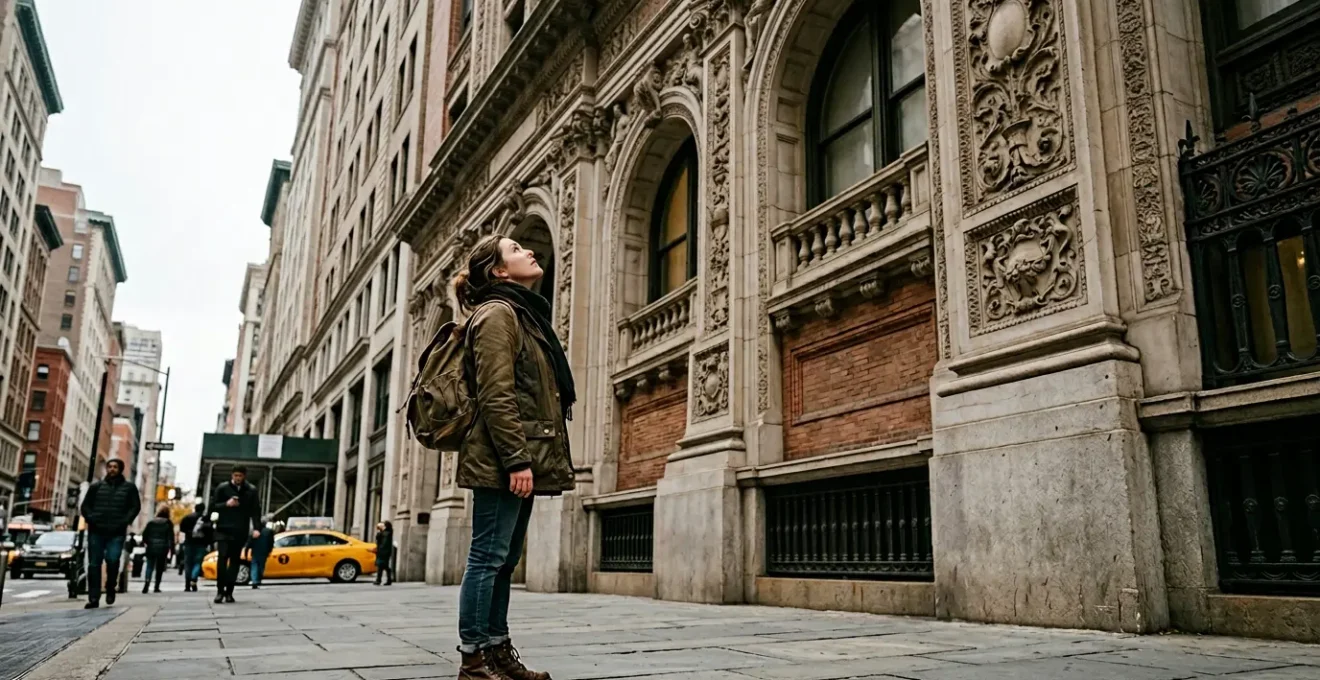
Most guides point out architectural styles. This one decodes the why. You’ll learn that NYC’s iconic shapes aren’t just aesthetic choices, but the direct result of legal battles, engineering necessities, and intense rivalries. It is a guide to reading the city’s hidden stories written in stone and steel, turning your next walk into an act of architectural discovery.
A walk through New York City is a conversation with history, ambition, and physics. You crane your neck to take in a sheer wall of glass, a terra cotta eagle, a jagged spire piercing the clouds. It’s easy to spot the famous silhouettes—the Empire State, the Chrysler Building—and categorize them by style. But to truly understand the city, you must learn to read the buildings themselves. Why do so many rooftops host what look like giant wooden barrels? Why do so many older skyscrapers suddenly retreat from the street, stepping back like a tiered wedding cake? These are not random quirks; they are narratives frozen in time.
The conventional approach is to learn the names of styles: Art Deco, Beaux-Arts, International. While useful, this is like learning the names of colors without understanding how a painter mixes them. The real story, the one that makes the city come alive, is in the functional imperatives and historical pressures that forced an architect’s hand. The city’s form is a palimpsest, where the ghost of a 1916 law is visible in the shape of a 2024 skyscraper. The key to decoding this urban text is not just to ask “What is that?” but “Why is it like that?”
This guide abandons the simple style-spotting tour. Instead, we will explore the forces that sculpted the skyline. We will examine how the need for water pressure created an icon, how the fear of shadows reshaped an entire city’s silhouette, and how a bitter rivalry for the title of “world’s tallest” was won with a secret spire. By the end of this walk, you will see the city not as a collection of static objects, but as a dynamic story of vertical negotiation—a constant dialogue between gravity, law, money, and human ego.
In the sections that follow, we will dissect specific, often-overlooked architectural features. Each one offers a clue, a piece of the puzzle that, when assembled, reveals a much deeper and more fascinating portrait of New York City.
Summary: A Walker’s Guide to NYC’s Architectural DNA
- Wood vs. Steel: Why NYC Still Relies on Wooden Water Tanks
- The Practical Function of Gargoyles: More Than Just Scary Faces
- The Wedding Cake Shape: How 1916 Zoning Laws Sculpted the Skyline
- Lighting the Canyon: The Best Time of Day to Photograph Midtown Architecture
- The “Beaux-Arts” Mile: A Self-Guided Walking Tour of the Upper West Side
- London vs. New York: Which City Protects Its Sightlines Better?
- The Underground Passageways of Midtown: Walking 5 Blocks Without Going Outside
- Chrysler vs. Empire State: Which Art Deco Landmark Definition Wins the Style War?
Wood vs. Steel: Why NYC Still Relies on Wooden Water Tanks
Look up from almost any street in Manhattan, and you will see them: curious wooden barrels perched atop the city’s flat roofs. In an age of steel and glass, these structures seem like relics from another century. Yet, there are approximately 17,000 wooden water tanks still operating across the five boroughs. Their endurance is not a matter of nostalgia, but of pure, unadulterated function. For buildings over six stories tall, municipal water pressure is often insufficient to service the upper floors. The rooftop tank acts as its own gravity-fed water tower, with pumps filling it at night so residents have reliable pressure during the day. This simple system also provides an essential reserve for firefighting.
But why wood? Cedar is the material of choice for its natural resistance to rot and its insulating properties, which prevent the water from freezing in winter. The construction itself is a masterclass in elemental engineering. The wooden staves are held together by steel hoops, without any sealant. When filled, the wood swells, creating a naturally waterproof seal. This technology is so effective and economical that it has remained largely unchanged for over a century, a testament to its skeletal honesty. The image below reveals the elegant simplicity of this design, where material properties and physics do all the work.

This enduring trade is dominated by a remarkably small number of companies. The market is a story in itself, a living piece of New York history. As one case study reveals, just three family-owned businesses—Rosenwach Tank Company (est. 1866), Isseks Brothers (est. 1890), and American Pipe and Tank—build and maintain the vast majority of these tanks. They pass down specialized coopering (barrel-making) techniques through generations, a craft that has become as much a part of the city’s DNA as the tanks themselves.
The Practical Function of Gargoyles: More Than Just Scary Faces
The Gothic and neo-Gothic facades of New York are often adorned with a menagerie of stone creatures, peering down from cornices and ledges. We call them all “gargoyles,” but an architectural historian sees a crucial distinction. As the editors at Untapped New York clarify, true gargoyles are technically water spouts while grotesques purely are decorative. The word “gargoyle” itself derives from the Old French gargouille, meaning “throat,” a direct reference to its function: to channel rainwater away from the building’s masonry, preventing erosion. A grotesque, on the other hand, is any fanciful or frightening carved figure that does not serve as a drainpipe.
This distinction highlights a core principle of architectural reading: the functional imperative often precedes the decorative flourish. The need to manage water flow created the opportunity for artistic expression. On your next walk, look for the tell-tale sign of a true gargoyle: an open mouth or channel designed to spew water clear of the wall. Grotesques, freed from this engineering constraint, can take on any form their carvers imagined.
Case Study: The Carvers of the Woolworth Building
Cass Gilbert’s 1913 “Cathedral of Commerce,” the Woolworth Building, is famously clad in over 400,000 pieces of terra cotta. Its facade teems with both gargoyles and grotesques. Here, the stone carvers were given remarkable creative freedom. A foreman might simply point to a keystone and instruct, “Give me a Moses!” The artisan was then free to interpret that prompt, often carving portraits of themselves, their colleagues, or even their unimpressed father-in-law into the building’s skin for eternity.
Many of these figures are technically “skeuomorphs”—decorative elements that mimic a functional form from a previous era. They look like water spouts but are purely ornamental, a nod to an older architectural language. This practice reveals how architecture carries its history, referencing past solutions even after technology has rendered them obsolete.
The Wedding Cake Shape: How 1916 Zoning Laws Sculpted the Skyline
Perhaps no single piece of legislation has had a more visible impact on New York’s appearance than the 1916 Zoning Resolution. To understand its origin, you must look to a single, monolithic building: the Equitable Building at 120 Broadway. Completed in 1915, it rose 40 stories straight up from its property line, a sheer cliff of masonry that cast a colossal seven-acre shadow over the surrounding streets, plunging them into darkness and causing property values to plummet. It became the ultimate symbol of unchecked development.
Public outcry led to the 1916 law, which mandated that as a building grew taller, it had to “step back” from the street to allow light and air to reach the ground. Architects responded with the iconic “wedding cake” or “ziggurat” form, creating the terraced silhouettes that define landmarks like the Empire State Building. This was a direct act of vertical negotiation, not between developers, but between a building and the public good. The law prescribed a “sky exposure plane,” an imaginary angled line from the center of the street that a building could not penetrate.
This table illustrates how the philosophy of shaping the skyline evolved from ensuring light at street level to incentivizing public space.
| Feature | 1916 Zoning Resolution | 1961 Zoning Resolution |
|---|---|---|
| Primary Regulation | Setback requirements based on street width | Floor Area Ratio (FAR) regulation |
| Building Form | Wedding cake / setback-and-tower structures | Towers with plazas (incentive zoning) |
| Street-Level Impact | Buildings align with street wall, gradual setbacks | Buildings set back from street with public plazas |
| Iconic Examples | Empire State Building, Chrysler Building | Seagram Building, Lever House |
| Height Limit | 25% of lot coverage above certain heights | FAR-based with bonuses for public space |
The 1961 revision introduced the concept of Floor Area Ratio (FAR) and incentive zoning. This allowed developers to build taller, sheer towers (like the Seagram Building) if they provided a public plaza at the base. This created a new kind of building, one that receded from the street entirely at ground level, fundamentally altering the pedestrian experience and creating the “tower in a park” model.
Lighting the Canyon: The Best Time of Day to Photograph Midtown Architecture
New York’s rigid street grid, a feature that can feel monotonous at ground level, creates a spectacular celestial alignment twice a year known as Manhattanhenge. During this event, the setting sun aligns perfectly with the east-west street grid, flooding the city’s concrete canyons with a breathtaking, cinematic glow. For photographers and observant pedestrians alike, it is the most dramatic time to capture the city’s architecture. According to the American Museum of Natural History, the next full sun-on-the-grid events will occur on May 28 at 8:14 PM ET and July 12 at 8:21 PM ET for 2026, offering unparalleled photographic opportunities.
However, you don’t need to wait for these specific dates to capture stunning images. The low position of the sun on the horizon from late May through July provides a “Manhattanhenge effect” almost every clear evening, bathing the city’s north-south avenues in a warm, golden light that emphasizes texture and form. This “golden hour” light is ideal for highlighting the intricate details of terra cotta facades or the metallic gleam of Art Deco spires.
To make the most of this phenomenon, a little planning goes a long way. The key is finding a long, clear view west. Major cross-town streets offer the best vantages, but elevation and composition are critical. This checklist provides a practical plan for capturing that perfect shot.
Action Plan: Capturing the Manhattanhenge Effect
- Scout Locations: Identify spots on major east-west streets (14th, 23rd, 34th, 42nd, 57th) with clear views toward New Jersey.
- Arrive Early: Get to your chosen spot at least 30 minutes before sunset to secure a good position and avoid the densest crowds.
- Leverage the Season: From May through July, use the low-horizon sun to capture golden hour moments on any clear evening, not just the official dates.
- Find Your Vantage: Position yourself as far east as possible to compress the perspective and frame the sun with more of the skyline.
- Use Optimal Settings: When shooting into the sun, use a high aperture (like f/16) and low ISO (100) to create a sharp “sun star” effect and control exposure.
- Consider Alternative Views: Explore elevated spots like the Tudor City Overpass or cross the river to Hunter’s Point South Park in Queens for unique perspectives.
Understanding the interplay of the sun and the grid transforms the city from a static landscape into a giant sundial, offering a different spectacle with each passing hour and season.
The “Beaux-Arts” Mile: A Self-Guided Walking Tour of the Upper West Side
The Upper West Side, particularly along boulevards like West End Avenue and Riverside Drive, is a living museum of the Beaux-Arts style. Flourishing from the 1880s to the 1920s, this architectural language was imported from the École des Beaux-Arts in Paris and became the preferred style for the Gilded Age elite. It is characterized by its strict symmetry, classical details (columns, swags, cartouches), and a sense of opulent, theatrical grandeur. But beyond its beauty, the style is a fascinating text on social hierarchy, an example of economic ornament.
On your walk, look for the tripartite division of the facade. The base, typically one or two stories of rusticated stone, was the public face of the building, with a grand, oversized entrance designed to impress. Above this, the main floors, or piano nobile, feature the largest windows, most elaborate balconies, and richest decoration—this is where the building’s wealthy residents lived. Finally, look to the very top, often tucked beneath a mansard roof. The windows here are noticeably smaller and simpler. These were the original servants’ quarters, their modest size a clear architectural signal of their occupants’ lower status.
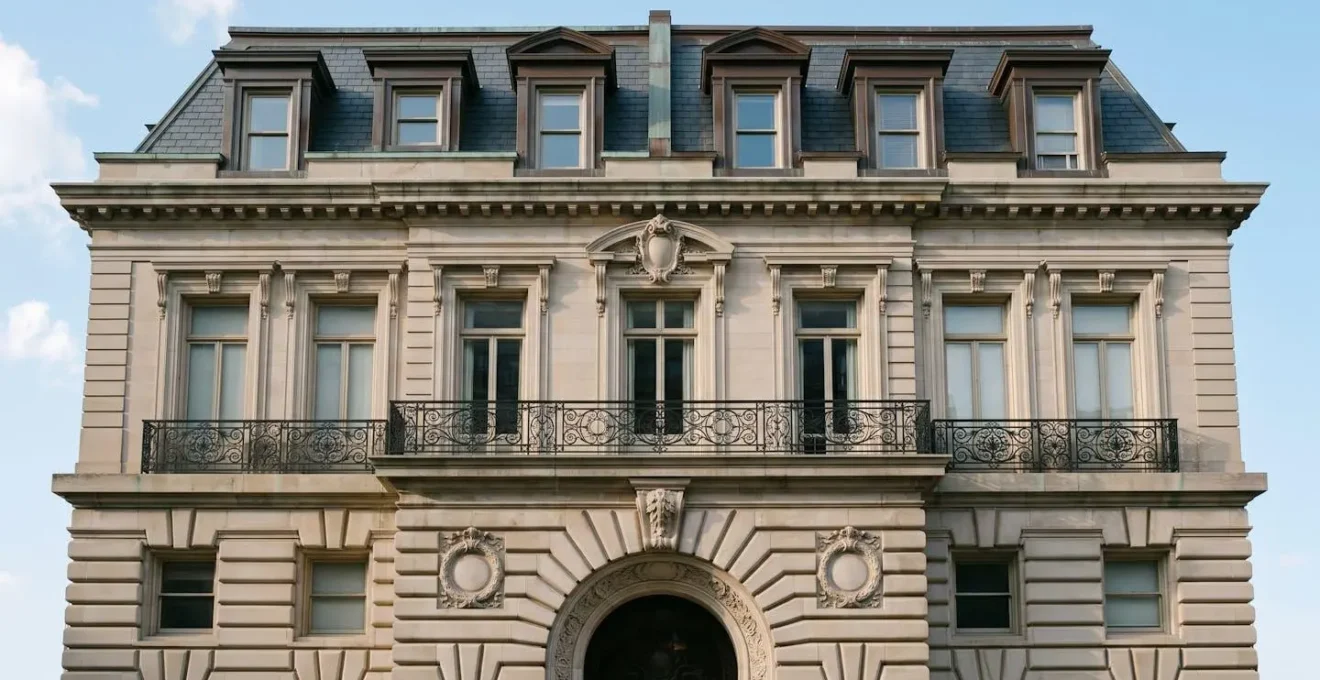
To read a Beaux-Arts building is to read the social structure of its time. The architecture doesn’t just house people; it organizes and displays them according to a rigid hierarchy. A self-guided tour of this “Beaux-Arts Mile” is not just an architectural hunt but a sociological one. Look for buildings like The Apthorp or The Belnord, and observe how every detail, from the size of a window to the intricacy of a carving, reinforces this story.
London vs. New York: Which City Protects Its Sightlines Better?
Every tall building is a negotiation for light and air, but it’s also a negotiation for views. How a city manages this “vertical negotiation” speaks volumes about its values. London and New York offer two starkly different philosophies. London employs a system of legally protected “viewing corridors.” These are specific, mapped-out sightlines to landmarks like St. Paul’s Cathedral and the Tower of London that new developments are forbidden to obstruct. This is a top-down, preservationist approach that prioritizes the public’s ability to see shared cultural monuments.
New York, in contrast, takes a far more market-driven approach. The city has no formal viewing corridors. Instead, it has a complex system of “air rights” and Transferable Development Rights (TDR). In essence, a historic or low-rise building that has not built to its maximum legal height can sell its unused vertical space—its “air”—to a developer of an adjacent lot. This developer can then add that purchased volume to their own project, allowing them to build a much taller skyscraper than would otherwise be permitted. This is what creates the quintessential New York aesthetic of a slender super-tall tower rising directly next to a small, historic church or townhouse.
The result is a skyline shaped not by planners trying to preserve a specific view, but by a series of individual real estate transactions. While this has led to the loss of many historic sightlines, it has also provided a crucial economic incentive for the preservation of landmarks. By allowing them to monetize their empty sky, the TDR system gives historic building owners a powerful reason not to demolish their properties. It’s a pragmatic, chaotic, and uniquely capitalist way of sculpting a city.
The Underground Passageways of Midtown: Walking 5 Blocks Without Going Outside
Beneath the bustling streets of Midtown lies another, hidden layer of the city: a network of underground passageways that allow pedestrians to traverse several city blocks without ever surfacing. This subterranean world is not a formal public works project but an ad-hoc collection of corridors, concourses, and privately-owned public spaces (POPS) that have evolved over decades. It’s an architecture of convenience, born from a desire to escape the city’s harsh weather and relentless crowds.
The most famous and extensive part of this network is centered around Rockefeller Center. Built in the 1930s, its underground concourse was a revolutionary piece of urban planning, connecting 19 commercial buildings and the subway system with a climate-controlled world of shops and restaurants. It set a precedent for a new kind of urban experience, where the life of the city could continue insulated from the elements.
Since then, the network has grown organically. The 1961 zoning law that encouraged plazas also gave developers incentives to create public thoroughfares, including underground passages that connect to subway stations or adjacent buildings. Walking from the LIRR tracks beneath Grand Central Terminal, through the station, and west toward Times Square via these connected corridors is a rite of passage for many commuters. It’s an example of the architectural palimpsest in action, where different eras of development and zoning have been stitched together to form a semi-cohesive, if sometimes confusing, whole.
Key Takeaways
- Decoration Follows Function: Seemingly ornamental features like wooden water tanks and gargoyles originated as practical engineering solutions for water pressure and drainage.
- Law Sculpts the Skyline: The iconic “wedding cake” shape of older skyscrapers is not an aesthetic choice but a direct consequence of the 1916 Zoning Resolution designed to bring light to the streets.
- The Skyline is a Story of Competition: From the spire of the Chrysler Building to the market for “air rights,” the height and shape of buildings are often the result of intense economic and personal rivalries.
Chrysler vs. Empire State: Which Art Deco Landmark Definition Wins the Style War?
The duel between the Chrysler Building (1930) and the Empire State Building (1931) was more than just a race for height; it was a battle for the soul of Art Deco. Though both are icons of the style, they represent two divergent philosophies. The Chrysler Building is the pinnacle of decorative, romantic Art Deco. Its architect, William Van Alen, celebrated the machine age with lavish, almost playful ornamentation. The building’s famous eagles, jutting out from the 61st floor, are stylized radiator caps, a direct homage to the automobile. Its magnificent crown of nested arches, clad in gleaming Nirosta steel, is pure economic ornament—a spectacular advertisement for the Chrysler Corporation and an unabashed celebration of wealth and modernity.
The Empire State Building, by contrast, represents the more austere, powerful side of the style, often called Streamline Moderne. Its design prioritizes mass, height, and verticality. Ornamentation is stripped back, used to emphasize the building’s powerful upward thrust rather than for its own sake. It is less a piece of jewelry and more a statement of raw commercial power and efficiency. Its famous rivalry with the Chrysler Building culminated in one of architecture’s greatest gambits. After the Chrysler Building secretly assembled and hoisted its 185-foot spire to claim the title of “world’s tallest,” the Empire State’s backers simply revised their plans, adding a mooring mast for dirigibles to their roof to decisively reclaim the crown.
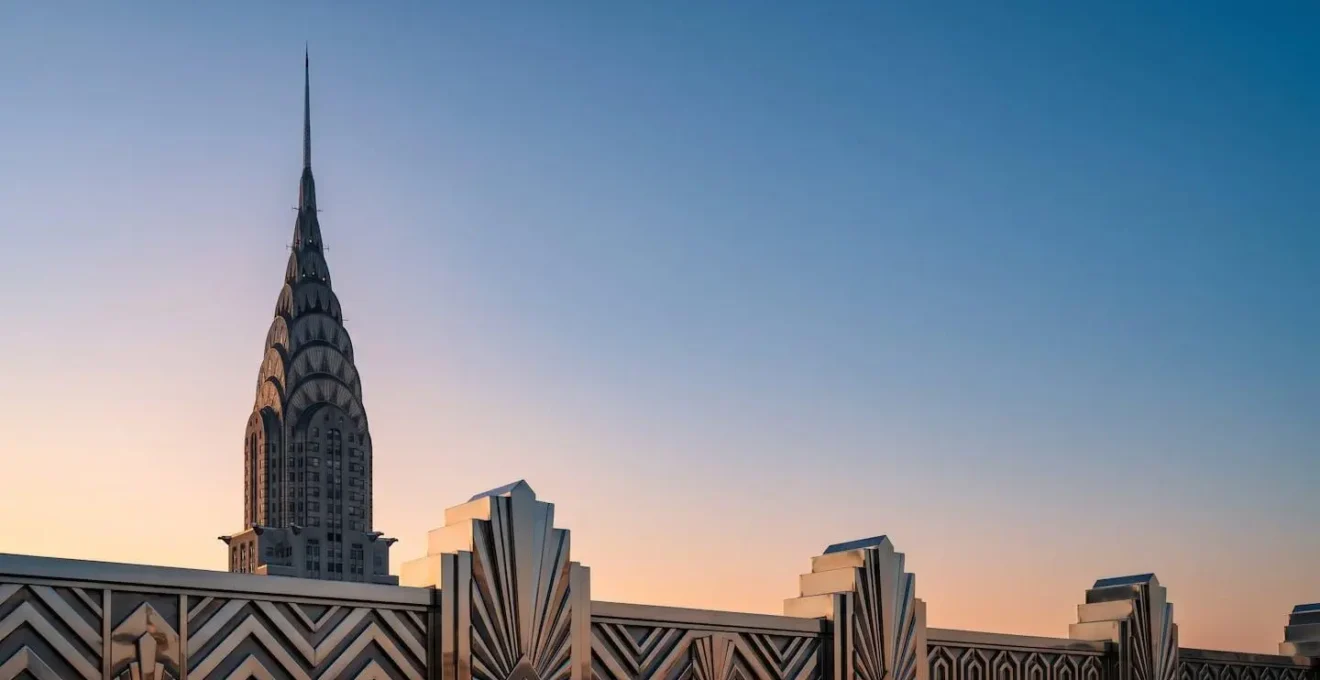
This “style war” provides a perfect lesson in reading architecture. The Chrysler Building tells a story of exuberant, decorative capitalism, while the Empire State Building speaks to a more sober, dominant form of corporate ambition. Observing them both reveals the expressive range of a single architectural style and the human stories of rivalry embedded within their very forms.
Now that you are equipped with the tools to decode these stories, your next walk through the city can become an entirely new experience. Go out and start reading the rich, complex, and fascinating text that is New York City’s architecture.